


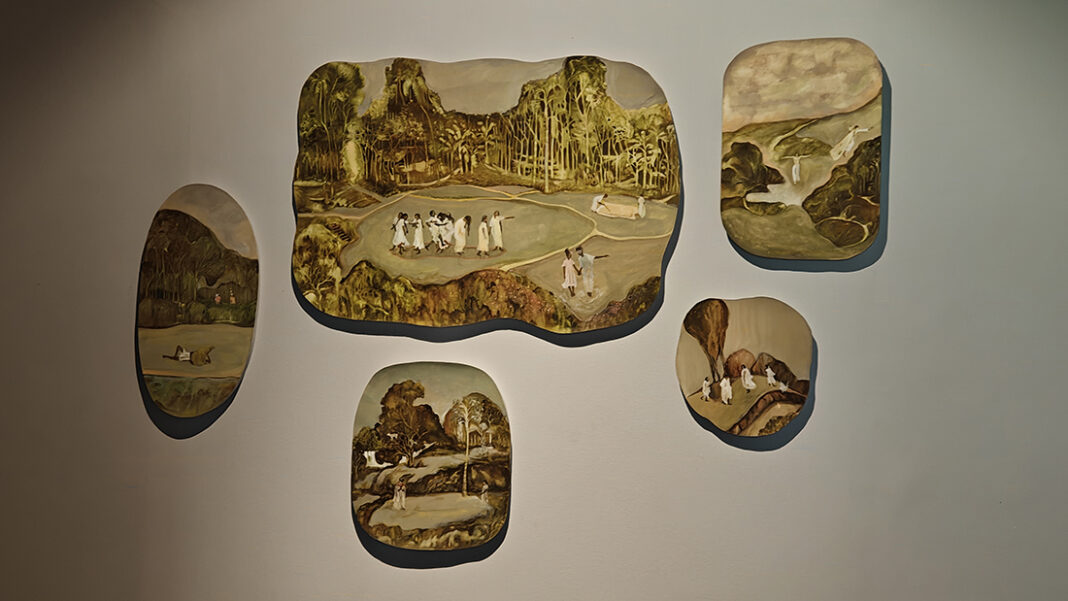
At the Kochi-Muziris Biennale, theatre artist Smitha M Babu presents Pakkalam, a multidisciplinary project blending watercolour, performance, and sound. Rooted in her experiences along Kollam’s Ashtamudi Lake, the work archives coir-making traditions, weaving together craft, memory, and myth to resist cultural erasure and celebrate resilience through embodied art.
With a theatre career spanning more than two decades, Smitha M Babu has long been recognised for her ability to extend the pictorial into the performative. At the Kochi-Muziris Biennale, she brings this sensibility to Pakkalam (2023–ongoing), a project that is at once personal archive, cultural testimony, and sensorial theatre. Rooted in her lived experiences along the Ashtamudi Lake in Kollam, Pakkalam draws from the rhythms of working-class life centred on coir-making traditions, transforming them into a layered aesthetic encounter.
The word “pakkalam” in Malayalam refers to the weaving workspace, and Smitha’s project embodies this meaning both literally and metaphorically. It is conceived as a site where gesture, painting, and sound coalesce, creating a living archive of labour and resilience. By weaving together traditional craft, communal memory, and embodied action, she resists the erasure of a fragile micro-heritage. The coir-making communities of Kollam, often overlooked in mainstream narratives, find themselves represented here not as ethnographic subjects but as protagonists in a sensorial theatre of endurance and creativity.
Smitha’s watercolour practice forms the visual backbone of Pakkalam. Breaking away from the conventional transparency associated with the medium, she layers pigments to achieve an opaque density. Her earth-toned palette, drawn from the textures of soil, husk, and fibre, imbues her paintings with a tactile quality that mirrors the materiality of coir. Stylised gestures transform scenes of rural life by the lake into theatrical tableaux, where lighting and expression recur as motifs. The stage is not merely a backdrop but an active presence in her imagery, underscoring her dual identity as painter and theatre practitioner.
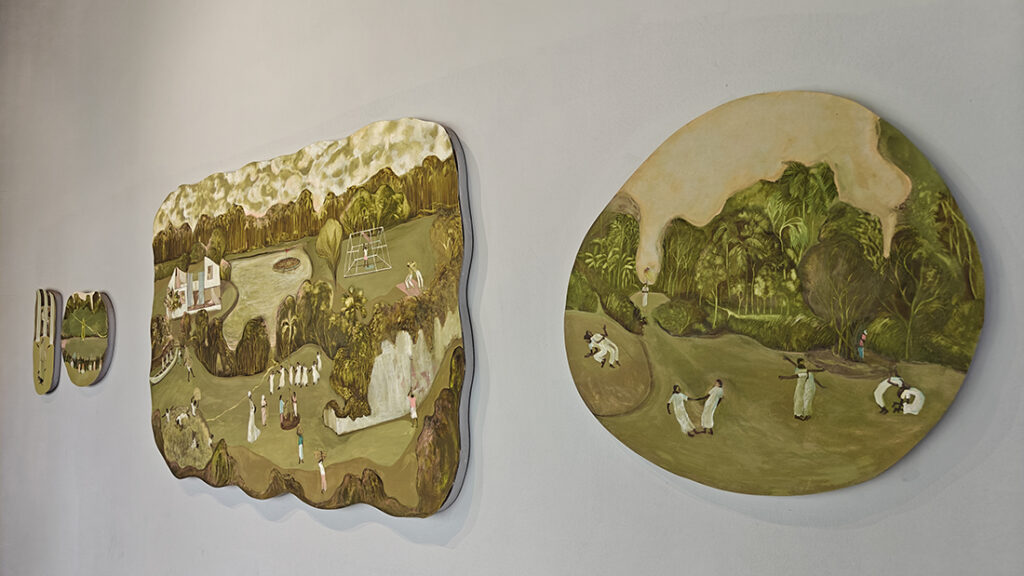
Yet, Smitha’s visual field is not confined to ethnographic realism. Fantastical presences—bogeymen, masked figures, strangers caught mid-dance—inhabit her paintings, layering Pakkalam with mythic and dreamlike overtones. These figures disrupt the everyday gestures of labour, suggesting that the coir sheds and lakeside spaces are also sites of imagination, folklore, and subconscious memory. In this interplay between the real and the fantastical, Smitha situates Kollam’s working-class life within a broader continuum of cultural storytelling.
At Aspinwall House, nearly thirty of her paintings are exhibited, each one a portal into the world of Pakkalam. But Smitha does not stop at the pictorial. Alongside her four-member team, she stages a fifteen-minute performance over three days, integrating live theatre with the visual and sonic textures of coir-making. The performance is set against a soundscape collated from the banks of Ashtamudi Lake—the rhythm of spinning wheels, the lapping of water around coir sheds, the clamour of workers at their tasks. These sounds, recorded and reassembled, provide cadence and atmosphere, grounding the performance in the lived environment of Kollam’s coir industry.
The raw materials of coir production—coconut husk, coir fibre, the ratt machine—are repurposed as props and instruments. In the hands of Smitha and her collaborators, they become extensions of the body, tools of gesture, and sources of rhythm. The tactile engagement with these materials bridges the gap between craft and performance, underscoring the embodied nature of labour. The audience is invited not merely to watch but to sense, to feel the textures and rhythms that define the coir-making workspace.
What emerges is a multidisciplinary archive that is both personal and collective. For Smitha, Pakkalam is an act of memory, a way of preserving her own experiences of growing up by the lake. But it is also a documentation of a community whose traditions risk being forgotten in the face of industrial change and cultural neglect. By situating coir-making within the aesthetic space of painting and theatre, she elevates it from the realm of the ordinary to that of cultural heritage.
The resilience of Kollam’s coir workers is central to this narrative. Their everyday gestures—spinning, weaving, carrying—become choreographed movements, imbued with dignity and rhythm. In Smitha’s hands, these gestures are not merely functional but expressive, capable of conveying stories of endurance, solidarity, and creativity. The performance thus becomes a tribute to the workers, acknowledging their labour as both economic necessity and cultural practice.
At the same time, the mythic and fantastical elements in her paintings remind us that heritage is not static. It is layered with imagination, folklore, and the subconscious. The bogeymen and masked figures that haunt her imagery suggest the presence of stories untold, fears unspoken, and dreams unacknowledged. They complicate the narrative of labour, infusing it with ambiguity and depth. In doing so, Smitha resists the temptation to romanticise coir-making as a simple ethnographic subject. Instead, she presents it as a living, evolving practice, shaped by both material conditions and cultural imagination.
The opacity of her watercolours is particularly striking in this context. By rejecting transparency, Smitha challenges the conventional association of watercolour with delicacy and lightness. Her dense layering of pigments mirrors the density of memory and labour, suggesting that heritage is not fragile but robust, built on layers of resilience. The earth-toned palette reinforces this sense of rootedness, grounding her imagery in the soil and fibre of Kollam’s landscape.
In Pakkalam, theatre and painting are not separate disciplines but intertwined practices. The stage recurs in her imagery, while her performance draws from the visual motifs of her paintings. This interplay expands the aesthetic boundaries of both mediums, creating a hybrid form that is at once pictorial and performative. For the audience, the experience is immersive, engaging multiple senses—sight, sound, touch—in a holistic encounter with heritage.
Smitha’s project also raises broader questions about the role of art in preserving micro-heritages. In an era when industrialisation and cultural homogenisation threaten local traditions, Pakkalam stands as a reminder of the importance of documenting and celebrating the everyday practices of communities. By situating coir-making within the space of the Biennale, she asserts its value as cultural heritage, worthy of aesthetic attention and collective memory.
Ultimately, Pakkalam is a work of communion. It ties together personal memory, communal labour, and cultural imagination, weaving them into a sensorial archive that resists erasure. For Smitha, the project is both an act of remembrance and a gesture of resilience, affirming the dignity of Kollam’s coir workers while situating their practices within a broader cultural continuum.
At the Kochi-Muziris Biennale, where global and local voices converge, Pakkalam resonates as a deeply rooted yet expansively imaginative work. It reminds us that heritage is not merely about preserving the past but about engaging with the present, acknowledging the resilience of communities, and opening spaces for imagination. In Smitha M Babu’s hands, the weaving workspace becomes a stage, the coir fibre becomes a prop, and the rhythms of labour become a performance. Together, they form an archive of endurance, creativity, and cultural memory—a living theatre that honours the fragile yet resilient heritage of Kollam’s coir-making communities.
Discover more from Creative Brands
Subscribe to get the latest posts sent to your email.