


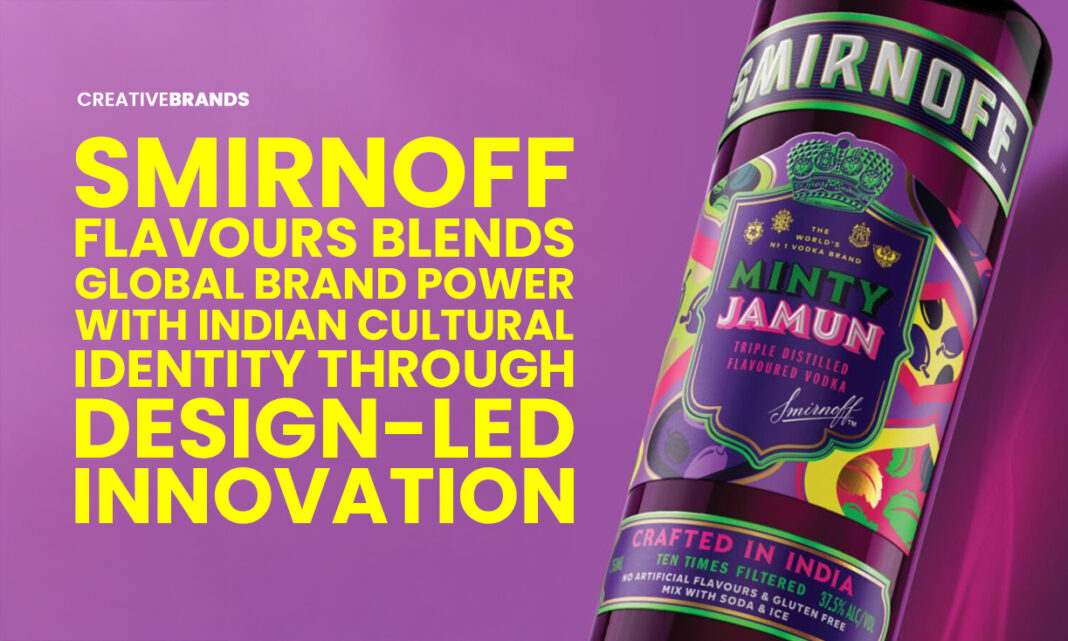
Smirnoff’s India-exclusive flavours—Minty Jamun, Mirchi Mango and Zesty Lime—reimagine the global vodka brand through culturally rooted, design-led packaging. Created by Bulletproof, the range fuses Smirnoff’s iconic identity with Indian visual traditions, setting a new benchmark for culturally adaptive brand innovation.
When global brands enter fast-evolving markets like India, the challenge is no longer simply about availability or pricing. It is about cultural fluency. Smirnoff, one of the world’s most recognisable vodka brands, has long been defined by its bold personality, street-smart confidence and instantly recognisable design system. But as India’s young adult consumers became increasingly global in outlook while remaining deeply connected to local culture, the brand saw an opportunity to expand its relevance in a way that felt authentic rather than imported. The result was Smirnoff Flavours, a design-led innovation that connects global identity with Indian cultural expression, brought to life through Bulletproof’s packaging strategy and visual language.
For Smirnoff, extending its flavour portfolio in India was never meant to be a routine product launch. The ambition was bigger: to create India-exclusive variants that felt unapologetically Indian without diluting the brand’s global equity. Minty Jamun, Mirchi Mango and Zesty Lime were not just new tastes, but cultural signifiers—flavours rooted in everyday Indian experiences, street-side memories and shared rituals. The challenge lay in making these flavours feel contemporary, premium and unmistakably Smirnoff, while avoiding clichés or surface-level localisation.
At the centre of this approach was the belief that packaging could act as a cultural bridge. Rather than treating design as a decorative afterthought, Bulletproof and Smirnoff positioned packaging as a storytelling device, one capable of expressing both heritage and modernity. The aim was to create an identity shift that allowed Smirnoff to speak the language of Indian culture while retaining the clarity and confidence of its global design system.
Key Smirnoff equities were carefully preserved. The iconic shield remained central, anchoring the designs in the brand’s global DNA. Structured layouts and confident typography ensured continuity with the wider Smirnoff portfolio. Around these familiar elements, however, a new design language emerged—one inspired by Indian textures, colours and visual rhythms. This balance between consistency and creativity became the foundation of the range.
The most distinctive element of the design was a pattern system inspired by Indian textiles, Mughal architecture, jali screens and traditional crafts. These references were not literal reproductions but reinterpretations. Hand-drawn motifs were transformed into layered compositions that felt rich yet controlled, allowing each flavour to tell its own story while remaining part of a cohesive system. The patterns added depth and tactility, inviting consumers to engage more closely with the bottle.
Each label placed the Smirnoff shield at its heart, using it as a framing device for storytelling. Ingredients were illustrated with care and character: jamun swirls intertwined with fresh mint leaves, sliced mangoes punctuated by red chillies, and zesty limes bursting with freshness. These illustrations were woven into paisley-inspired shapes and architectural grids, creating a visual tension between whimsy and structure. The result was packaging that felt expressive without becoming chaotic, detailed without losing clarity.
The design process also responded to practical and environmental considerations. While the initial concept envisioned full-bottle sleeves to maximise visual impact, the final execution shifted towards more sustainable label formats. This change required a rethinking of hierarchy and composition, ensuring that the richness of the design translated effectively within a reduced surface area. By refining details and focusing on what mattered most, the team achieved packaging that balanced visual abundance with efficiency.
Colour played a critical role in bringing the flavours to life. Bold tones and vibrant finishes were chosen not only to signal taste cues but also to ensure standout on retail shelves. Each variant had its own colour story, yet all sat comfortably within a shared palette that reinforced brand cohesion. Typography was similarly fine-tuned, blending modern confidence with subtle nods to heritage, ensuring that the brand voice remained strong while inviting local relevance.
When Smirnoff Flavours launched, the response was immediate and emphatic. Within Diageo, the range was celebrated as a benchmark for culturally adaptive innovation. In the market, consumers described the packaging as “beautifully Indian” and “unlike any other vodka design,” signalling that the brand had succeeded in standing apart in a crowded category. The bottles did more than hold attention; they sparked conversation.
The visual system proved flexible and powerful across channels. In retail environments, the packaging commanded visibility, while on social media it became a storytelling asset in its own right. Consumers shared images, commented on the designs and actively sought out the products. The launch post by Diageo India’s Head of Design generated unprecedented engagement on LinkedIn, with users from across the country asking where they could buy the bottles. For a category where packaging is often understated or interchangeable, Smirnoff Flavours became a talking point.
Internally, the project has since been referenced as a case study in extending brand equity with cultural sensitivity. It demonstrated how a global brand can localise meaningfully without fragmenting its identity, using design as a strategic tool rather than a cosmetic layer. The range also established a visual system built to scale, offering future opportunities for expansion while maintaining coherence.
More broadly, Smirnoff Flavours reflects a shift in how global brands approach India. Today’s consumers are discerning and design-aware; they recognise when localisation is superficial and reward brands that invest in genuine cultural understanding. By grounding the project in Indian visual traditions while maintaining global consistency, Smirnoff showed that localisation does not have to come at the expense of brand strength.
In the end, this was more than a new product line. It marked a creative and strategic evolution for Smirnoff in India. The flavours extended the portfolio, but the packaging extended the brand’s meaning, positioning Smirnoff as a label that understands and celebrates local culture while remaining confidently global. Through thoughtful design, the brand connected its international heritage with Indian hearts and homes, setting a new standard for how global brands can belong locally.
Discover more from Creative Brands
Subscribe to get the latest posts sent to your email.