


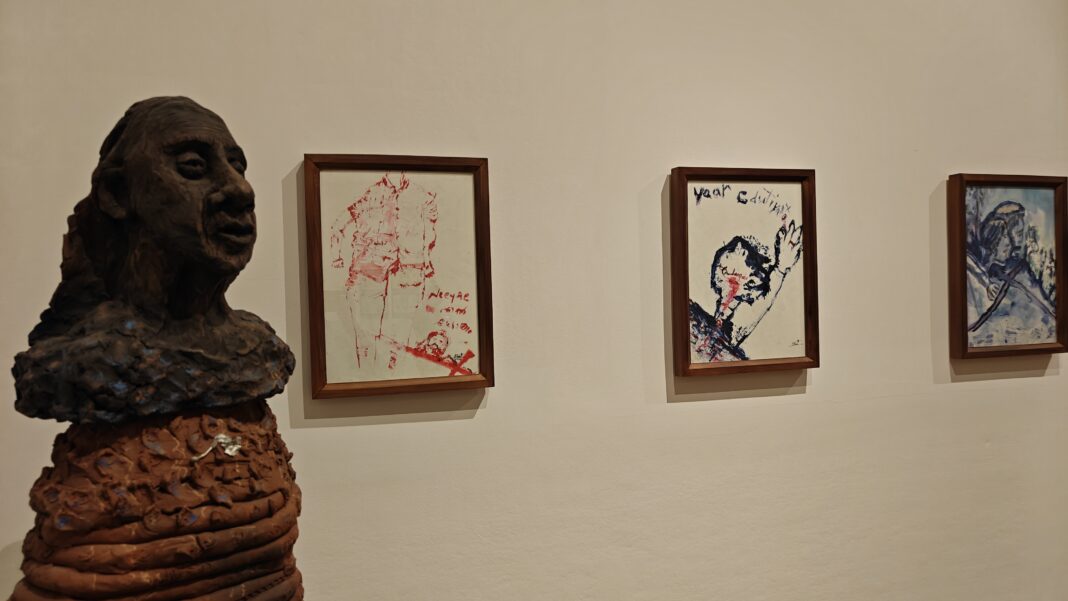
Sister Roswin CMC, born Malu Joy in Angamaly, India, brings psychological depth to her drawings and terracotta sculptures, portraying fellow nuns and elderly visitors with fragile humanity. Exhibiting at the Kochi-Muziris Biennale, her work transforms pain, waste, and vulnerability into sites of empathy, recovery, and shared presence.
In the quiet corridors of a convent in Angamaly, Kerala, Sister Roswin CMC, born Malu Joy in 1990, has cultivated an artistic practice that is as intimate as it is profound. Her work, spanning pen drawings in monochrome and colour alongside terracotta sculptures, is rooted in the immediacy of her surroundings. Fellow nuns, elderly mothers, and visitors to the convent’s sickroom become her subjects, not as idealised figures but as fragile, imperfect beings whose humanity is etched into their bodies by time, labour, and resilience. Through her art, Sister Roswin enunciates the subtle intricacies of human presence, producing a psychological intensity that transcends realism.
Her journey into art began within the convent itself, where she painted biblical scenes and lettering upon its walls. These early gestures of devotion and creativity laid the foundation for a practice that would later evolve into a more searching exploration of the human figure. While pursuing a Bachelor of Fine Arts at the RLV College of Music and Fine Arts, she shifted towards figurative study, moving beyond surface likeness to probe the deeper registers of human experience. Her subjects are not polished or perfected; they are rendered with the marks of endurance, the scars of labour, and the quiet dignity of survival.
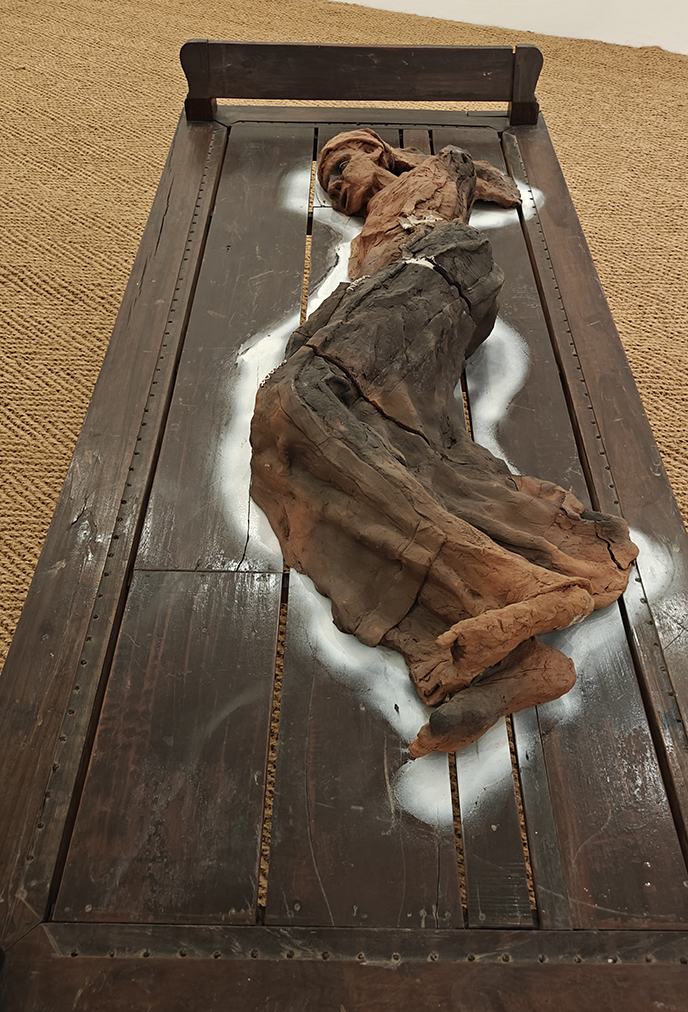
At the Kochi-Muziris Biennale, Sister Roswin presents thirty drawings under the titles Mother I (2025) and Mother II (2025), alongside ten terracotta sculptures. These works turn their gaze towards the elderly mothers and visitors at the convent’s sickroom, capturing them in states of repose and vulnerability. One sculpture depicts an elderly nun with her head tilted in exhaustion, her posture embodying the weight of years and devotion. Another portrays a man suspended in the moment of a yawn, an epilogue to long hours of work. These forms are not monumental in scale, but monumental in empathy, shaped by the rhythms of community life and the conversations that animate it.
Conversation is central to Sister Roswin’s method. She sketches while speaking with her subjects, attentive to the words and memories that unlock their inner lives. In this exchange, her own subjectivities and recollections surface, creating a shared space burgeoning with empathy. Her background in sociology and counselling psychology informs this dialogic approach, layering her works with critical and affective registers. The act of drawing becomes not merely representation but communion, a co-presence that restitutes her subjects from conditions of rejection and abjection.
Pain recurs as a theme in her work, not as spectacle but as lived reality. She interrogates notions of waste and usefulness, reframing them through her practice. As a student, she used paper waste as canvas and the sidewalk as exhibition venue, gestures that challenged conventional hierarchies of art and material. Today, she continues to expand the contours of her drawings with notations gleaned from conversations, embedding fragments of speech and memory into the visual field. In doing so, she transforms art into a site of recovery, where the overlooked and discarded are attended to with care and dignity.
Her terracotta sculptures, earthy and tactile, embody this ethos of recovery. The medium itself, humble and grounded, resonates with her subjects—ordinary people whose lives are marked by endurance rather than grandeur. The clay forms, shaped by her hands, bear the imprint of community and co-existence. They are not isolated artefacts but extensions of lived experience, imbued with the warmth of shared presence. In their vulnerability, they resist the monumental and instead affirm the fragile resilience of human life.
The drawings, meanwhile, oscillate between monochrome precision and bursts of colour, each line attentive to the contours of ageing skin, the folds of fabric, the gestures of repose. They do not flatter but reveal, attending to the imperfections that constitute humanity. In their psychological intensity, they transcend realism, enunciating the subtle intricacies of being. The elderly mothers she depicts are not anonymous figures but individuals whose lives are inscribed upon their bodies, whose fragility is met with empathy rather than erasure.
Sister Roswin’s practice is deeply situated in community. It is shaped by the rhythms of convent life, by the conversations with fellow nuns, by the presence of visitors in the sickroom. Her art emerges not from isolation but from co-existence, from the shared spaces of care and service. In this sense, her work is both personal and collective, a testament to the ways in which art can emerge from the everyday and transform it into a site of reflection and recovery.
Her engagement with waste materials and unconventional exhibition spaces underscores her commitment to challenging hierarchies of value. By using discarded paper as canvas or sidewalks as venues, she reframes art as an act of reclamation, a gesture that restitutes what has been rejected. This ethos extends to her subjects, who are often elderly, weary, or vulnerable. Through her attentive presence, she restores dignity to their fragility, affirming their humanity in the face of abjection.
At the Biennale, her works stand as quiet yet powerful interventions. They do not shout but whisper, inviting viewers into spaces of vulnerability and empathy. In a world often dominated by spectacle, her art insists on the value of the overlooked, the fragile, the imperfect. It is an art of care, of co-presence, of recovery. It is an art that enunciates the subtle intricacies of human condition, reminding us that dignity resides not in perfection but in resilience.
Born in Angamaly and shaped by the convent, Sister Roswin CMC embodies a practice that is both rooted and expansive. Her art is rooted in the immediacy of her surroundings, in the conversations and communities that animate her life. Yet it is expansive in its reach, touching upon universal themes of pain, resilience, and empathy. In her drawings and sculptures, the local becomes universal, the fragile becomes profound, the overlooked becomes central.
Her work challenges us to reconsider the boundaries of art and its subjects. By attending to the elderly, the weary, the vulnerable, she reframes art as a site of recovery and restitution. By using waste materials and unconventional spaces, she challenges hierarchies of value and asserts the dignity of the discarded. By engaging in conversation and co-presence, she transforms representation into communion. In all these ways, her practice is a testament to the power of art to enunciate the intricacies of human presence and condition.
As visitors encounter her works at the Kochi-Muziris Biennale, they are invited into spaces of vulnerability and empathy. They are asked to see not idealised figures but fragile humans, not perfected forms but resilient beings. They are asked to listen to the whispers of pain and endurance, to attend to the marks of time and labour. In doing so, they participate in the recovery that her art enacts, a recovery that restitutes dignity through the care of attention and co-presence.
Sister Roswin CMC’s art is not monumental in scale but monumental in empathy. It is not about spectacle but about presence. It is not about perfection but about resilience. In her drawings and sculptures, she enunciates the subtle intricacies of human condition, reminding us that art, at its core, is an act of care.
Discover more from Creative Brands
Subscribe to get the latest posts sent to your email.