


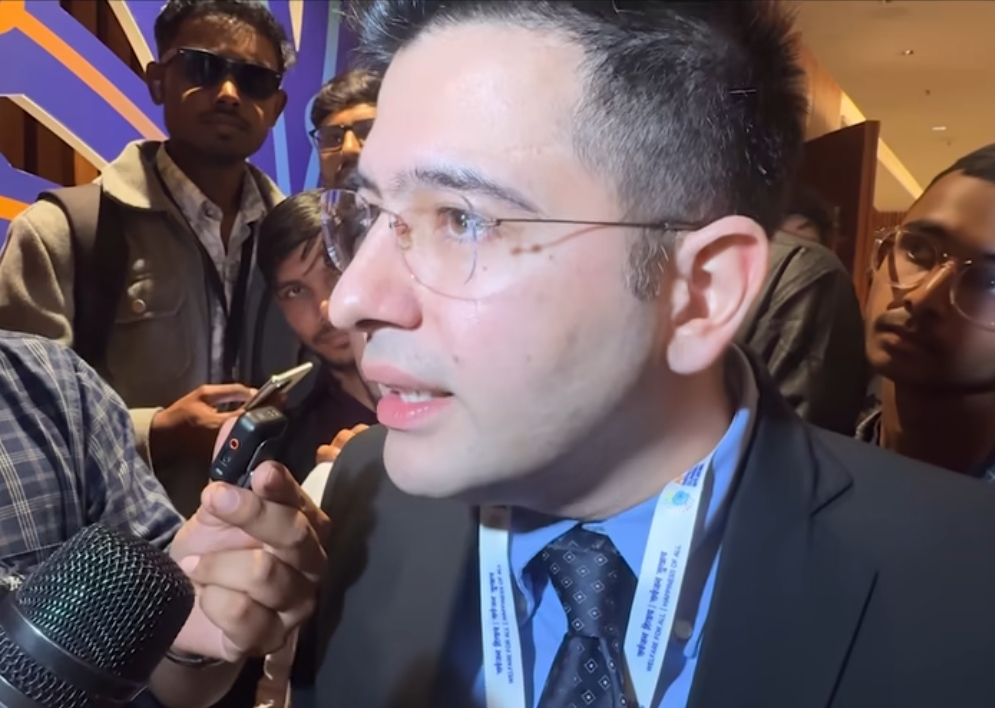
At the India AI Impact Summit 2026, Raghav Chadha cautioned that artificial intelligence risks eroding India’s intellectual heritage if regional languages and oral traditions remain undigitised. He urged stronger initiatives like the India AI Mission and Bhashini to embed India’s cultural and linguistic diversity into future AI ecosystems.
At the India AI Impact Summit 2026, Raghav Chadha, the youngest Member of Parliament in India’s upper house, raised a concern that cut deeper than the familiar anxieties about automation and job loss. He spoke of “knowledge displacement,” a risk that artificial intelligence could marginalise vast swathes of India’s intellectual heritage if the country fails to digitise its regional languages, oral traditions, and civilisational wisdom. His intervention was striking not only for its originality but also for its urgency, as India positions itself as a global leader in AI innovation while grappling with the responsibility of safeguarding its cultural identity.
Chadha’s argument was simple yet profound: if tomorrow’s AI models are trained only on digitised data, they will inevitably reflect a narrow slice of India’s knowledge systems. The oral traditions of tribal communities, the philosophical discourses preserved in Sanskrit, the folk songs sung in Bhojpuri, and the everyday idioms of Tamil or Assamese risk being excluded from the datasets that shape the future of machine intelligence. In such a scenario, India’s contribution to global AI would be incomplete, skewed towards the dominant languages and literatures that happen to be digitised, while the richness of its civilisational diversity fades into obscurity.
He called for stronger initiatives like the India AI Mission and Bhashini, the government’s language translation platform, to ensure that India’s full cultural and linguistic diversity is embedded into tomorrow’s AI ecosystem. For Chadha, this was not merely a technical challenge but a civilisational imperative. “We must digitise our wisdom before it is displaced,” he urged, framing the issue as one of preservation and continuity. His words resonated with the audience, many of whom were technologists and policymakers accustomed to thinking of AI in terms of efficiency, productivity, and disruption, rather than cultural survival.
Chadha’s intervention at the summit was consistent with his broader approach to public life. A Chartered Accountant by training, he has long sought to bring clarity and rigour to policy debates. Within the Aam Aadmi Party (AAP), he has served as National Treasurer, National Spokesperson, and Member of the National Executive, roles that demanded both precision and persuasion. In 2022, as the state incharge, he led AAP’s campaign in Punjab, securing 92 of 117 seats—a mandate so decisive it became the largest in the state’s history. That victory underscored his ability to translate ideas into action, and his subsequent role as Chairman of the Chief Minister’s Advisory Panel in Punjab allowed him to work directly on governance and delivery.
In Parliament, Chadha has focused on issues that affect citizens in their daily lives: relief in income tax, affordable facilities at airports, GST concessions on essentials. His tenure as Vice Chairman of the Delhi Jal Board saw him expand access to clean drinking water, a reminder that his politics is grounded in tangible improvements rather than abstract rhetoric. He has also championed youth participation in public life, building platforms where young people can contribute to decision-making and benefit from policies on skills, jobs, and financial independence.
The theme of inclusion runs through his career, and his warning about knowledge displacement in AI fits neatly into that arc. Just as he has sought to democratise access to water, education, and political participation, he now seeks to democratise the datasets that will shape artificial intelligence. For Chadha, the question is not whether India will be part of the AI revolution—it already is—but whether India’s full cultural spectrum will be represented in that revolution.
His call carries weight beyond India’s borders. As AI systems become global, the absence of Indian languages and traditions from training data would mean their exclusion from the digital commons of the future. This is not merely a loss for India but for humanity, which stands to benefit from the pluralism and depth of Indian thought. Chadha’s intervention thus reframes AI not only as a technological frontier but also as a cultural battleground, where the stakes include identity, continuity, and dignity.
Recognition of his leadership has already come from international quarters. He has been honoured with the India-UK Outstanding Achievers award, named a Young Global Leader by the World Economic Forum, and invited to programs at Harvard Kennedy School and the USA’s International Visitor Leadership Program. These accolades reflect his growing stature as a voice that bridges local concerns with global debates. His remarks at the summit, therefore, were not parochial but universal, reminding the world that the future of AI must be multilingual, multicultural, and inclusive.
The India AI Impact Summit 2026 was filled with discussions about innovation, regulation, and investment, but Chadha’s intervention stood out for its moral clarity. He reminded the audience that technology is not neutral; it reflects the data it consumes and the priorities of those who build it. If India fails to digitise its oral traditions and regional languages, it risks allowing AI to become a mirror that reflects only part of its soul.
In the coming years, as India accelerates its AI initiatives, Chadha’s warning will likely echo in policy circles. The challenge of digitisation is immense, requiring resources, coordination, and sensitivity. Yet the cost of inaction is greater: a future where India’s civilisational wisdom is displaced, not by conquest or neglect, but by omission from the datasets of artificial intelligence.
For Chadha, the task ahead is clear. Just as he has worked to expand access to water, tax relief, and youth participation, he now seeks to expand access to the digital future, ensuring that India’s heritage is not lost in translation. His vision is one where AI does not merely serve efficiency but also preserves identity, where algorithms are trained not only on data but on diversity.
At the summit, his words carried the weight of both warning and hope. Knowledge displacement, he argued, is preventable if India acts decisively. The India AI Mission and Bhashini are steps in the right direction, but they must be scaled and strengthened. In the end, Chadha’s intervention was not only about artificial intelligence but about human responsibility: the responsibility to ensure that the wisdom of generations is not displaced by the silence of omission.
Discover more from Creative Brands
Subscribe to get the latest posts sent to your email.