


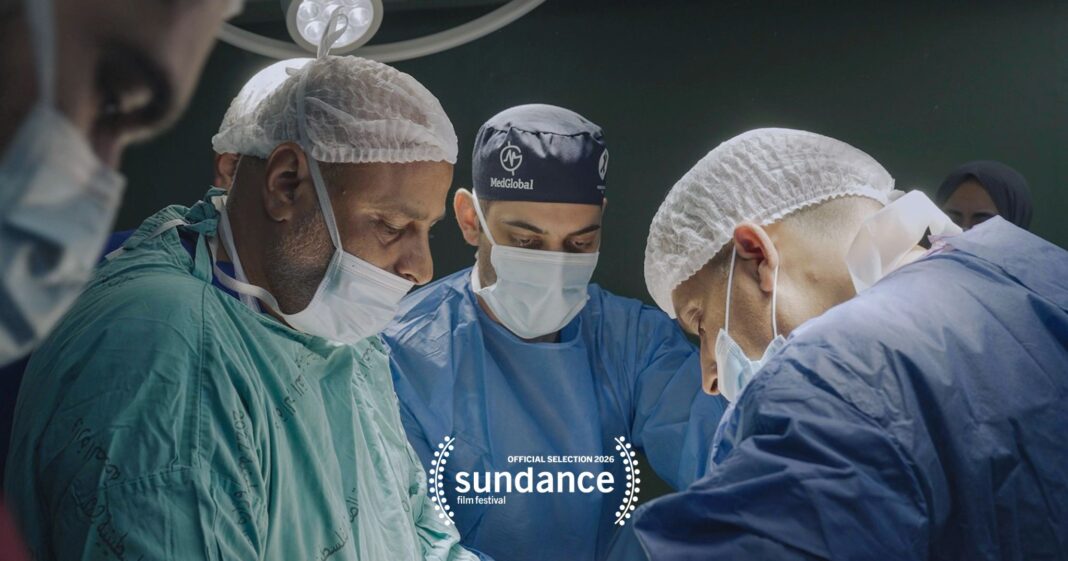
American Doctor, the directorial debut of filmmaker Poh Si Teng, will world premiere at the Sundance Film Festival. The vérité documentary follows three physicians of different faiths as they move from a besieged Gazan hospital to Washington, united by medicine, friendship and a shared oath to save lives.
Poh Si Teng’s announcement that AMERICAN DOCTOR, her directorial debut, will world premiere at the Sundance Film Festival marks a defining moment in the filmmaker’s career and places a deeply human story of medicine, friendship and moral responsibility onto one of the world’s most influential documentary stages. Known until now as a director, producer and executive producer through her company Tiny Boxer Films, Poh steps into Sundance with a vérité documentary shaped by urgency, trust and an uncommon degree of access across borders, belief systems and political fault lines.
AMERICAN DOCTOR follows three prominent physicians—Palestinian, Jewish and Zoroastrian—whose lives and identities could not appear more different, yet who are bound by a shared oath to save lives. Friends before they are political actors, the doctors are drawn together by medicine and by a commitment to patients caught in the crossfire of geopolitics. Filmed in unfolding, on-the-ground scenes, the documentary traces their journey from a Gazan hospital under siege to the corridors of power in Washington, DC, as they move their fight from emergency rooms to the halls of Congress.
At the heart of the film is a promise: to continue the struggle where it might matter most, in the United States, on behalf of Palestinian colleagues and patients whose voices are often drowned out by political rhetoric. Rather than framing its subjects as symbols or spokespeople, AMERICAN DOCTOR remains grounded in lived experience, allowing moments of exhaustion, disagreement, humour and grief to surface organically. The result is an intimate portrait of friendship tested by circumstance, and of medical ethics strained by war.
For Poh, the project represents both a professional and personal leap. Describing the completion of the film as “a big exhale,” she has spoken openly about the weight of responsibility that came with telling this story. As a first-time feature director, she chose a vérité approach that demanded patience and trust, following events as they unfolded rather than shaping them into a predetermined narrative. The decision lends the film a raw immediacy, placing viewers alongside doctors navigating bombed hospitals, media scrutiny and political advocacy, often in real time.
Central to that trust are the film’s three protagonists: Dr. Thaer Ahmad, Dr. Mark Perlmutter and Dr. Feroze Sidhwa. Poh has credited them not only for their openness on camera but for allowing the production into moments of vulnerability and moral reckoning. Their willingness to be seen not just as professionals but as friends with differing backgrounds and beliefs gives the film its emotional spine. In a landscape saturated with polarised debate, AMERICAN DOCTOR resists easy binaries, instead focusing on how shared humanity persists amid deep division.
The film’s scope mirrors the global nature of its subject. Production spanned six countries—the United States, Palestine, Malaysia, Qatar, Denmark and Japan—with additional field production in Jordan and music composition in Canada. This international footprint reflects both the logistical complexity of the project and the transnational networks of care, advocacy and storytelling required to bring it to life. In practical terms, it meant coordinating teams across time zones, navigating travel restrictions and security concerns, and adapting constantly to rapidly changing circumstances on the ground.
Poh’s collaboration with her director of photography Ibrahim Al Otla and co-producer Mohammed Sawwaf was particularly crucial to the film’s Gaza sequences. Shot under extreme conditions, the footage captures the strain on medical workers and infrastructure without sensationalism. Poh has described the film as part of a broader promise—to the crew, to their families and to the subjects themselves—that the story would be brought back to the United States in a meaningful way. Sundance, with its history of launching documentaries into public discourse, provides a powerful platform for that return.
The production credits underline the collective effort behind AMERICAN DOCTOR. Poh produced the film alongside Kirstine Barfod and Reem Haddad, with executive producers Simon Kilmurry and Hamza Ali providing strategic and institutional backing. Editors Christopher White and Ema Ryan Yamazaki shaped the sprawling material into a coherent narrative while preserving the immediacy of lived moments. Cinematography was led by Ibrahim Al Otla and Chris Renteria, with additional camera work by Arthur Nazaryan, Ramzy Haddad, Rafael Roy, Nicholas Lindner and Poh herself, reinforcing the sense of a film made from within events rather than at a distance.
Sound and music play an equally significant role. Original music by Suad Bushnaq underscores the film with restraint, allowing emotion to rise without manipulation. Sound recordist Shu Ling Yong and the post-production team, including Kristian Eidnes Anderson and Patrick Svaneberg Vejen, crafted an audio landscape that places audiences inside hospitals, protest spaces and quiet moments of reflection. Subtle design choices ensure that the film’s impact comes from presence rather than emphasis.
For Poh, whose career has spanned directing, producing and executive producing across formats, AMERICAN DOCTOR represents a crystallisation of long-held concerns about power, responsibility and storytelling. Founding Tiny Boxer Films allowed her to pursue projects driven by character and consequence rather than spectacle, and her debut feature aligns with that ethos. By foregrounding the oath to save lives as a unifying principle, the film reframes debates that are often abstracted into policy or ideology.
The Sundance premiere situates AMERICAN DOCTOR within a festival environment known for championing documentaries that challenge audiences and influence conversation. For a first-time feature director, the selection is both recognition and amplification, placing Poh alongside filmmakers whose work has shaped public understanding of complex global issues. It also reflects Sundance’s ongoing commitment to documentary voices that operate across borders and disciplines.
As the film prepares to meet its first audiences, its ambitions extend beyond the screen. With an impact producer attached and a story that moves deliberately toward the US political arena, AMERICAN DOCTOR is positioned not only as a cinematic experience but as a catalyst for dialogue about medical ethics, foreign policy and the responsibilities of those with access to power. The doctors’ fight, as depicted in the film, is not about winning arguments but about upholding commitments made under the most basic of oaths.
In sharing news of the premiere, Poh expressed gratitude to the many collaborators who made the film possible, framing the project as a collective act rather than a singular achievement. That sensibility is embedded in the film itself, which insists that progress—whether in medicine, advocacy or storytelling—comes through solidarity. As AMERICAN DOCTOR makes its debut at Sundance, it carries with it not only the voices of its three subjects, but the labour, risk and care of an international team determined to bring a story of conscience back to where it might be heard most clearly.
Discover more from Creative Brands
Subscribe to get the latest posts sent to your email.