


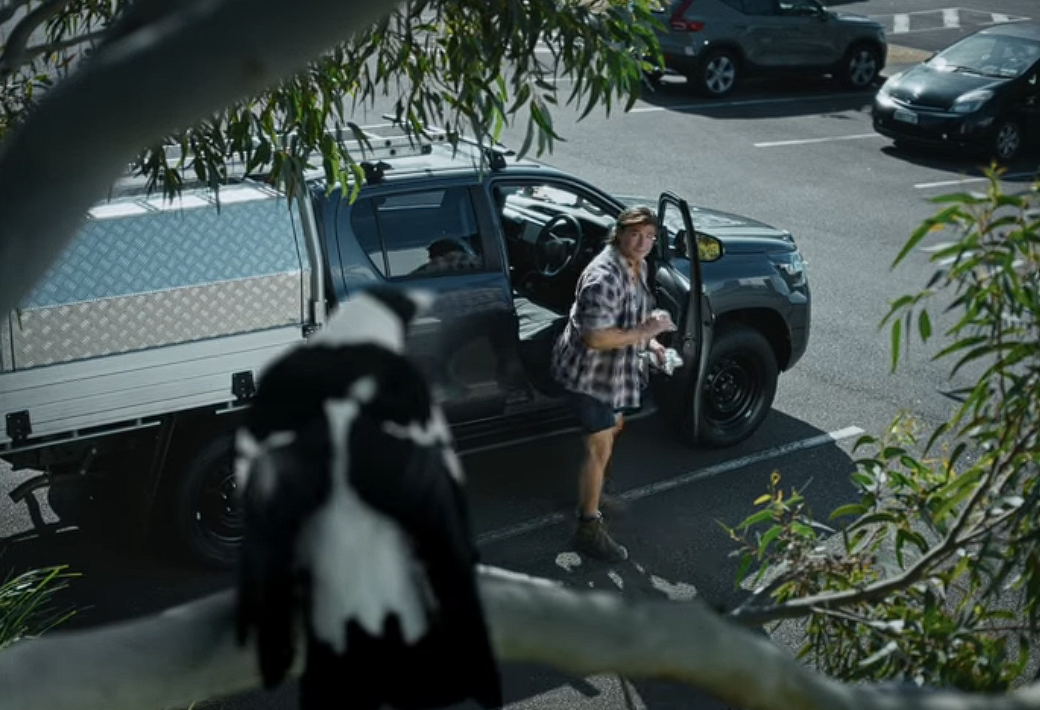
The NSW EPA’s new “Nature Hates a Tosser” campaign uses angry, watchful wildlife to confront littering behaviour, targeting young men who litter when they feel unobserved. Created by 303 MullenLowe, the campaign taps psychological cues of being watched to trigger personal accountability and push lasting change in everyday litter habits.
Nature has finally had enough — and it’s staring right back at you. In the new “Nature Hates a Tosser” campaign from the NSW Environment Protection Authority (EPA), the birds, possums, fish and other creatures that inhabit Australia’s landscapes are no longer the silent victims of littering. They are witnesses. They are furious. And they want you to know it.
This bold new chapter builds on more than a decade of the iconic “Don’t Be a Tosser” platform, but shifts sharply in tone and strategy. Instead of depicting nature as fragile and needing protection, the campaign personifies wildlife as watchful, fed up, and holding humans accountable in real time. The result is a message that lands with greater urgency and—crucially—a very deliberate sense of personal shame.
The NSW EPA’s motivation for the shift is both psychological and practical. For years, its messaging has succeeded in raising awareness and shaping attitudes. But a stubborn segment of the public—often young men aged 18 to 44—continues to litter despite acknowledging that it’s wrong. They justify it by insisting there was no bin nearby, or dismissing harmless-seeming items like wrappers, bottle caps, or cigarette butts. In many cases, they behave differently when someone is watching. The anonymity of being alone emboldens them to litter when they think they can get away with it.
This behavioural insight is central to the reimagined campaign. As 303 MullenLowe Sydney’s Chief Strategy Officer Jody Elston explains, anonymity is a powerful driver. “We know that anonymity increases people’s propensity to litter. Young men in particular are less likely to drop litter when people are around or they are closer to home, so we needed to shift from evoking social shame when people are watching, to personal shame in the moment.”
To do that, the agency dug deep into secondary research, including a well-known psychological experiment that found images of eyes—simulated watchfulness—significantly reduce antisocial or dishonest behaviour. Whether on a poster, a product, or a campaign, those eyes evoke the subconscious presence of authority, even when no one is physically there. Humans, it turns out, still react instinctively to being watched.
303 MullenLowe seized on this cognitive trigger and fused it with the realities of environmental harm. The result is striking: nature’s angry eyes appear everywhere. Not soft, pleading eyes. Not eyes begging for help. Eyes that glare. Eyes that confront. Eyes that accuse. They make the viewer feel seen, and in doing so, force them to consider the immediate consequences of the flicked cigarette, tossed bottle, or dropped snack wrapper.
It’s a sharp departure from the sentimental environmental messaging many are accustomed to—less guilt-tripping through sadness, more direct confrontation through disappointment and anger. Yet, that is exactly the attitude the target audience responds to. The goal isn’t to make litterers feel bad about nature in theory; it’s to make them feel accountable in the moment, in real life, with tangible consequences.
For the agency, this is the first major campaign delivered since winning the NSW EPA account in a competitive pitch earlier this year. The team worked closely with the agency’s Litter Prevention Unit, ensuring the concept was grounded in research, relevant to the demographic, and aligned with the state’s broader environmental strategy. Together, they developed the creative platform, communications architecture, and production rollout that would bring nature’s fury to life across outdoor, digital, and social environments.
“Tosser has been highly successful at driving home litter prevention messages since first airing in 2014,” notes NSW EPA Director of Corporate Affairs, Vanessa Grimm. The humour and memorable phrasing made it a cultural fixture, widely recognised and often referenced. But even strong campaigns must evolve, she says, because the challenge persists.
“But we know that despite these efforts, there is still a group within our communities that will litter using excuses like ‘there wasn’t a bin nearby’ or ‘it’s only a small wrapper or bottle top.’” These seemingly small actions add up, posing a cumulative threat to waterways, wildlife, and habitats.
The agency’s hope is that this hard-edged characterisation of nature will cut through the rationalisations. “We hope by showing that nature is watching and angry, these litterers will understand and acknowledge the impact their littering has, and ultimately change their behaviour.” It’s a shift from broadcasting environmental consequences to confronting personal responsibility.
From a magazine’s vantage point, the campaign represents a refreshing willingness to challenge old norms in public messaging. While many environmental initiatives rely on gentle persuasion, this one opts for sharper emotional tension. It credits the audience with enough intelligence—and enough conscience—to recognise themselves in the scenarios depicted. It acknowledges that behaviour change often requires disruption, not comfort.
More importantly, the campaign taps into a growing global movement: reframing environmental protection not as idealistic activism but as a practical, everyday responsibility. Littering isn’t an abstract problem reserved for activists and policymakers. It’s a behavioural issue performed in small, repeated acts by regular people. And therefore, the solution must also operate at the level of personal habit.
The creative execution reinforces that intimacy. Posters place viewers in the position of being directly observed. Digital videos capture nature reacting in real time. The tone is unapologetic and firm—there is no sugar-coating the harm litter causes or the frustration nature would express if it could speak. By assigning nature a voice, a gaze, and a clear emotional boundary, the campaign humanises environmental protection in unexpected ways.
For the NSW EPA, the measure of success will be whether young men—and the broader public—alter their behaviour when no one is around to judge them. Can a pair of illustrated eyes genuinely influence a split-second decision in a parking lot, on a hiking trail, or beside a roadside bin? Research suggests yes. Humans are wired to respond to social cues. If those cues come from nature itself, the message may land even more powerfully.
Ultimately, “Nature Hates a Tosser” isn’t just a slogan. It’s a mirror held up to human behaviour. It’s the uncomfortable truth that the environment suffers silently for actions many justify easily. And it’s a reminder that nature is no longer being portrayed as a distant, helpless victim. It is here, it is watching, and it is utterly done with excuses.
In a world where environmental messaging competes with constant noise, perhaps anger—rather than anguish—is what finally cuts through.
Discover more from Creative Brands
Subscribe to get the latest posts sent to your email.