


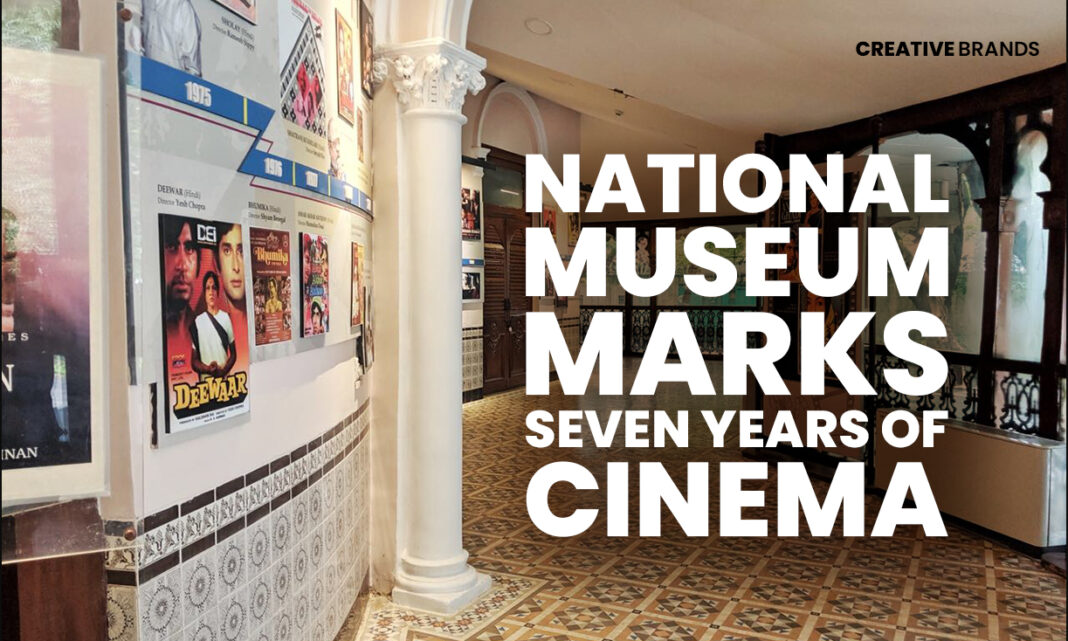
The National Museum of Indian Cinema celebrated its seventh anniversary with a curated programme honouring India’s rich cinematic heritage. Established in 2019 under the NFDC and inaugurated by Prime Minister Narendra Modi, the museum has become a vital cultural institution preserving film history through immersive exhibits, archives and public engagement initiatives.
The National Museum of Indian Cinema (NMIC), under the aegis of the National Film Development Corporation (NFDC), marked a significant milestone as it celebrated its seventh anniversary, honouring the extraordinary legacy, evolution and cultural impact of Indian cinema. Inaugurated in 2019 by Hon’ble Prime Minister Narendra Modi, the museum has since carved its place as India’s foremost institution dedicated to preserving and showcasing the history, artistry, and socio-cultural influence of the country’s film industry. The anniversary event reaffirmed that mission, bringing cinephiles, students, scholars, and film enthusiasts together in an immersive celebration of storytelling, technology, and heritage.
Housed in the historic Gulshan Mahal and an adjacent modern building in Mumbai, the NMIC represents a vast cinematic timeline that stretches from the silent era to the contemporary digital age. Its seventh anniversary programme reaffirmed the museum’s role not merely as a repository of artifacts but as a living cultural space where cinema is studied, experienced, contextualised and reimagined. The museum’s thoughtfully curated anniversary events showcased how Indian cinema has shaped collective memory, influenced public discourse and mirrored the aspirations of a nation in constant motion.
Since its inception, the NMIC has drawn widespread appreciation for its diverse collection of memorabilia, archival prints, costume pieces, posters, film equipment, rare documents, and interactive installations that invite visitors to understand the creative, technological and cultural processes behind filmmaking. That legacy was front and centre during the celebration. Visitors were guided through carefully designed exhibits that highlighted the medium’s fascinating progression—from the pioneering work of Dadasaheb Phalke to the studio era of the 1930s and 40s, from the golden age of parallel cinema to the current era of global Indian cinema that thrives across platforms and continents.
Under the guidance of Prakash Magdum, Managing Director of NFDC, and D. Ramakrishnan, General Manager at NFDC, the anniversary programme was curated with an emphasis on engagement and education. Instead of simply commemorating the past, the event sought to deepen audience appreciation of cinema as an art form and an industry, while also celebrating its evolving identity. Magdum noted in conversations with attendees that the museum’s mission has always extended beyond display and preservation, underscoring the importance of creating a bridge between generations. Older visitors rediscovered films they once grew up with, while younger guests encountered histories they might never have known. The museum’s curatorial philosophy embraces the idea that cinema is not static; it is a living archive built on collaboration, serendipity and reinvention.
Central to the anniversary celebration was a renewed focus on the foundational role of films in shaping the social and cultural fabric of independent India. Cinema in India has never been confined to entertainment alone. Films have driven discourse, inspired movements, reflected anxieties, shaped language and fashion, and forged a shared cultural vocabulary across an incredibly diverse population. The museum’s exhibits demonstrated this vividly through artefacts and digital installations that explored key cinematic touchpoints—such as the influence of music in narrative storytelling, the evolution of special effects, the rise of regional industries, and the emergence of globally recognised auteurs.
Visitors were also invited to participate in screenings and discussions that brought new perspectives to classic works. Panel conversations delved into film restoration, archiving, music composition and poster art, highlighting the often unseen crafts that contribute to the magic of cinema. Students of film and media found immense value in these exchanges, which illuminated the meticulous labour behind what appears effortless on screen. For many participants, the museum became not just a place to observe history but a platform to imagine cinema’s future.
The NMIC’s importance has grown considerably over the past seven years as interest in film preservation and historical scholarship has expanded across India. With streaming platforms and global distribution reshaping viewing habits, there has also been a concurrent revival of curiosity about the origins of Indian cinematic language. For researchers, the museum has emerged as one of the few institutions that consolidate audiovisual material, printed records, documentation and cultural context under one roof. International collaborations have also gradually expanded, with the museum engaging with global film museums, archives and institutions seeking to understand the world’s most prolific cinematic ecosystem.
The anniversary also drew attention to the museum’s unique structure as an experiential space. Unlike traditional museums where artefacts remain behind glass, NMIC encourages tactile and interactive engagement. Digital timelines allow visitors to navigate decades of cinematic history. Audio-visual displays recreate iconic scenes and soundscapes. Restored equipment reveals the technological leaps that transformed filmmaking—from hand-cranked cameras to contemporary digital rigs. This immersive approach has made the museum particularly popular with young audiences, who are able to connect more dynamically with content that predates their time.
Cinema has always been India’s most accessible art form, cutting across class, community, language and geography. The museum’s celebration acknowledged this universality. Films have functioned as both mirror and escape—reflecting lived realities while transporting audiences into imagined worlds. The anniversary events embraced this duality by honouring films not only for their craft but also for the dreams they shaped and the emotional common ground they helped create. The museum’s recognition of regional cinemas further underscored that India’s film heritage is not monolithic but a mosaic of linguistic and cultural traditions, each with its own artistic signatures.
The milestone also arrived at a time when conversations around cultural preservation are gaining urgency. As celluloid decays, as theatres shutter, and as digital platforms influence what survives and what disappears, the role of dedicated institutions becomes increasingly consequential. The NMIC’s work in safeguarding prints, posters, scripts, costumes and allied material speaks to a broader national priority of protecting intangible cultural memory. In this sense, the anniversary did not simply reflect on seven years gone by; it served as a call to sustain long-term preservation efforts for decades ahead.
As the event concluded, attendees lingered across galleries and screening halls, a testament to the enduring fascination Indian cinema continues to evoke. The mood was celebratory yet contemplative, filled with admiration for the artists, technicians, innovators and storytellers who helped shape one of the world’s most prolific film traditions. For the National Museum of Indian Cinema, the seventh anniversary was not just a chronological milestone but a reaffirmation of purpose: to educate, to archive, to showcase and to inspire. In a country where cinema is deeply interwoven with identity, aspiration and collective memory, the museum stands as a vital custodian of history and imagination, poised to continue its journey for generations to come.
Discover more from Creative Brands
Subscribe to get the latest posts sent to your email.