


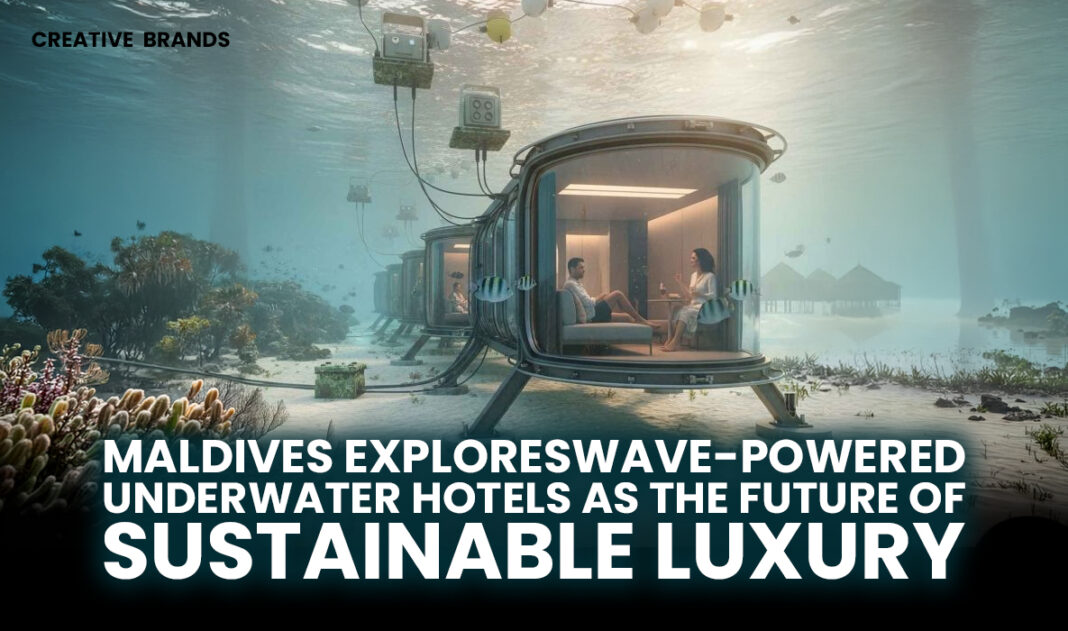
The Maldives is pioneering a bold vision for regenerative tourism by exploring wave-powered underwater hotels. Designed to minimise environmental impact, these glass-walled luxury suites would harness ocean energy for power while supporting marine ecosystems, redefining how high-end travel can coexist with fragile island environments.
In the Maldives, where luxury tourism and environmental vulnerability coexist in uneasy proximity, a new idea is beginning to take shape beneath the surface of the Indian Ocean. It is a vision that asks whether the future of high-end travel can be both indulgent and regenerative: underwater hotel suites powered entirely by the rhythm of the sea itself.
Imagine waking up inside a glass-walled room submerged below the waterline, reef fish gliding past at eye level while sunlight ripples across coral formations outside. Above, waves roll endlessly across the surface. What sets this vision apart from earlier underwater resorts is not only its spectacle, but its ambition. The same waves that frame the experience are being explored as the primary source of energy that lights the room, circulates the air, and sustains the stay.
The Maldives is pioneering the concept of pairing luxury underwater accommodations with offshore wave-energy devices, testing whether renewable ocean power can be seamlessly integrated into hospitality design. Instead of relying on diesel generators or energy imported from distant grids, the proposal centres on using the ocean’s constant motion to meet the hotel’s operational needs. Submerged mechanical arms or buoy-based systems would convert wave movement directly into electricity, creating a closed-loop relationship between environment and experience.
This approach reflects a broader shift within luxury travel, where sustainability is no longer positioned as a compromise but as a defining feature. For a destination like the Maldives—comprising low-lying islands acutely exposed to climate change—the stakes are particularly high. Rising sea levels, coral bleaching and the environmental pressure of tourism itself have forced the nation to rethink how it builds, powers and protects its most valuable assets.
Underwater hotels are not new to the Maldives. Over the past decade, they have become architectural symbols of extravagance, offering guests the rare privilege of sleeping among marine life. However, these structures have also raised difficult questions about energy consumption, construction impact and long-term ecological cost. The wave-powered underwater hotel concept attempts to answer those concerns by embedding sustainability at the very foundation of the experience.
At the core of the idea is a collaboration between architects, marine scientists and energy engineers. Their goal is to ensure that underwater units are sited and designed in a way that avoids sensitive coral heads, seagrass meadows and marine migration corridors. This careful placement is essential, not only to minimise damage during construction, but to ensure that the presence of the structures does not disrupt the delicate balance of reef ecosystems over time.
Material choice is equally critical. Designers are exploring corrosion-resistant composites and coatings that can withstand prolonged exposure to saltwater while also encouraging marine colonisation. The outer surfaces of these submerged structures are intended to function as living foundations, gradually attracting algae, corals and small organisms. Over time, the hotel itself could become part of the reef system, transforming from an intrusion into a habitat.
The wave-energy component introduces another layer of complexity—and opportunity. Wave power differs from solar and wind in that it is remarkably consistent. Ocean swells continue day and night, making wave energy especially well suited to environments like the Maldives, where surrounding waters offer a near-constant source of motion. By harnessing this energy directly at the site, underwater hotels could significantly reduce transmission losses and dependency on backup fossil fuels.
If successful, the system would allow suites to operate with a near-zero operational carbon footprint. Lighting, climate control and essential services would be powered by the same waves guests watch through their windows. In this model, the ocean is no longer just scenery; it becomes infrastructure.
For Maldives policymakers and tourism leaders, such experiments carry strategic importance. Tourism is the backbone of the nation’s economy, yet it is also one of the primary sources of environmental strain. The challenge has always been how to reconcile economic dependence on visitors with the urgent need to protect fragile marine ecosystems. Regenerative tourism—where developments actively contribute to environmental health rather than simply minimising harm—has emerged as a guiding principle.
Wave-powered underwater hotels are being framed as part of that regenerative approach. By reducing emissions, limiting seabed disturbance and potentially enhancing marine habitats, these projects aim to demonstrate that tourism infrastructure can evolve from extractive to symbiotic. Each rolling wave would not only provide ambience for guests, but literally sustain their stay.
There is also a symbolic dimension to building such structures underwater in a nation threatened by rising seas. Rather than retreating from the ocean, the Maldives is exploring ways to coexist with it more intelligently. In this sense, the underwater hotel becomes a statement of adaptation as much as innovation—an assertion that climate vulnerability can drive creative responses rather than resignation.
Challenges remain, of course. Wave-energy technology, while proven in experimental and small-scale applications, is still evolving. Integrating it into luxury hospitality requires ensuring reliability, redundancy and safety without compromising the guest experience. Underwater construction demands extraordinary precision, and long-term maintenance in a marine environment is both complex and costly. Environmental monitoring would need to be continuous, with the flexibility to adjust or even remove structures if unintended impacts emerge.
Yet proponents argue that the very nature of luxury travel allows room for such experimentation. High-end resorts, with their limited number of guests and premium pricing, can absorb the costs of innovation in ways mass tourism cannot. In doing so, they can function as test beds for technologies and design philosophies that may later be applied more widely, both within the Maldives and in other coastal destinations.
There is also a cultural shift underway among luxury travellers themselves. Increasingly, exclusivity is defined not just by privacy and spectacle, but by access to experiences that align with personal values. Staying in a wave-powered underwater suite offers a story of conscious indulgence—an opportunity to participate, however briefly, in a model of living that respects planetary limits.
For the Maldives, success in this arena could extend beyond tourism branding. If wave-energy systems prove viable at resort scale, they could inform broader coastal energy strategies, supporting island communities that currently rely on imported fuels. The hotel, in this sense, becomes both showcase and laboratory.
As plans evolve, the vision remains aspirational but grounded in necessity. The Maldives cannot afford to separate luxury from sustainability; its future depends on their convergence. In exploring wave-powered underwater hotels, the nation is pushing the boundaries of what hospitality can be—where engineering meets ecology, and where the sea is not just something to admire, but something to work with.
In this emerging vision, waking up beneath the ocean is no longer just about the thrill of being underwater. It is about reimagining the relationship between humans, technology and the natural world. Each passing wave becomes a reminder that luxury, in its most forward-looking form, may no longer be defined by excess, but by harmony.
Discover more from Creative Brands
Subscribe to get the latest posts sent to your email.