


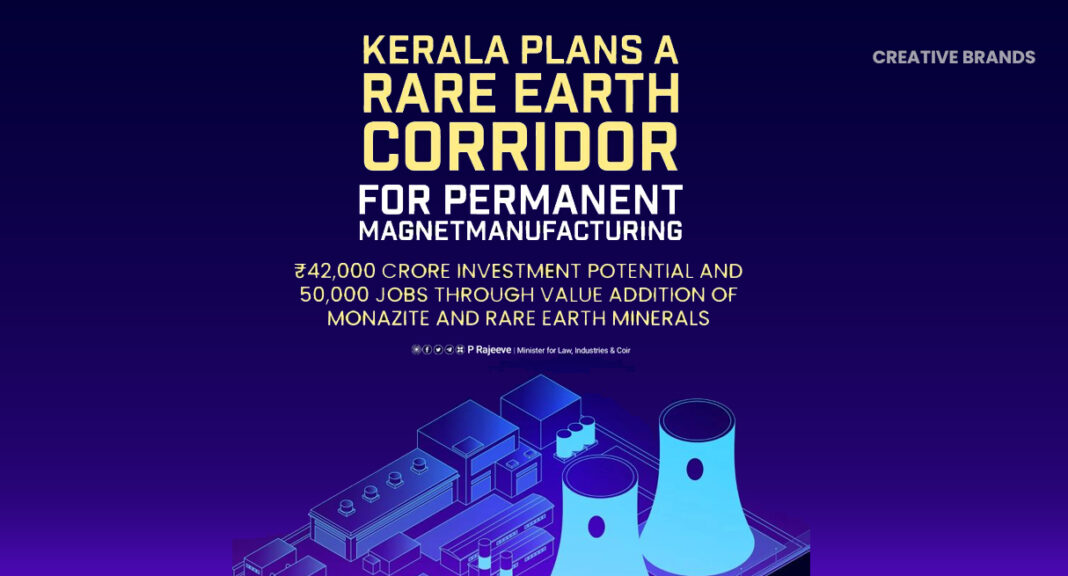
Kerala’s new Budget unveils a Rare Earth Corridor linking Vizhinjam and Kochi, aiming to transform mineral sands into high-value products. With ₹42,000 crore investments and 50,000 jobs, the initiative positions India in the global permanent magnet value chain, reducing reliance on China and boosting clean energy and advanced manufacturing.
Kerala has placed itself firmly on the global industrial map with its latest Budget announcement, unveiling a Rare Earth Corridor that could redefine India’s role in the permanent magnet value chain. In a sector overwhelmingly dominated by China, this bold initiative signals both economic ambition and strategic foresight, positioning Kerala as a critical player in the future of clean energy and advanced manufacturing.
The corridor, stretching from Vizhinjam International Seaport to Kochi through Chavara, is designed to harness the mineral wealth of the Kollam-Alappuzha coastal belt. This region is rich in monazite, a mineral that holds the key to rare earth elements such as neodymium and praseodymium. These elements are indispensable in the production of high-strength magnets, which power electric vehicles, wind turbines, and a host of advanced technologies. By tapping into this resource, Kerala is not only unlocking economic potential but also contributing to India’s strategic independence in critical materials.
The Budget earmarks ₹42,000 crore in investments for the corridor, alongside the promise of 50,000 new jobs. This scale of investment underscores the seriousness of the state’s intent. It is not merely about industrial expansion; it is about laying the foundation for a sector of national importance. Rare earth elements are the backbone of modern technology, and securing their supply is a matter of both economic and geopolitical significance.
Currently, global supply chains for rare earths are heavily dependent on China, which controls the lion’s share of production and processing. This dependence has long been viewed as a vulnerability by countries seeking to diversify their sources of critical materials. Kerala’s initiative, therefore, gains added weight in the international context. By establishing a domestic value chain for permanent magnets, India can reduce its reliance on imports, strengthen its manufacturing base, and assert itself in a sector that will define the future of energy and mobility.
The Rare Earth Corridor is not a standalone project. It is backed by a collaborative framework involving Kerala Minerals and Metals Limited (KMML), Keltron, and the National Facility for Technology Development Centre (NFTDC) in Hyderabad. Together, these institutions will implement the Rare Earth Critical Mission, for which ₹100 crore has been allocated in the Budget. This mission represents the technical and scientific backbone of the corridor, ensuring that the extraction and processing of rare earths meet global standards of efficiency and sustainability.
Vizhinjam International Seaport plays a pivotal role in this vision. As a deep-water port strategically located on the international shipping route, Vizhinjam provides Kerala with the logistical advantage needed to integrate into global supply chains. By linking the port with Kochi through the corridor, the state is creating a seamless infrastructure for the movement of raw materials and finished products. This connectivity enhances Kerala’s competitiveness and ensures that its rare earth products can reach global markets swiftly and efficiently.
The implications of this initiative extend beyond economics. Rare earth magnets are central to the clean energy transition. Electric vehicles rely on them for efficient motors, while wind turbines depend on them for generating renewable power. By establishing a domestic supply chain for these materials, Kerala is contributing directly to India’s climate goals and its commitment to sustainable development. The corridor thus becomes not just an industrial project, but a symbol of Kerala’s role in shaping a greener future.
For Kerala, the Rare Earth Corridor also represents a transformation of its economic landscape. Traditionally known for its strengths in tourism, agriculture, and services, the state is now positioning itself as a hub for advanced manufacturing and strategic industries. The creation of 50,000 jobs will have a profound impact on local communities, offering opportunities in high-tech sectors and fostering skill development. This shift could redefine Kerala’s identity in the national economy, making it a model for how states can leverage natural resources for long-term growth.
The announcement has already sparked interest among industry observers, who see Kerala’s move as a decisive step in India’s broader industrial strategy. As nations worldwide scramble to secure rare earth supplies, Kerala’s corridor could become a beacon of resilience and innovation. It demonstrates how regional initiatives can align with national priorities, creating synergies that strengthen India’s global standing.
At the heart of this initiative lies a vision of self-reliance. By converting monazite into world-class products, Kerala is asserting control over a resource that has long been underutilized. The collaboration between KMML, Keltron, and NFTDC ensures that the state has both the industrial capacity and the technological expertise to succeed. The Budget allocation of ₹100 crore for the Rare Earth Critical Mission reflects a commitment to research, innovation, and sustainable practices, ensuring that the corridor is built on solid foundations.
As the world moves towards a future defined by clean energy and advanced technologies, the demand for rare earth magnets will only grow. Kerala’s Rare Earth Corridor positions India to meet this demand, not as a dependent consumer but as a competitive producer. It is a bold statement of intent, a recognition that strategic industries must be nurtured at home, and a testament to Kerala’s ability to think beyond conventional boundaries.
In announcing this initiative, Kerala has not only charted a new course for its own economic future but also contributed to India’s quest for industrial sovereignty. The Rare Earth Corridor is more than a Budget proposal; it is a vision of transformation, resilience, and leadership. As the corridor takes shape, it promises to reshape Kerala’s destiny and strengthen India’s place in the global value chain of critical materials.
Discover more from Creative Brands
Subscribe to get the latest posts sent to your email.