


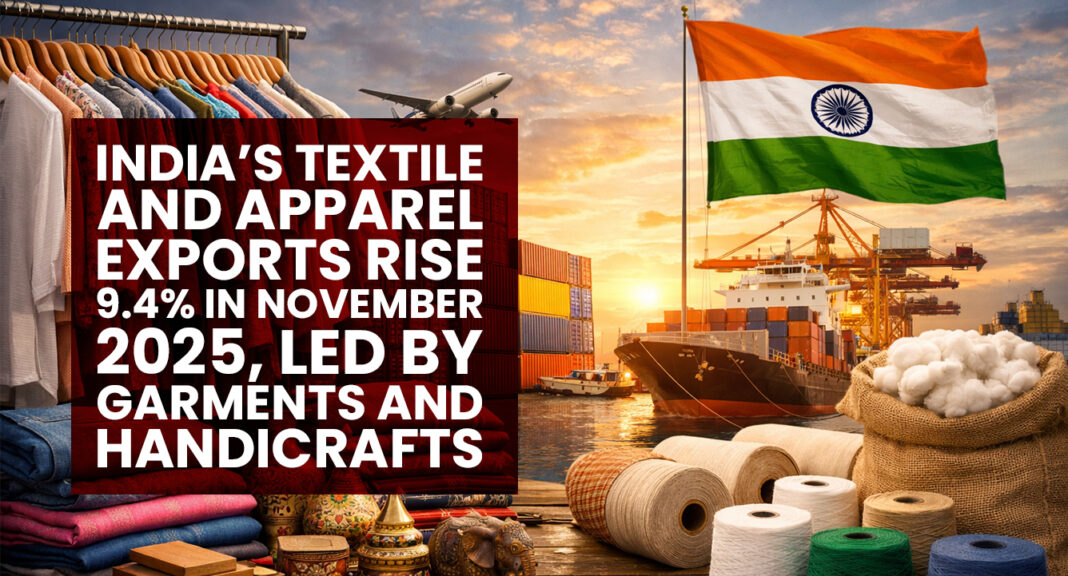
India’s textile and apparel exports reached US$ 2.86 billion in November 2025, growing 9.4% year-on-year. Strong gains in readymade garments, man-made textiles and handicrafts drove the increase, reflecting renewed global demand and the sector’s gradual diversification despite modest cumulative growth for the year.
India’s textile and apparel sector has delivered a measured but encouraging performance as global trade conditions remain uneven, with exports in November 2025 showing clear signs of resilience across key segments. According to the latest figures, India’s exports of textiles and apparel, including handicrafts, stood at US$ 2,855.8 million in November 2025, registering a growth of 9.4 per cent compared to the same month last year, when exports were valued at US$ 2,601.5 million. The uptick reflects a combination of renewed overseas demand, improved supply-chain stability, and the steady repositioning of Indian manufacturers in higher-value and diversified product categories.
The November numbers are significant not merely for the overall growth rate but for the breadth of segments that contributed to it. Readymade garments, long regarded as the backbone of India’s apparel exports, recorded an 11.3 per cent increase during the month. This growth suggests that Indian exporters are benefiting from restocking cycles in key markets such as the United States and Europe, where retailers had previously reduced inventories amid inflationary pressures and cautious consumer spending. As price pressures eased and demand began to normalise, Indian suppliers appear to have regained momentum, especially in value-driven and mid-market apparel categories.
Man-made yarns, fabrics and made-ups emerged as one of the strongest performers in November, posting a robust growth of 15.7 per cent. This segment’s expansion highlights a gradual but strategic shift within India’s textile industry toward synthetic and blended products, which are increasingly favoured in global markets for their durability, versatility and cost efficiency. The strong performance also reflects investments made over the past few years in modern manufacturing facilities, technical textiles, and capacity expansion, allowing Indian exporters to better compete with established synthetic textile producers in East and Southeast Asia.
Cotton yarns, fabrics, made-ups and handloom products, traditionally one of India’s strongest export categories, recorded a more modest growth of 4.1 per cent in November 2025. While the pace is slower compared to other segments, it nonetheless points to stable demand amid fluctuating cotton prices and competition from other cotton-producing countries. The continued growth in this category underscores the enduring appeal of Indian cotton textiles, particularly in premium and niche markets that value craftsmanship, sustainability and traceability. Handloom products, often associated with regional identities and artisanal skills, continue to find buyers seeking authenticity and heritage-led offerings.
One of the most striking figures in the November data is the sharp rise in handicraft exports, excluding handmade carpets, which grew by an impressive 29.7 per cent year-on-year. This surge reflects growing international interest in handmade and artisanal products, driven by consumer preferences for sustainable, ethically sourced and culturally distinctive goods. Indian handicrafts, ranging from metalware and woodcraft to pottery and decorative items, have benefited from improved market access through digital platforms, targeted export promotion initiatives, and a renewed focus on design innovation that aligns traditional skills with contemporary tastes.
While the November performance offers a positive snapshot, the cumulative export data for January to November 2025 presents a more nuanced picture. During this eleven-month period, exports of textiles and apparel excluding handicrafts amounted to US$ 32,560.0 million, reflecting a marginal growth of 0.26 per cent compared to the corresponding period of the previous year, when exports stood at US$ 32,474.9 million. The modest overall increase highlights the challenges the sector has faced throughout much of the year, including subdued demand in major markets, geopolitical uncertainties, and ongoing cost pressures related to energy, logistics and compliance.
Within the cumulative figures, however, there are clear signs of structural strength and selective growth. Readymade garment exports during January–November 2025 grew by 3.6 per cent over the same period in the previous year. This growth is noteworthy given the volatility in global apparel demand over the past year, and it reinforces the central role of garments in sustaining India’s textile export earnings. Indian apparel manufacturers have increasingly focused on shorter lead times, flexible production runs and closer collaboration with international buyers, helping them respond more effectively to changing fashion cycles and consumer preferences.
Jute products also recorded a growth of 6.1 per cent during the January–November period, reflecting renewed global interest in natural and biodegradable materials. As sustainability considerations gain prominence in packaging, home furnishings and lifestyle products, jute has re-emerged as a viable alternative to synthetic materials. India, being one of the world’s largest producers of jute, is well positioned to capitalise on this trend, particularly as regulations and corporate commitments push for reduced plastic usage across markets.
Industry observers note that the mixed performance across segments and over the year underscores the transitional phase the sector is currently navigating. On one hand, traditional strengths such as cotton textiles and garments continue to anchor export volumes. On the other, faster-growing segments like man-made textiles, handicrafts and jute signal a gradual diversification that could make India’s export basket more resilient over time. Government initiatives aimed at boosting manufacturing competitiveness, improving infrastructure, and supporting exporters through policy measures have played a role in cushioning the sector against external shocks.
The November growth also reflects the benefits of improved logistics and port efficiency, which have helped reduce delays and costs for exporters. Additionally, trade engagement with key partner countries and regions has contributed to stabilising demand, even as some markets remain cautious. Exporters have increasingly sought to expand their presence in non-traditional markets, including parts of Africa, Latin America and West Asia, to offset slower growth in mature economies.
Looking ahead, industry stakeholders remain cautiously optimistic. While global economic uncertainties persist, the steady recovery in monthly exports and the strong performance of certain segments suggest that the sector may be entering a more stable phase. Much will depend on how effectively Indian exporters can continue to move up the value chain, invest in sustainability and technology, and adapt to evolving global standards and consumer expectations.
For now, the November 2025 export figures provide a welcome boost to sentiment in one of India’s most employment-intensive industries. The data points to a sector that, despite headwinds, is finding ways to grow, diversify and remain relevant in a competitive global marketplace. As the year draws to a close, the textile and apparel industry’s ability to build on these gains will be closely watched by policymakers, businesses and workers alike, all of whom have a stake in its long-term growth and stability.
Discover more from Creative Brands
Subscribe to get the latest posts sent to your email.