


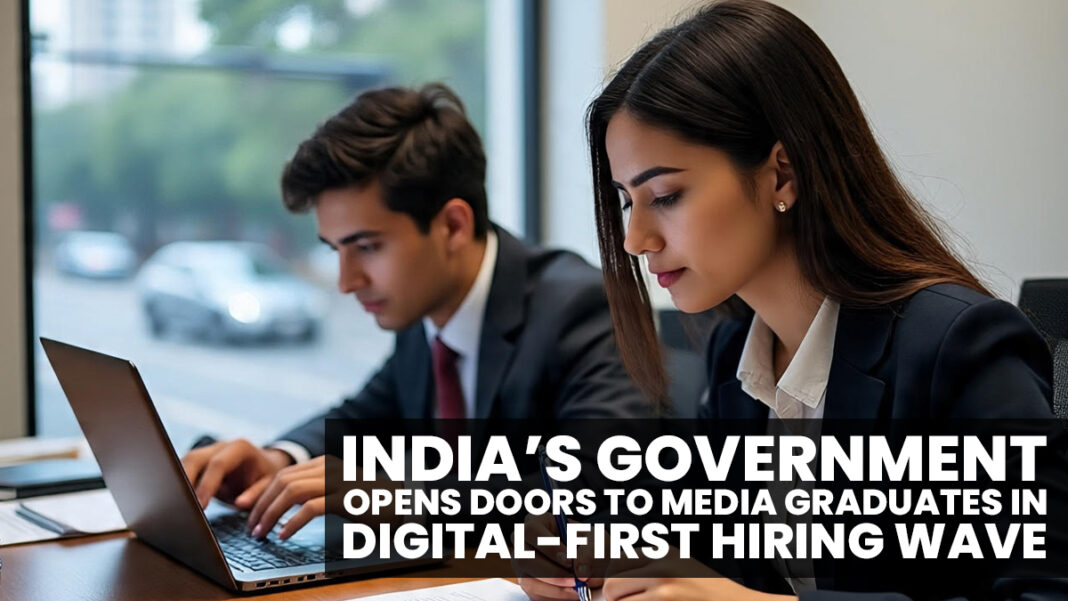
The Government of India is recruiting media professionals at an unprecedented scale in 2025-26, moving beyond traditional civil services. Ministries, PSUs, and autonomous bodies now seek digital-first talent for social media, data storytelling, and regional outreach. With competitive pay, flexibility, and national impact, young graduates are finding new career pathways.
The corridors of power in New Delhi are witnessing a quiet but profound transformation. For decades, government communication was synonymous with press releases, official gazettes, and the occasional televised address. Today, however, India’s public communication ecosystem is being reshaped by digital-first strategies, and at the heart of this shift is a new wave of hiring. The Government of India, across ministries, public sector undertakings (PSUs), and autonomous bodies, is recruiting media professionals like never before. What was once the preserve of civil services is now opening up to fresh graduates armed with skills in social media, multimedia storytelling, and data visualization.
This change is not incidental. It reflects a broader recognition that governance in the digital age requires more than bureaucratic precision; it demands agility, creativity, and the ability to engage citizens in real time. The government’s communication machinery is being retooled to meet the expectations of a population that consumes information on smartphones, scrolls through social media feeds, and expects instant clarity on policy decisions. Ministries are no longer content with issuing circulars; they want Instagram reels, Twitter threads, and interactive infographics that can cut through the noise and reach diverse audiences.
At the center of this transformation is MyGov, the citizen engagement platform that has become a hub for digital campaigns. Social media managers, content creators, and scriptwriters are being hired to craft narratives that resonate with India’s young and digitally savvy population. Regional language outreach is a particular focus, with positions opening for social media managers fluent in Telugu, Odia, Marathi, and other languages. The government has realized that effective communication in India’s multilingual landscape requires more than translation—it requires cultural nuance and local storytelling.
Beyond MyGov, the Digital India Corporation (DIC) is emerging as a major recruiter. With initiatives like Build for Bharat Fellowships offering stipends of around ₹40,000 per month, the government is signaling its intent to attract young talent into tech-driven communication roles. Content leads, digital strategists, and infographic designers are being brought on board to ensure that policy narratives are not just accurate but visually compelling. The emphasis on data visualization reflects a growing awareness that citizens are more likely to engage with charts, maps, and interactive dashboards than with dense policy documents.
Prasar Bharati, India’s public broadcaster, is also undergoing a digital push. Once associated primarily with radio and television, it is now hiring contractual digital content professionals, marketing executives, and district-level stringers to expand its reach in the digital domain. The broadcaster’s transformation is emblematic of a larger trend: traditional institutions are reinventing themselves to stay relevant in a media environment dominated by online platforms.
Specialized communication roles are proliferating as well. Digital media consultants, earning between ₹50,000 and ₹60,000 per month, are being tasked with shaping strategies for ministries and PSUs. Media analysts are being recruited to track sentiment and trends, ensuring that government messaging is responsive to public opinion. Production managers in the Directorate of Advertising and Visual Publicity (DAVP) and the Publications Division are overseeing the creation of multimedia campaigns that blend traditional formats with digital innovation.
For students of journalism and mass communication, this hiring wave represents a paradigm shift. Programs like the BA Journalism and Mass Communication at UPES are already aligning their curricula with these evolving requirements. Students are being trained in digital content creation, social media strategy, multimedia storytelling, and regional media practices, making them industry- and government-ready from day one. The synergy between academic training and government demand is creating a pipeline of talent that can step directly into impactful roles.
The skills in demand underscore the nature of this transformation. Content strategy and policy storytelling are essential, as the government seeks to explain complex initiatives in accessible language. Social media analytics, search engine optimization (SEO), and digital marketing are critical for ensuring that messages reach the right audiences. Proficiency in multimedia tools like Adobe Premiere Pro, Photoshop, and Canva is increasingly a baseline requirement. Regional language proficiency, long undervalued in national communication, is now a prized asset.
What makes these opportunities particularly attractive is their accessibility. Most roles require only 0-2 years of experience, making them ideal for fresh graduates. The pay is competitive, often exceeding what entry-level positions in private media organizations offer. Flexibility is another draw, with many roles structured on contractual or consultancy bases, allowing professionals to balance government work with other pursuits. Most importantly, these positions offer the chance to make a tangible impact at the national level. A social media campaign designed by a young graduate could shape public understanding of a major policy initiative, influence citizen behavior, or even contribute to national unity.
Tracking these opportunities requires vigilance. The Ministry of Information and Broadcasting (MIB) portals, Digital India Corporation career pages, and the Central Information Service through the UPSC route are key sources. For those willing to navigate the application processes, the rewards are significant. Unlike traditional civil service roles, which demand years of preparation and grueling examinations, these positions are accessible to those with the right skills and a willingness to adapt to the fast-paced world of digital communication.
The broader implications of this hiring wave are worth noting. By opening its doors to media professionals, the government is acknowledging that communication is not a peripheral function but a core aspect of governance. In a democracy as vast and diverse as India, the ability to tell stories, explain policies, and engage citizens is as important as drafting legislation or implementing schemes. The recruitment of media graduates signals a recognition that governance in the 21st century is inseparable from communication.
It also reflects a democratization of opportunity. For decades, the most prestigious government roles were accessible only through the civil services, a path that required years of preparation and often excluded those with creative or technical skills. Today, a graduate with expertise in video editing or social media analytics can find a place in the government’s communication ecosystem. This shift is not just about hiring; it is about redefining what it means to serve the nation.
As India moves deeper into the digital age, the demand for skilled communicators will only grow. Policies on climate change, digital infrastructure, healthcare, and education will require nuanced storytelling to reach diverse audiences. The government’s embrace of media professionals is both a response to current needs and a preparation for future challenges. For young graduates, the message is clear: the nation needs your skills, your creativity, and your ability to connect.
In the coming years, the sight of young media professionals walking into government offices, laptops in hand and ideas at the ready, will become increasingly common. They will not be bureaucrats in the traditional sense, but they will be nation-builders in their own right. Their work will shape how citizens perceive policies, how communities engage with governance, and how India presents itself to the world.
The big takeaway is simple yet profound: the Government of India is no longer just hiring administrators; it is hiring storytellers, strategists, and digital innovators. For media graduates, this is not just a career opportunity—it is an invitation to participate in the grand narrative of India’s journey in the digital age. And for the nation, it is a recognition that in the battle for attention, clarity, and trust, communication is the most powerful tool of governance.
Discover more from Creative Brands
Subscribe to get the latest posts sent to your email.