


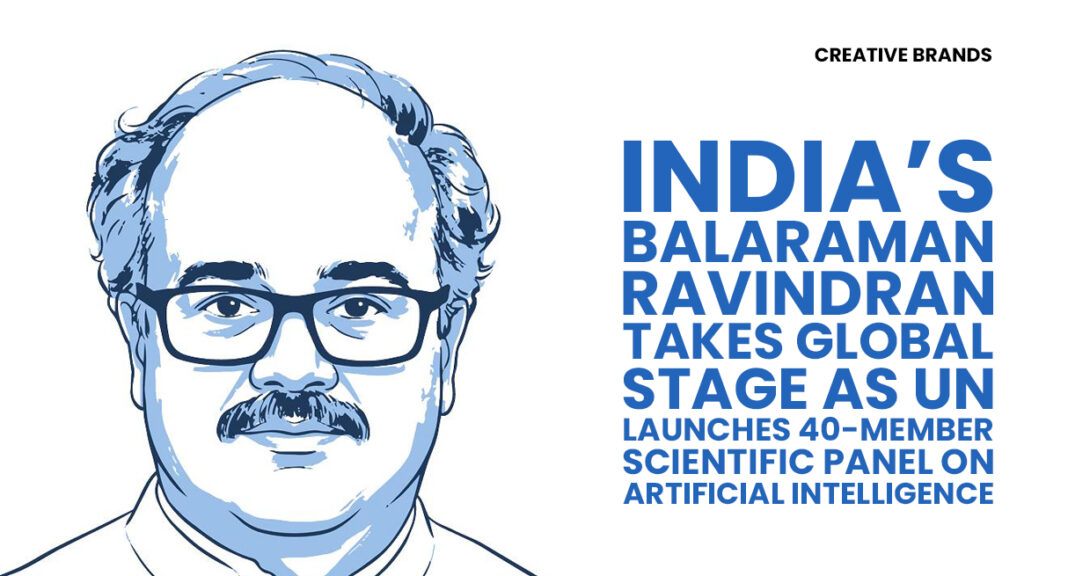
The United Nations has launched a 40-member Independent International Scientific Panel on AI, drawing experts from across the globe. Among them, Indian computer scientist Balaraman Ravindran stands out for his leadership in responsible AI. The panel aims to shape global governance, ethics and technical standards for artificial intelligence.
The United Nations has convened a 40-member Independent International Scientific Panel on Artificial Intelligence, assembling a rare concentration of technical brilliance, policy experience and ethical insight at a time when AI systems are rapidly reshaping economies, democracies and daily life. Drawn from all five of the UN’s regional groups, the panel reflects an explicit effort to ensure geographic balance and multidisciplinary depth in guiding the global conversation on AI governance.
From machine learning pioneers to digital health leaders, and from AI ethicists to infrastructure architects, the members span academia, government, civil society, the private sector and the technical community. Their collective mandate is ambitious: to provide authoritative scientific assessments of AI’s capabilities, risks and opportunities, and to inform international cooperation on its safe and equitable development.
At the heart of this new body is Balaraman Ravindran, one of India’s most respected AI researchers and a leading voice in responsible AI. Ravindran is the founding head of the Centre for Responsible AI (CeRAI) at the Indian Institute of Technology Madras, widely known as IIT Madras. With more than three decades of experience in artificial intelligence, his career traces the arc of the field itself—from early research in machine learning to the current era of deep reinforcement learning and AI governance.
Ravindran’s inclusion signals the growing prominence of India in global AI discourse. As the world’s most populous country and one of its fastest-growing digital economies, India has grappled with deploying AI at scale across diverse and complex social contexts. Ravindran’s work reflects that lived reality. At CeRAI, he has championed research that integrates technical innovation with societal safeguards—ensuring that systems built for healthcare, finance or public services are transparent, accountable and fair.
His research spans responsible AI frameworks and deep reinforcement learning, a branch of machine learning that allows systems to learn through interaction and feedback. But beyond academic publications, Ravindran has been a bridge-builder—connecting policymakers, industry leaders and civil society organisations in India to craft AI systems that are not only powerful but trustworthy.
Colleagues say his approach is emblematic of what the UN panel seeks to achieve globally: a synthesis of cutting-edge science with ethical foresight. “AI cannot be governed through fear or hype,” Ravindran has often argued in public forums. “It requires rigorous understanding and inclusive dialogue.” That philosophy will now inform deliberations at the highest multilateral level.
The panel’s composition underscores its international scope. Among its members is Adji Bousso Dieng, a Princeton professor leading research at the intersection of AI and the natural sciences; Aleksandra Korolova, who studies the societal impacts of AI; and Alvitta Ottley, a specialist in human-computer interaction and data visualisation.
From Europe, figures such as Anna Korhonen of Cambridge University bring expertise in human-inspired AI and sustainable development, while Bernhard Schölkopf, a pioneer in causal inference and co-founder of the Max Planck Institute for Intelligent Systems, adds foundational machine learning insight.
The panel also includes practitioners working at the interface of AI and public good. Bilal Mateen, Chief AI Officer at PATH, has overseen hundreds of millions of dollars in digital health initiatives worldwide. Girmaw Abebe Tadesse leads Microsoft’s AI for Good Lab in Kenya, co-developing solutions to global challenges with governments and nonprofits.
From Asia, Haitao Song contributes experience in bridging technical innovation and high-level policy-making, while Jian Wang, founder of Alibaba Cloud and director of Zhejiang Lab, brings infrastructure and industrial transformation expertise. Hoda Heidari, based at Carnegie Mellon University, focuses on machine learning and societal computing, particularly fairness and accountability.
Latin America and Africa are also represented by leading voices such as Carlos Coello Coello, known for his work in bio-inspired multi-objective optimization, and Awa Bousso Dramé, who advises governments on AI applications through her company CoastGIS.
Yet as diverse as the panel is, India’s representation through Ravindran carries particular weight in current geopolitical and technological dynamics. India has positioned itself as a champion of digital public infrastructure, advocating open and interoperable systems that can be scaled across developing nations. The country’s experience with biometric identity, digital payments and public data platforms provides real-world laboratories for AI deployment in complex democratic settings.
Ravindran’s long-standing engagement with policymakers in New Delhi and his advocacy for inclusive AI frameworks could influence how the UN panel frames questions of access and equity. Developing countries, he has noted in past lectures, cannot afford to be passive recipients of AI systems designed elsewhere. They must be co-creators, shaping standards and safeguards from the outset.
The establishment of the panel comes amid intensifying debates about frontier AI models, autonomous systems and generative technologies that can produce human-like text, images and code. Governments are struggling to keep pace with rapid technical advances. Some have introduced national AI strategies; others are experimenting with regulatory sandboxes. But global coordination remains fragmented.
By bringing together technical experts and policy thinkers under UN auspices, the Independent International Scientific Panel on AI aims to fill that gap. Its work is expected to feed into broader UN discussions on digital cooperation, sustainable development and human rights.
For India, participation in such a body marks a maturation of its AI ecosystem. Once primarily seen as a back-office technology hub, India now contributes original research and thought leadership on AI governance. Ravindran’s career mirrors that trajectory—rooted in technical excellence, but increasingly focused on societal impact.
Observers suggest that his experience leading a centre explicitly dedicated to responsible AI could help the panel navigate one of its thorniest challenges: reconciling innovation with precaution. Too little oversight, and societies risk harm from biased or unsafe systems. Too much rigidity, and innovation may stall, exacerbating global inequities.
In interviews and public talks, Ravindran has emphasised that responsible AI is not about slowing progress but about steering it wisely. That message may resonate strongly within a UN framework seeking consensus among nations with differing political systems and economic priorities.
As the panel begins its work, expectations are high. Its reports could shape international norms on AI safety, influence national regulatory approaches and guide investment in research and infrastructure. Whether addressing algorithmic bias, misinformation, automation’s impact on labour markets or the environmental costs of large-scale computing, the panel’s assessments will likely carry significant moral and scientific authority.
For Ravindran and his fellow members, the task is formidable. Artificial intelligence is evolving at a speed that challenges traditional policymaking cycles. Yet the formation of this panel signals recognition that global governance must be informed by rigorous science.
In that endeavour, India’s voice—articulated through Balaraman Ravindran’s decades of scholarship and advocacy—will play a central role in shaping how the world understands and steers one of the most transformative technologies of our time.
Discover more from Creative Brands
Subscribe to get the latest posts sent to your email.