


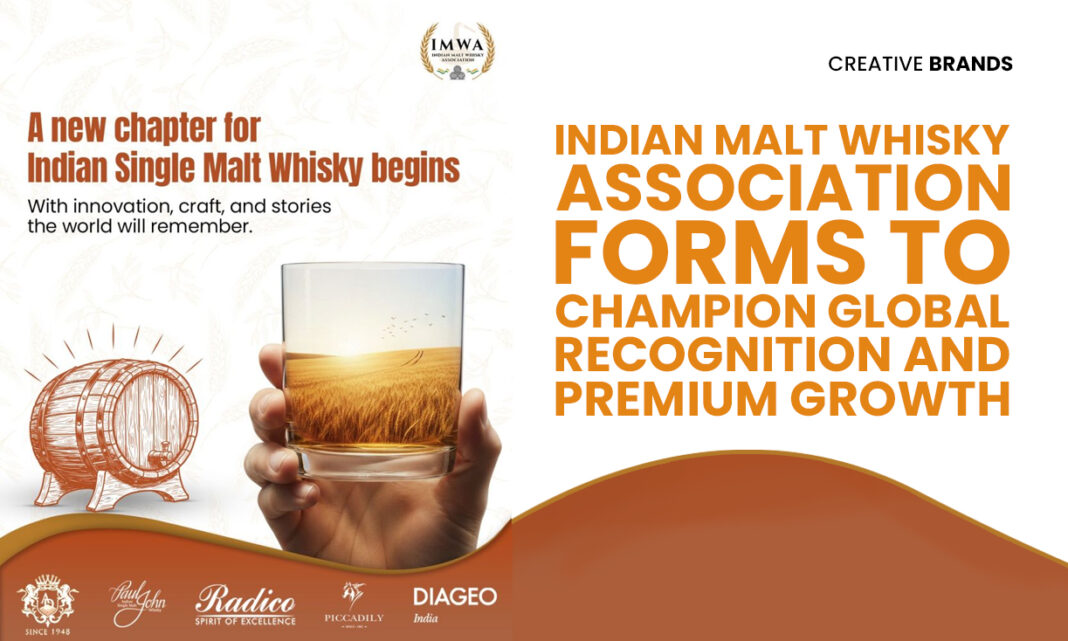
Founded in 2024 by leading producers including John Distilleries, Amrut, Radico Khaitan and Piccadily Agro, the Indian Malt Whisky Association aims to define and promote Indian malt whisky globally. Acting as a unified voice, it seeks regulatory clarity, premiumization and international respect for high-quality “Made in India” malts while driving sustainable industry growth.
The formation of the Indian Malt Whisky Association (IMWA) in 2024 marks a decisive moment for India’s rapidly ascending malt whisky sector, an industry that has evolved from a niche curiosity to one of the most closely watched players in global spirits. For decades, India was largely viewed as a vast consumption market for imported malts, while its own distillers worked quietly to refine technique, experiment with climate, and challenge preconceived notions of what world-class malt whisky could be. Today, the country’s leading malt whisky producers — including John Distilleries, Amrut Distilleries, Radico Khaitan and Piccadily Agro — stand together as members of IMWA, united not merely to champion category growth but to fundamentally redefine India’s place in the global whisky conversation. Their collaboration underscores a shared belief: that Indian malt whisky can no longer be confined to the margins of international recognition and must instead be acknowledged as one of the category’s most compelling contemporary chapters.
Indian malt whisky’s rise did not happen by accident. Over the past 15 years, a new generation of distillers began performing on the world stage, winning awards, impressing whisky critics and gaining visibility among discerning consumers from London to Tokyo. International judges praised the complexity found in India’s fast-ageing whiskies, a result of the country’s uniquely warm maturation climate. Others celebrated the craft techniques, barley selection and cask management that rivalled storied Scottish and Japanese practices. Yet despite this progress, Indian producers lacked a unified platform. Regulatory fragmentation persisted between states, misunderstanding about definitions of malt persisted in trade discussions, and the category was occasionally overshadowed by broader narratives about Indian alcohol imports and exports. The creation of IMWA attempts to solve these problems by establishing a single authoritative body capable of advocacy, standard-setting and global brand building on behalf of the malt whisky industry as a whole.
According to IMWA, the association’s core intent is to be the unified voice of Indian malt producers, ensuring that domestic whiskies command respect internationally as high-quality, authentic malts. The focus on authenticity speaks to a broader shift in consumer expectation within the premium spirits world, where provenance, production integrity and craft have become essential markers of quality. The association recognises that for Indian producers to secure durable recognition in export markets, the category must be well defined at home. Establishing technical standards for what constitutes “Indian malt whisky,” introducing certification mechanisms, and engaging directly with policymakers will not simply protect producers — it will set the foundation for future premiumization, pricing power, and market expansion.
In policy terms, IMWA’s role is both protective and aspirational. On one hand, the association seeks to ensure the category is not misrepresented domestically or abroad; on the other, it aims to promote growth through education, diplomacy and regulatory alignment. Members believe that by working closely with government, trade bodies and opinion leaders, IMWA can shape an environment that supports long-term investment, innovation and global competitiveness. This includes advocating for reasonable and implementable legislation, tax structures that do not discourage premiumization, and standards that enhance credibility in export markets. Such collaboration could strengthen India’s hand in international trade negotiations where definitions, geographical indications, labelling norms and product categories are routinely debated.
Beyond economics and regulation, IMWA’s formation carries cultural significance. The association’s vision frames Indian malt whisky as a luxury product anchored in craftsmanship and heritage — qualities that resonate deeply in global markets where consumers have shown an appetite for products that combine authenticity with storytelling. India is already globally recognised for its artisanal traditions, from textiles and jewellery to culinary craft. IMWA argues that malt whisky deserves similar recognition, not merely as an industrial output but as a cultural expression shaped by climate, geography and technique. By highlighting India’s malting traditions, ageing environments, barley heritage and blending philosophies, the industry aims to position Indian malt whisky as a world-class symbol of the country’s contemporary luxury landscape.
One of the association’s most ambitious pillars is its mission to champion “Made in India” brands within a category historically dominated by Scottish, Irish, Japanese and more recently Taiwanese producers. The arrival of Indian malts on international shelves over the past decade has challenged consumer assumptions and introduced a new terroir to whisky discourse. IMWA seeks to build on this curiosity by nurturing an ecosystem that is not only commercially viable but globally competitive. Its mission emphasises producing high-quality malts capable of standing peer-to-peer with international benchmarks, while simultaneously fostering domestic pride and awareness.
The economic stakes are significant. The current members of IMWA already generate a substantial portion of the revenue derived from malt whisky production in India, and the industry’s future growth trajectory suggests expanding output, higher export volumes, and greater premiumization. Premium spirits categories globally have outperformed value segments for several years, buoyed by affluent consumers who prioritise craft, origin and limited editions. Indian malts — with their rapid ageing cycles, experimental cask finishes and distinctive flavour profiles — are well-positioned to capture this segment if supported by coherent branding and regulatory clarity. The association’s efforts to align the industry on standards and best practices could therefore translate directly into export competitiveness and revenue generation.
The timing of IMWA’s establishment coincides with India’s broader push to elevate value-added exports and build internationally respected consumer brands. While the country has long been recognised as a major spirits consumption market, its next ambition is to become a spirits-producing powerhouse. Whisky is arguably the most logical category through which to assert this ambition. India is already the world’s largest whisky-consuming nation by volume, but until recently most production was oriented toward domestic mass-market blends. The pivot toward single malts and premium expressions reflects both rising local affluence and the industry’s confidence in its own craftsmanship. The association’s founders believe that through unified voice, technical clarity and global advocacy, Indian malt whisky can evolve into one of the country’s most successful export-led luxury categories.
The long-term vision extends beyond commerce. IMWA’s mandate includes preserving heritage, supporting sustainable growth and contributing responsibly to the economy and society. Members acknowledge that maintaining category credibility requires transparent production norms, responsible marketing and alignment with international expectations around labelling, sustainability and consumer awareness. As climate, agriculture and land use become central to global spirits discussions, the Indian malt industry sees advantage in organising itself early to adopt best practices and influence future frameworks.
If successful, IMWA’s strategy could also reshape how global consumers perceive Indian-made goods. For decades, Indian exports were mainly associated with software services, pharmaceuticals and industrial commodities. Luxury consumer products were rarely part of the narrative. By treating malt whisky as a symbol of premium craftsmanship, IMWA taps into a new vision of India — one that embraces luxury, heritage and modernity simultaneously. It is a vision in which India is not only a consumer of global culture but an exporter of it.
In its founding year, IMWA stands at the beginning of what its members hope will be a multi-decade transformation. The challenges ahead — from navigating regulatory complexity to building a shared identity among diverse producers — are not insignificant. Yet the association’s existence signals a new maturity in the Indian malt space. What once appeared as scattered individual success stories may soon cohere into a national category with unified standards, consistent messaging and global ambition. For whisky enthusiasts worldwide, it represents the opening of a new chapter. For India’s spirits industry, it is the declaration of a long overdue intention: to claim its place on the world’s top shelves, not as an outlier but as a peer.
Discover more from Creative Brands
Subscribe to get the latest posts sent to your email.