


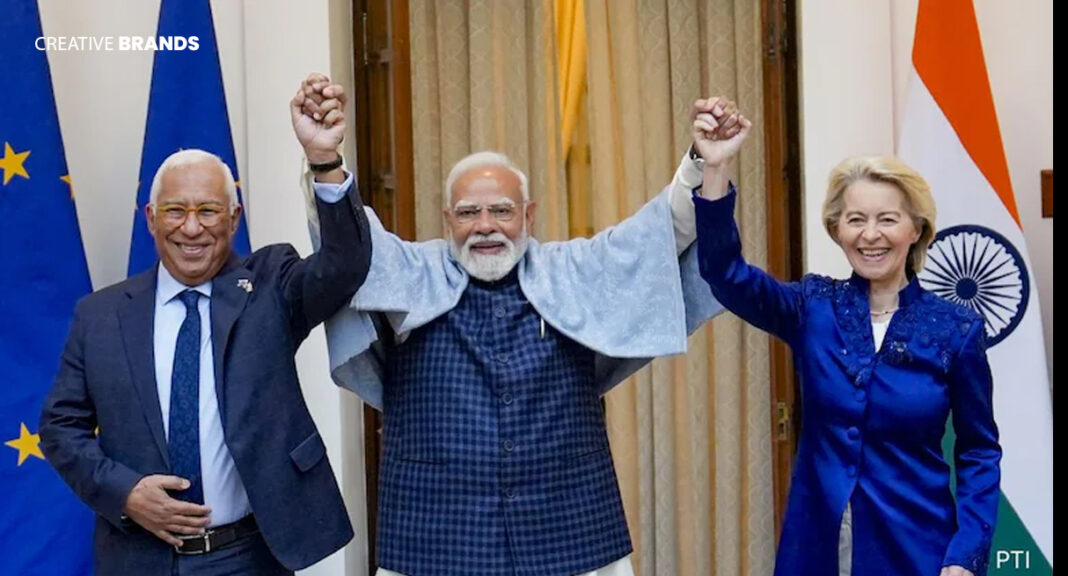
India and the European Union have signed what negotiators are calling the “mother of all” trade agreements, slashing tariffs and opening preferential access across nearly all traded goods. The pact creates an integrated market of roughly two billion people and a quarter of global GDP — a move that has drawn pointed attention from Washington.
The signing of the India-EU free trade agreement marks one of the most consequential global economic alignments in recent memory — sweeping in scope, geopolitical significance, and market potential. For years, trade negotiators in Brussels and New Delhi had described the talks as complex, occasionally unwieldy, and politically sensitive. Few had expected them to culminate so decisively. Yet on Tuesday, Prime Minister Narendra Modi confirmed that the two sides had finally inked the deal. Within hours, analysts were debating whether Washington’s apparent discomfort signalled the beginning of a new era in multipolar trade diplomacy.
The pact itself is ambitious in both scale and impact. It slashes tariffs on almost 97 per cent of European Union exports entering India, covering goods ranging from automobiles and industrial machinery to pharmaceuticals and luxury products. In return, Indian exporters will receive preferential access to 97 per cent of tariff lines in the EU market, covering an overwhelming 99.5 per cent of the trade value. For Indian manufacturers — especially those in textiles, food processing, engineering goods, and chemicals — the agreement promises to remove barriers that have long hindered entry into Europe’s lucrative consumer and industrial economy.
Negotiators on both sides are publicly celebrating the commercial and strategic magnitude of the outcome. Calling it the “mother of all agreements,” officials have been quick to point out its vast demographic and economic footprint. The integrated market created by the trade deal accounts for roughly two billion people, combining the scale of India’s growing consumer base with the EU’s affluent markets. Economists estimate that together the two would represent close to a quarter of global GDP. For India, the FTA advances its ongoing bid to reposition itself as a global manufacturing hub at a moment when multinationals are actively seeking alternatives to China. For Europe, it provides a crucial link to the fastest-growing major economy in the world at a time when internal sluggishness and external shocks have weighed down growth prospects.
Images released on the day of the announcement captured European Council President Antonio Costa, European Commission President Ursula von der Leyen, and Prime Minister Modi in a symbolic tableau of shared strategic intent. The composition was notable not just for who appeared on the podium but also for who loomed in the global backdrop. Washington took unusually visible notice. The day before Modi’s confirmation, US treasury secretary Scott Bessent had doubled down on allegations that India’s discounted oil trade with Russia was effectively subsidising Moscow’s war effort in Ukraine — a position that has been at odds with India’s articulation of energy security and non-alignment.
The timing of Bessent’s remarks did not go unnoticed in diplomatic circles, generating speculation that Washington was attempting to pre-emptively frame the narrative around India’s expanding role in global trade. For US strategists, the India-EU rapprochement is doubly significant: not only does it strengthen one of America’s closest European alliances, it also advances India’s trade diversification in a way that could reduce its future reliance on US markets and institutions. In effect, the deal signals that the global trade architecture is no longer being shaped exclusively in Washington and Beijing — Brussels and New Delhi have now inserted themselves into the center of that conversation.
European analysts have described the accord as a “geoeconomic victory,” particularly in light of Europe’s ongoing energy dependence, China-related supply chain recalibration, and relative stagnation in transatlantic trade talks. For India, the tone has been one of cautious confidence. Officials in New Delhi emphasise that the FTA aligns with the country’s long-term export strategy, industrial policy, and infrastructure investments — including the Production-Linked Incentive (PLI) schemes designed to accelerate manufacturing capacity in electronics, autos, textiles, and renewables. While India walked away from the China-led RCEP (Regional Comprehensive Economic Partnership) in 2019 over concerns about domestic industrial pressure, the EU deal is seen as more balanced and mutually reinforcing.
The economic stakes are matched by political optics. India has been steadily expanding its bilateral and multilateral trade footprint, signing FTAs with Australia, the UAE, and several smaller economies in the past five years. The EU agreement, however, elevates that strategy into an entirely different orbit. For Brussels, it marks the most significant free trade achievement since the Japan-EU Economic Partnership Agreement, reinforcing Europe’s narrative that rules-based trade can still thrive despite protectionist pressures elsewhere.
Critics in both regions have raised questions about the distribution of benefits. European farmer groups, for instance, have historically been wary of agricultural imports from large producers, while Indian MSME associations worry about industrial competition from highly capitalised European firms. Yet most trade economists argue that the negotiated tariff lines, safeguard mechanisms, and gradual phase-outs suggest a balanced compromise rather than an ideological leap. Moreover, services — India’s most competitive domain — are expected to be addressed in follow-on frameworks covering mobility, digital standards, and regulatory cooperation.
The geopolitical layer is impossible to ignore. Over the past decade, the United States has been the undisputed gravitational center for global trade alliances, even as it retreated from multilateral agreements like the Trans-Pacific Partnership. The India-EU deal complicates that landscape by creating a platform that does not require US participation to exert influence. It also opens the door for potential trilateral cooperation in areas where interests align, such as semiconductor supply chains and clean energy investment, while highlighting diverging priorities in energy security and sanctions regimes.
India, for its part, has shown little inclination to mediate its trade policy through competing pressure systems. In forums such as the G20, Prime Minister Modi has consistently articulated a posture of strategic autonomy, one that allows engagement with Western security blocs without committing to their economic or geopolitical alignments. The EU deal reinforces that positioning, offering India a way to deepen relations with Europe without being seen as a proxy for American or Chinese strategic objectives.
As the fine print of the agreement is gradually made public and implementation mechanisms get underway, the focus will shift to business adaptation and sectoral impact. Automotive majors, pharmaceutical players, luxury brands, renewable infrastructure firms, and high-tech exporters in Europe are already seen as primary beneficiaries of Indian tariff reductions. Conversely, Indian exporters in textiles, engineering goods, agrifood, and IT-enabled services are expected to chase long-blocked opportunities in the EU’s high-value markets.
Washington’s response — whether rhetorical, diplomatic, or economic — will be closely studied in the weeks ahead. While the United States remains India’s largest trading partner and a critical geopolitical partner, the India-EU deal underscores that the future of global trade is increasingly multipolar, diversified, and strategically negotiable rather than neatly bloc-aligned. Far from merely stimulating commerce, the agreement may end up shaping the grammar of how nations conduct trade in a world where economic influence no longer maps cleanly onto military or ideological alliances.
For now, negotiators are basking in the glow of a deal that few believed would arrive so smoothly — or with such global resonance. The “mother of all agreements” has not only rewritten tariff schedules and market access formulas; it has forced the world to pay attention to a new axis of trade power that runs through New Delhi and Brussels, compelling even Washington to watch, assess, and perhaps recalibrate for what comes next.
Discover more from Creative Brands
Subscribe to get the latest posts sent to your email.