


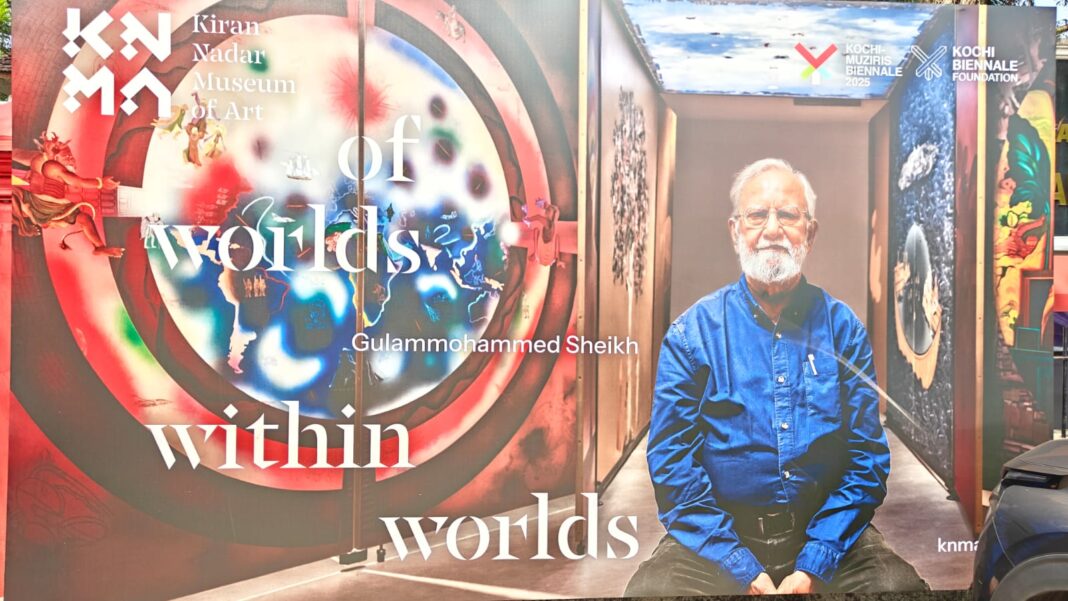
Presented by the Kiran Nadar Museum of Art at the Kochi-Muziris Biennale, Of Worlds Within Worlds is a major retrospective of Gulammohammed Sheikh. Curated by Roobina Karode, the exhibition traces six decades of the artist’s richly layered narratives blending memory, history, culture, and humanist reflection.
At Durbar Hall Art Gallery in Kochi, visitors stepping into “Of Worlds Within Worlds” find themselves entering not just an exhibition, but an intricate constellation of memories, histories, and imaginations that have shaped the artistic journey of Gulammohammed Sheikh for over six decades. Presented by the Kiran Nadar Museum of Art as part of the sixth Kochi-Muziris Biennale and curated by Roobina Karode, the retrospective brings to the coastal city an expansive survey of one of India’s most influential modern artists, whose work has consistently resisted linear narratives and singular truths.
The exhibition’s title serves as both an invitation and a key. Gulammohammed Sheikh has long challenged the notion that art must inhabit one world, one time, or one cultural frame. Instead, his practice has unfolded as a series of overlapping universes—personal and political, historical and mythical, local and global. Across paintings, drawings, texts, and visual narratives, Sheikh has persistently layered stories within stories, creating pictorial spaces that seem to breathe, expand, and fold back into themselves. At Kochi, this layered vision finds renewed resonance within the Biennale’s broader engagement with histories of exchange, migration, and cultural crossings.
Sheikh’s early fascination with writing and drawing lies at the heart of this retrospective. As a young student, he found himself equally drawn to the tactile act of mark-making and the lyrical possibilities of language. This dual preoccupation would later define him not only as a painter, but also as a poet, translator, and pedagogue. Emerging in postcolonial India, Sheikh became a formative voice in shaping how art could engage critically with tradition while remaining open to global influences. His work refuses to be confined to one discipline or medium, mirroring his belief that human experience itself is composed of multiple, interwoven realities.
The roots of Sheikh’s imagination are firmly anchored in Wadhwan, the town in Gujarat’s Saurashtra region where he spent his childhood and formative years. The exhibition revisits this early geography as a crucible of memory, where sacred and everyday spaces coexisted in quiet harmony. His visits to the Ranakdevi Temple, the Madha Vav step-well, and the dargah of Geban Shah Pir introduced him to a lived syncretism that left an indelible imprint on his sensibility. These sites, representing Hindu, architectural, and Islamic traditions, were not isolated monuments but integral parts of a shared social fabric. In Sheikh’s art, this pluralism resurfaces as a deeply felt ethos rather than a political slogan, embedded in the way figures, symbols, and architectural forms converse across cultural boundaries.
Living in India, Sheikh has often observed, is to live in many times at once. This awareness permeates his pictorial worlds, where ancient myths coexist with contemporary anxieties, and historical figures appear alongside ordinary townspeople. His paintings frequently evoke the banyan tree canopies, bustling marketplaces, and narrow by-lanes of Indian towns—spaces where life spills into the street and conversations unfold without urgency. Baroda, where Sheikh has lived since his student days at the Faculty of Fine Arts at Maharaja Sayajirao University, emerges as another key locus in his visual vocabulary. The city’s rhythms, its layered histories, and its intellectual climate nurtured his evolving practice and provided fertile ground for experimentation.
Over the years, Sheikh developed a multi-dimensional approach to art-making that draws from diverse traditions of space-making and storytelling. His works often resemble visual palimpsests, where different spatial systems intersect and challenge one another. Elements of Rajasthani miniature painting, with their intense colours and narrative density, merge seamlessly with Italian Renaissance perspectives. Persian cloud formations drift across Mughal-inspired seas, while architectural fragments suggest cities that are both real and imagined. The pictorial surface becomes a site of negotiation, where disparate visual languages are not merely juxtaposed but allowed to transform one another.
Populating these worlds is an eclectic cast of figures that speaks to Sheikh’s expansive humanism. Faqirs and Zen masters share space with lovers, angels, and monsters, their presence suggesting both spiritual yearning and existential unease. These figures are not fixed symbols but evolving presences, shaped by the contexts in which they appear. By restructuring memory and borrowing from art history, literature, and lived experience, Sheikh condenses layers of meaning into compositions that reward slow looking and contemplation.
Central to this retrospective is Sheikh’s enduring engagement with ethical and philosophical questions. Seeking the essence of humanity across civilizations and cultures, he repeatedly returns to figures whose lives and teachings embody compassion, resistance, and introspection. Gandhi appears not as a monumental icon but as a fragile, reflective presence, vulnerable yet resolute. Kabir’s verses echo through visual metaphors that challenge dogma and affirm lived spirituality. Saint Francis, Mirabai, and Mary Magdalene emerge as figures of devotion and dissent, their stories reanimated in contexts marked by violence, intolerance, and fragmentation. Through these recurring presences, Sheikh amplifies the relevance of historical voices in addressing the moral crises of the present.
Formally, Sheikh’s use of scale, colour, and detail heightens the emotional charge of his narratives. Figures may appear disproportionately large or startlingly small, disrupting conventional hierarchies and inviting viewers to reconsider their own points of reference. Radiating colour tones draw attention to specific moments within a composition, while meticulously rendered details act as visual quotations that reward close scrutiny. Each borrowed image or motif is carefully reworked, stripped of nostalgia, and reinserted into a contemporary frame of meaning. In doing so, Sheikh resists the temptation of mere pastiche, instead forging a living dialogue with history.
The exhibition also underscores Sheikh’s role as a storyteller whose narratives are never fully resolved. His paintings often lead viewers into a moment of recognition—an image, a figure, or a memory that feels familiar—only to unsettle them with unexpected juxtapositions or ambiguities. This oscillation between clarity and uncertainty reflects the artist’s belief that art should not offer easy answers. Rather, it should provoke questions about the worlds we inhabit, the worlds we carry within ourselves, and the worlds we are in the process of creating.
Curated with sensitivity and depth by Roobina Karode, “Of Worlds Within Worlds” traces the arc of Sheikh’s six-decade career while allowing each work to retain its autonomy. The retrospective does not impose a linear chronology but instead mirrors the artist’s own non-linear approach to time and memory. Viewers move through clusters of works that resonate thematically and visually, experiencing shifts in mood and perspective that echo the rhythms of Sheikh’s practice. Karode’s curatorial vision foregrounds the continuity of Sheikh’s concerns even as his formal strategies evolve, revealing an artist who has remained intellectually restless and ethically engaged throughout his career.
The presentation of the exhibition in Kochi, following its retrospective showing in Delhi at the Kiran Nadar Museum of Art, carries particular significance. Kochi’s own history as a port city shaped by centuries of trade and cultural exchange provides a compelling backdrop for Sheikh’s layered narratives. Within the context of the Kochi-Muziris Biennale, the exhibition enters into a broader conversation about global interconnectedness, displacement, and the enduring impact of history on contemporary life. The Durbar Hall Art Gallery, with its colonial-era architecture, becomes another layer in this dialogue, framing Sheikh’s works within a space that itself embodies complex histories.
As visitors navigate the exhibition, they encounter not a definitive account of Gulammohammed Sheikh’s career but an invitation to wander through his worlds. The experience is immersive yet demanding, asking viewers to slow down and engage with the density of images and ideas on display. In an era marked by speed and distraction, Sheikh’s art insists on attentiveness, offering instead a space for reflection and introspection.
Ultimately, “Of Worlds Within Worlds” affirms Gulammohammed Sheikh’s position as an artist whose work transcends boundaries of medium, culture, and time. His poetics draw us into moments of recognition while leaving us with unresolved questions—about coexistence, memory, and the ethical responsibilities of art. In Kochi, these questions resonate with particular urgency, reminding us that the worlds we inherit are never singular, and the worlds we imagine are always shaped by the layers we choose to acknowledge.
Discover more from Creative Brands
Subscribe to get the latest posts sent to your email.