


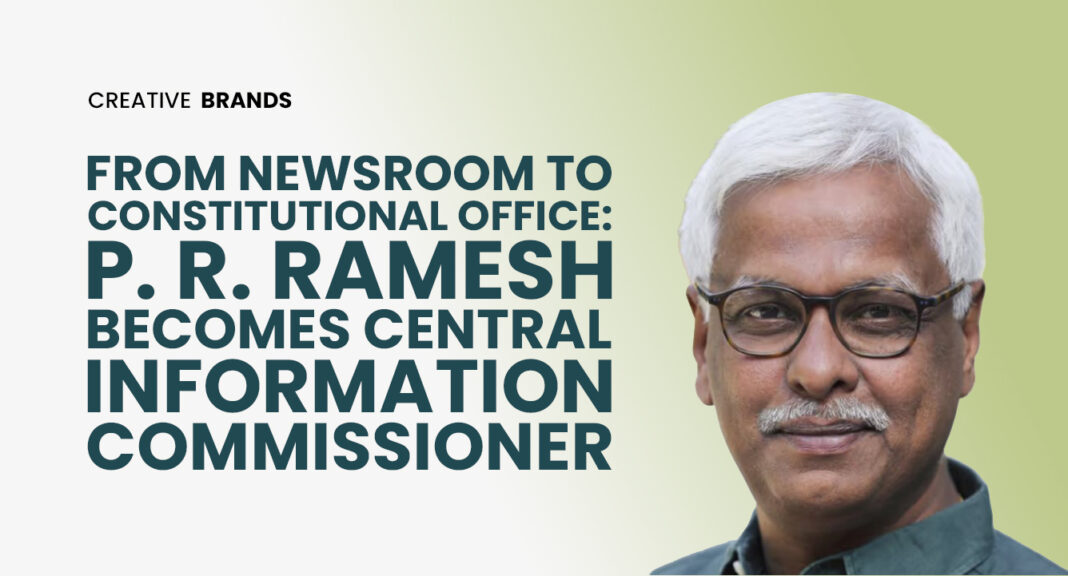
Senior journalist and Open Managing Editor P. R. Ramesh has been appointed Central Information Commissioner, becoming the first Malayali to hold the post. With decades of political reporting experience, his appointment is seen as a boost to transparency, accountability, and the spirit of India’s Right to Information framework.
The appointment of P. R. Ramesh as a Central Information Commissioner marks a significant moment in India’s democratic and media history. For the first time, a Malayali has been elevated to this constitutional position, one that sits at the intersection of transparency, accountability, and citizens’ rights. Beyond the regional milestone, the appointment carries wider implications: a senior journalist, shaped by decades of questioning power, now assumes responsibility within an institution designed to hold power to account.
Ramesh’s journey to the Central Information Commission is rooted firmly in journalism. Until his appointment, he served as the Managing Editor of Open magazine, where he built a reputation for rigorous political reporting and sharp editorial judgment. Over the years, his work reflected a deep engagement with the workings of government, policy, and power—often interrogating the very systems he is now entrusted to oversee in a quasi-judicial role. This transition from newsroom to constitutional office underscores a rare crossover between the fourth pillar of democracy and one of its most vital statutory guardians.
Born into the Puthoor family of Mannankarachira in Thiruvalla, Kerala, Ramesh’s early life was shaped by a milieu that valued education, debate, and public life. That grounding in Kerala’s socially and politically conscious environment is often cited by peers as formative to his worldview. While his professional life unfolded largely in Delhi’s national media ecosystem, his roots remained an integral part of his identity, informing his sensitivity to grassroots concerns and the lived realities of ordinary citizens.
Professionally, Ramesh has held some of the most influential editorial roles in Indian journalism. His tenure as National Political Editor at The Economic Times placed him at the heart of policy reportage, where he closely tracked Parliament, political parties, and the corridors of power. He later brought that experience to Open, shaping its political coverage with an emphasis on context, institutional memory, and accountability. His reporting and editorial leadership earned him several accolades, including the prestigious Prem Bhatia Award and the Red Ink Award, both recognising excellence, courage, and integrity in journalism.
These credentials take on particular significance in the context of the Central Information Commission. Established under the Right to Information Act, the Commission plays a crucial role in safeguarding citizens’ right to access information from public authorities. Over the years, the RTI Act has empowered millions, enabling journalists, activists, and ordinary citizens to seek transparency in governance. At the same time, the institution has faced criticism—ranging from delays in hearings to concerns about weakening autonomy. Against this backdrop, the induction of a commissioner with a lifelong engagement with transparency and public interest has been widely welcomed.
Ramesh’s career as a journalist was defined by his pursuit of information—often from reluctant institutions—and his insistence on asking difficult questions. That experience offers him a unique vantage point as a commissioner. Unlike career bureaucrats or legal professionals who traditionally dominate such bodies, he brings an insider’s understanding of how information is sought, denied, delayed, or diluted. Observers believe this perspective could influence a more citizen-centric interpretation of the law, reinforcing the spirit rather than merely the letter of the RTI Act.
The symbolism of his appointment resonates strongly in Kerala, a state long associated with high literacy, political engagement, and a vibrant press culture. Ramesh becoming the first Malayali Central Information Commissioner is widely seen as recognition of that tradition. Yet, the role he assumes is resolutely national in character. As a commissioner, he will adjudicate appeals and complaints from across the country, navigating complex legal, administrative, and ethical questions that affect governance at every level.
On a personal level, Ramesh’s life remains closely intertwined with journalism. He is married to Bharathi Jain, a senior editor at The Times of India. Together, they represent a partnership deeply embedded in the media landscape, shaped by shared professional values and an understanding of journalism’s public responsibility. Colleagues often note that this intellectual companionship has contributed to Ramesh’s nuanced perspectives on media, power, and democracy.
The move from journalism to a constitutional position also raises broader questions about the evolving relationship between media and institutions. In a time when trust in both journalism and public bodies is under strain, such crossovers can serve as bridges—bringing institutional understanding to journalism and journalistic ethics to governance. Ramesh’s appointment is being read by many as a signal that experience in questioning authority can be an asset, rather than a liability, within statutory frameworks.
As he takes on his new responsibilities, expectations are inevitably high. The Central Information Commission is often described as a sentinel of democracy, ensuring that the promise of transparency does not erode under bureaucratic inertia or political pressure. Ramesh’s professional record suggests a temperament inclined toward independence and clarity—qualities essential for maintaining the credibility of the institution. His challenge will lie in balancing procedural fairness with the moral urgency that has long animated the RTI movement.
Ultimately, P. R. Ramesh’s appointment is more than a personal milestone or a regional first. It reflects a broader narrative about the value of independent thought, institutional memory, and public service in sustaining democratic norms. As a journalist-turned-commissioner, he embodies a continuum between questioning power and upholding the mechanisms that allow such questioning to exist. In an era where transparency is both demanded and resisted, his presence in the Central Information Commission carries the promise of renewed faith in the idea that information, when made accessible, remains one of democracy’s most powerful tools.
Discover more from Creative Brands
Subscribe to get the latest posts sent to your email.