


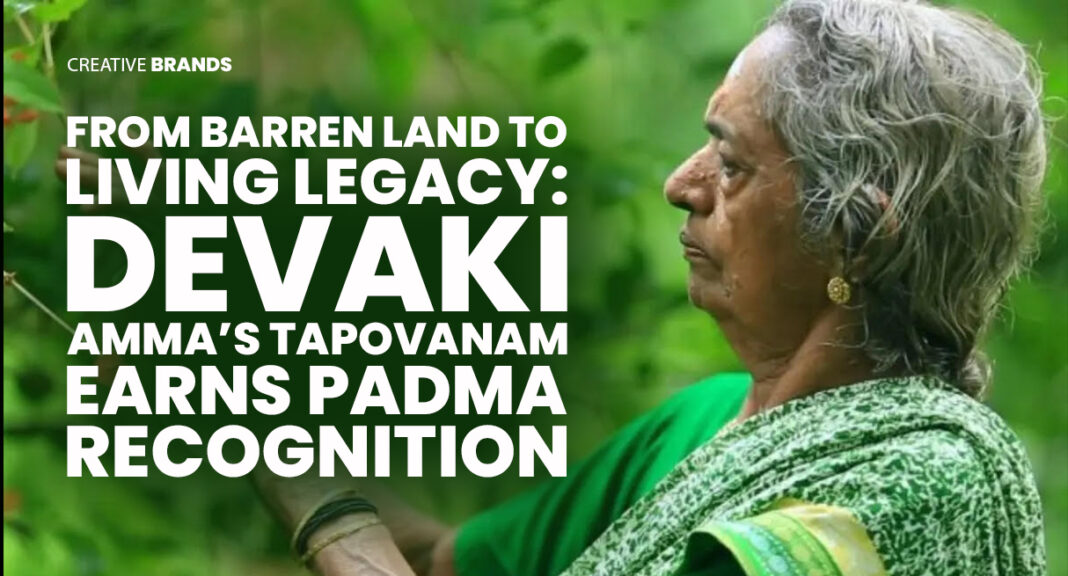
At 92, Devaki Amma of Alappuzha, Kerala, has been honoured in the Padma Awards 2026 for her extraordinary environmental contribution. Over four decades, she transformed five acres of barren land into Tapovanam, a self-sustaining forest teeming with trees, medicinal plants, birds, fish, and insects, inspiring generations with her quiet perseverance.
When the Padma Awards list for 2026 was announced, one of the names that immediately drew attention was that of Devaki Amma from Alappuzha in Kerala. At 92, she is not a public figure, nor a scientist, nor a politician. She is a woman who spent more than four decades of her life quietly nurturing a forest, one sapling at a time, on a barren plot of land at her ancestral Kollaykkal home. Her creation, Tapovanam, is now a thriving ecosystem that stands as a rare example of human dedication to nature, and her recognition in the Padma Awards is a testament to the power of individual commitment to environmental conservation.
The story of Tapovanam begins in the late 1970s, when Devaki Amma inherited a five-acre plot of land that was barren and unyielding. The soil was sandy, the climate unforgiving, and the surroundings dominated by backwaters and paddy fields. Most would have considered the land unsuitable for anything beyond subsistence farming. But Amma saw possibility where others saw futility. With no formal training in forestry or ecology, she began planting saplings, one after another, with her own hands. There was no grand plan, no blueprint, only a deep instinct to heal the land and a belief that nature, if given care, would respond.
Over the years, her daily routine became inseparable from the rhythm of the forest. She watered, mulched, and protected each sapling, often battling the elements and the skepticism of neighbours who wondered why she was investing so much effort in what seemed like an impossible task. Slowly, the barren land began to change. Saplings grew into trees, shade returned to the soil, and the first signs of life—birds, insects, and small animals—began to appear. What started as a solitary act of planting became a lifelong mission, and Tapovanam took root not just in the soil but in the imagination of those who witnessed its transformation.
Today, Tapovanam is a dense, self-sustaining forest. It is home to a wide variety of trees, including fruit-bearing species, medicinal plants, and native flora that have become increasingly rare in the region. The forest supports a vibrant ecosystem of birds, fish, and insects, creating a balance that is both delicate and resilient. Streams run through the land, replenished by the natural cycles of the forest, and the air is filled with the sounds of life. For visitors, Tapovanam is not just a forest but a living classroom, a reminder of what patience and perseverance can achieve.
What makes Devaki Amma’s achievement remarkable is not just the scale of her work but the context in which it was done. Kerala is known for its lush landscapes, but the region where Tapovanam stands is dominated by backwaters and paddy fields. Forests are rare, and the sandy soil is not conducive to dense vegetation. To create a thriving forest in such conditions required not just effort but vision. Amma’s work challenges conventional notions of land use and demonstrates that even the most unpromising terrain can be transformed into a sanctuary of biodiversity.
Her recognition in the Padma Awards is significant for another reason: it highlights the role of individuals in environmental conservation. In an era when climate change and deforestation dominate headlines, solutions are often framed in terms of large-scale policies, technological innovations, or global agreements. Amma’s story reminds us that conservation can also be deeply personal, rooted in the choices of individuals who decide to care for their immediate environment. Her forest is not the result of government schemes or corporate initiatives; it is the outcome of one woman’s unwavering commitment to nature.
The impact of Tapovanam extends beyond its ecological value. For the local community, it has become a source of inspiration and pride. Children visit the forest to learn about trees and birds, researchers study its unique ecosystem, and visitors leave with a renewed sense of connection to nature. Amma herself has become a symbol of resilience and humility. Despite her age, she continues to spend time in the forest, tending to plants and observing the cycles of growth. Her life is a quiet counterpoint to the fast-paced world outside, a reminder that true change often happens slowly, through consistent effort.
The recognition of Amma’s work also raises important questions about how society values environmental contributions. Too often, conservation is measured in terms of economic benefits or scientific breakthroughs. Amma’s forest offers something different: a moral lesson about the relationship between humans and nature. It shows that conservation is not just about preserving resources but about cultivating respect, patience, and responsibility. In honouring her, the Padma Awards committee has acknowledged that environmental stewardship is as worthy of recognition as achievements in science, arts, or public service.
For Amma, however, the award is not the culmination of her journey but a continuation. She has often said that she did not set out to win recognition; her only goal was to heal the land and create a space where life could flourish. The forest, in her view, is not hers alone but belongs to the generations that will come after her. Tapovanam is her gift to the future, a living legacy that will outlast her lifetime.
As India grapples with the challenges of climate change, deforestation, and urban expansion, stories like Amma’s offer hope. They remind us that solutions do not always require grand gestures or massive resources. Sometimes, they begin with a single sapling, planted with care and nurtured with patience. Tapovanam is proof that even one person, working quietly and persistently, can create a forest that sustains life and inspires others.
In the years to come, Tapovanam will continue to grow, adapting to the changing climate and supporting new forms of life. Amma may no longer be able to plant saplings with the same energy she once had, but her spirit lives on in every tree, every bird, and every stream in the forest. Her recognition in the Padma Awards ensures that her story will be remembered, not just in Kerala but across India, as an example of what dedication to nature can achieve.
The forest stands today as a sanctuary, a testament, and a challenge. It asks us to reconsider our relationship with the land, to see possibilities where we see limitations, and to act with patience in a world that often demands quick results. Above all, it reminds us that conservation is not an abstract concept but a lived practice, embodied in the choices of individuals like Devaki Amma.
In celebrating her, we celebrate the idea that the future of our planet depends not only on policies and technologies but also on the quiet, persistent efforts of people who choose to care. Tapovanam is more than a forest; it is a vision of what is possible when human will aligns with the rhythms of nature. And in honouring Amma, the nation has acknowledged that such visions are worth cherishing, protecting, and emulating.
Discover more from Creative Brands
Subscribe to get the latest posts sent to your email.