


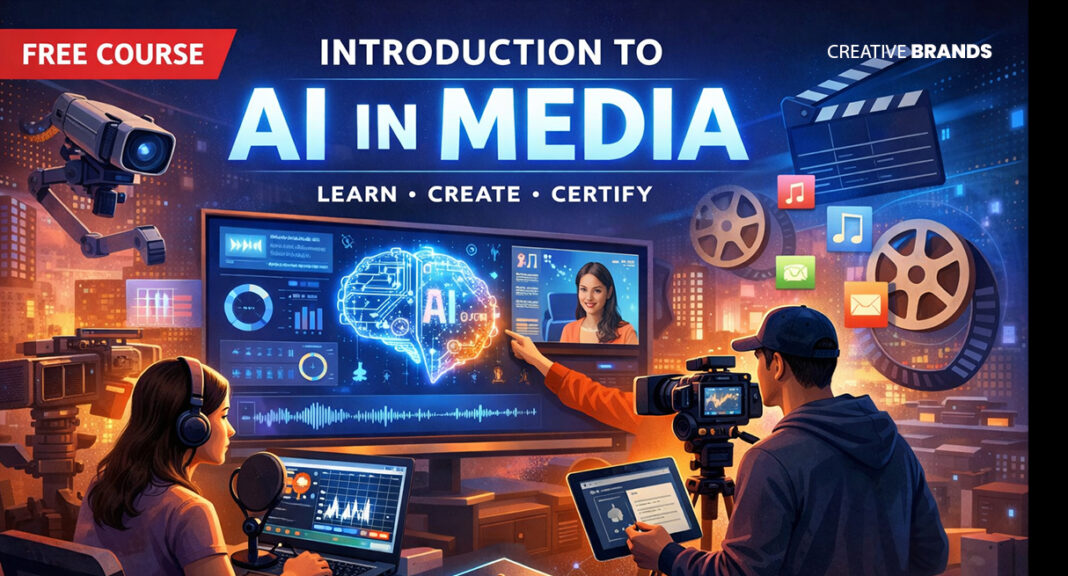
The global media industry is in the midst of one of its most transformative phases. Artificial intelligence, once considered a futuristic novelty, has become a mainstream ingredient shaping nearly every aspect of modern storytelling — from scriptwriting and production assistance to automated editing, personalised content delivery and real-time analytics. Against this rapidly evolving backdrop, the School of Executive Education has introduced a new and timely learning opportunity: a free online course titled Introduction to AI in Media, designed to help both aspiring and established creative professionals understand the technology that is swiftly redefining their craft.
In a landscape where media houses are experimenting with AI-generated news articles, film studios are incorporating predictive algorithms to optimise audience reception, and digital marketing teams are turning to machine intelligence for campaign performance, the demand for structured and accessible learning resources has been steadily rising. Yet, as with most emerging technologies, the barriers to entry have often been high — not merely financially, but also conceptually. Many professionals, especially those grounded in traditional media roles, have found the AI revolution exciting but intimidating. The new course attempts to address this gap by offering a beginner-friendly curriculum delivered entirely online and free of cost, opening the doors to a much more inclusive audience.
The course comprises 10 thoughtfully designed modules that dive into the fundamentals of AI as it applies to media-based environments. While artificial intelligence can often be mired in technical jargon — machine learning models, neural networks, computer vision, generative tools and algorithmic pattern recognition — the modules are crafted to simplify these concepts. Participants are not expected to come with a technical background, and the emphasis is on understanding the “why” and “how” of AI instead of getting lost in engineering complexities. This is significant, because in the world of media the most urgent demand is not necessarily for data scientists, but for informed creative practitioners who can collaborate with AI rather than fear it.
In addition to the theoretical framework, the learning experience is enriched with a set of live hands-on sessions delivered by experts working in the field. These sessions are expected to serve as a bridge between abstract concepts and real-world implementation, demonstrating how AI tools are being deployed today to support everyday workflows. Screening footage through automated tagging systems, enhancing colour or sound through machine-assisted editing, creating synthetic voiceovers, drafting storyboards with generative design tools and even aiding journalistic research are now becoming commonplace activities. For many learners, watching these processes unfold live can demystify AI in a way that a textbook simply cannot.
What distinguishes the programme further is its capstone project architecture. At the end of the course, participants can work on a practical project that applies the knowledge they have gathered. The capstone will then be evaluated, and participants who meet the criteria will receive certification. This model aligns closely with the newest trends in digital education, where outcome-based learning is increasingly preferred over passive consumption. Certification, while not the primary attraction for everyone, can certainly prove helpful for freelancers, job seekers and early-career aspirants who need tangible evidence of skill acquisition in a competitive market.
The choice to make the course freely accessible also reflects a broader shift in how institutions are positioning themselves in the AI era. Much of the global conversation today revolves around skills accessibility and talent acceleration. Countries and industries that are able to scale AI literacy across their workforce at speed are expected to gain strategic advantages, especially in media ecosystems intertwined with technology platforms, OTT services and global digital advertising networks. By enabling students, educators, journalists, designers, marketers, filmmakers and content creators to participate without financial barriers, the School of Executive Education is placing itself within this expanding vision of democratised upskilling.
For students, the course offers a chance to peek into an industry that may look nothing like the one their predecessors entered a decade ago. The idea of a newsroom where data models suggest trending topics, or a production house where AI aids in pre-visualisation and scheduling, may once have sounded futuristic. Today it is reality. For working professionals, meanwhile, the programme provides a breathing space to adapt without feeling overwhelmed. Many practitioners in media fields have expressed concern that AI will replace human creativity. Yet most experts argue that the near-term trajectory points towards augmentation rather than replacement. AI excels at repetitive, data-heavy or pattern-based tasks. Humans continue to shape narrative, emotion, cultural insight and editorial judgment — dimensions that algorithms cannot authentically replicate. The capacity to wield AI as a supportive tool, however, can determine who thrives in the next generation of media roles.
There is also a broader cultural conversation unfolding around AI ethics, authorship, copyrights and labour rights in creative industries. These issues, though still evolving, underscore the need for informed public discourse. Courses like this one can help participants engage more intelligently with the nuances of such debates. Understanding what AI is — and equally, what it is not — equips media professionals to push back against misinformation and technological hype, as well as to participate more confidently in policy and workplace dialogues.
For freelancers and independent creators, the opportunity could be particularly impactful. In an environment where clients increasingly request faster turnarounds, multi-format output and personalised audience segmentation, AI tools can significantly expand creative bandwidth. A designer who can generate multiple mock-ups instantly, a writer who can brainstorm alternative angles in seconds or a video editor who can automate mundane tasks could find not just efficiency gains, but also new creative possibilities. The capstone project, in fact, may provide a platform for some of these creators to showcase innovation using AI and potentially open professional doors.
Ultimately, the launch of the Introduction to AI in Media course arrives at a pivotal moment. The media ecosystem is undergoing reconstruction not through a single breakthrough, but through dozens of small but transformative shifts. From how stories are conceived to how they are distributed and monetised, AI is weaving itself into the creative pipeline. Education remains a crucial link in this chain, and when access is designed thoughtfully — free, modular, online, interactive and application-based — it has the potential to broaden participation rather than narrow it to a privileged few.
Registrations for the course are open through the School of Executive Education’s online learning portal, where participants can sign up and begin their modules at their own pace. With flexible structuring, expert engagement and a certification path, the initiative signals a meaningful step towards equipping the media world for the technologies that will define its next chapter. As industries across the world rethink talent and tools, the creative sector finds itself at the crossroads of tradition and innovation — and for many learners, this free programme may serve as a welcome starting point for navigating that future.
Join the course at: https://onlinesee.in/online-courses
Discover more from Creative Brands
Subscribe to get the latest posts sent to your email.