


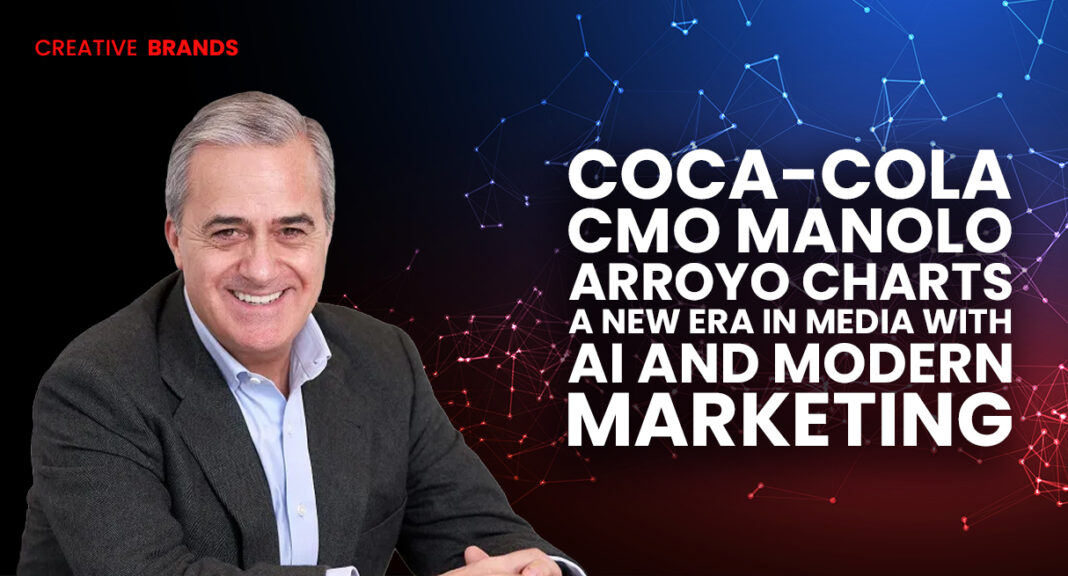
Coca-Cola’s CMO Manolo Arroyo is redefining global marketing, consolidating agency partnerships, and pioneering a “modern media” approach that blends data, digital, and AI-driven insights. Amid record ad spending and market challenges, Arroyo emphasizes human creativity, ethical AI use, and hyper-personalized strategies, reinforcing Coca-Cola’s enduring brand strength and cultural relevance worldwide
Coca-Cola’s marketing juggernaut is showing how one of the world’s most iconic brands continues to thrive in an era defined by complexity, disruption, and technological transformation. Despite 2025 presenting global businesses with daunting challenges—from inflation and geopolitical uncertainty to regulatory shifts and evolving consumer behavior—Coca-Cola has reported strong financial results, surpassing Wall Street expectations. Its latest trading update revealed net sales of $12.46 billion, up 5%, alongside a 6% increase in organic revenue, signaling resilience in a mature and competitive category.
This commercial performance is mirrored by Coca-Cola’s brand strength. Analysts and market data confirm that Coca-Cola remains consistently among the world’s most valuable brands. According to Kantar, the brand has not only maintained relevance but has also enhanced its meaningfulness and salience, particularly in the U.S., giving it pricing power and a continued edge over competitors such as Pepsi. BrandZ data further underscores Coca-Cola’s global dominance, showing that the brand is ranked number one in the soft drinks category in 90% of markets while being accessible to over half of all drinkers worldwide. On the creative front, Coca-Cola ranks alongside Nike and Red Bull for the quality of its advertising, a testament to the consistency and executional excellence that has long been a hallmark of the company.
Fueling this performance is a marketing organization that has undergone a radical transformation over the past four years, led by Manuel “Manolo” Arroyo, Coca-Cola’s EVP and global chief marketing officer. Arroyo, a nearly 30-year veteran of the company, has overseen a sweeping restructuring of agency relationships, media strategy, and creative output. “The market is recognizing that we are definitely at the top in terms of performance,” he says. “We’re managing to drive revenue, volume and transactions. Obviously, marketing and innovation are the major drivers of the growth of our company. Our company is a marketing company. It’s pretty much the heart and the soul.”
When Arroyo took the helm of marketing modernization in 2021, the brand’s marketing ecosystem was sprawling and fragmented. Coca-Cola was working with roughly 6,000 agency partners globally, while the bulk of its multi-billion-dollar media budget remained tied to traditional channels. The ambition was clear: reduce complexity, deepen integration, and pivot toward digital-first execution at scale. This led to the consolidation of Coca-Cola’s global advertising account with WPP and the creation of Open X, a bespoke unit designed to manage the brand across markets and disciplines. Nine studios were established in key regions, blending Coca-Cola employees, WPP staff, and specialist partners into what Arroyo calls “a marketing factory.” Today, the company has shifted from investing nearly three-quarters of paid media on traditional television in 2019 to allocating roughly 70% to digital platforms, particularly social and influencer-led marketing, which has effectively become the brand’s new TV.
WPP’s stewardship of Coca-Cola’s advertising has come at a time of pressure on holding companies. WPP has faced declining share prices amid client losses and internal restructuring, a reality further complicated when Coca-Cola moved its North American media business to Publicis earlier this year. Nevertheless, Arroyo maintains that his close collaboration with WPP’s staff across the nine studios has built a deep understanding of the industry’s pressures and accelerated technological changes. He remains a vocal supporter of WPP’s direction under CEO Cindy Rose, who succeeded Mark Read in September. “WPP is very bullish and I’m a huge advocate and supporter of the direction that [Cindy Rose] is taking in the industry. We’re really happy with the partnership. They are deploying for us right now the next iteration in media,” he notes.
This evolution has paved the way for what Arroyo calls a “modern media” approach, a data-led, highly segmented strategy that integrates consumer, retailer, media, content, creator, and e-commerce data into a unified environment. The initiative is being rolled out in Coca-Cola’s top 40 markets by the end of this year and will expand to more than 76 markets by the first quarter of next year. For a company selling 2.3 billion beverages a day across 30 million outlets in 200 countries, the scale and complexity of the operation are immense. Modern media, Arroyo explains, moves away from one-size-fits-all plans toward ultra-segmented growth audiences defined down to the postcode level but executed globally. This approach enables the brand to understand consumption drivers, motivations, and triggers, and to align content in a contextual, relevant manner to drive transactions.
Coca-Cola has already experimented successfully with hyper-personalized communication at scale. Its enduring ‘Share a Coke’ campaign returned across more than 10 billion bottles and cans in 120 countries, featuring over 30,000 locally relevant names. The campaign fueled single-serve transaction growth and supported Coca-Cola Zero Sugar’s fourth consecutive quarter of double-digit volume growth. Arroyo emphasizes that the initiative generated 20 million first-party data points globally, demonstrating the substantial data dividend of personalization strategies.
Artificial intelligence is a central pillar of this transformation, though Arroyo is careful to frame its role as augmentation rather than replacement. Within Coca-Cola’s marketing organization, 85% of the 2,000 global marketers regularly use ChatGPT, alongside a suite of other AI tools. “You can help our teams do way better and faster marketing if they are really able to leverage the power of human genius and human creativity and AI capability at the same time,” he says. AI accelerates insights, creative ideation, media planning, and performance tracking, but Arroyo insists that human judgment remains indispensable. “I don’t see a world without the human playing a significant role in crafting, in creating, in curating the output.”
While the use of AI has occasionally sparked controversy—most notably around Coca-Cola’s Christmas campaign, which drew criticism for its perceived inconsistencies—Arroyo defends the work. The campaign earned a 5.9 score in System1 testing and was ranked the second-best Christmas ad across all categories by Kantar, underscoring the potential of AI-driven creativity when combined with human oversight. For Arroyo, these experiences reinforce the importance of transparency, ethics, and trust in adopting emerging technologies.
Arroyo’s approach reflects a broader philosophy: integrating technology responsibly while ensuring human creativity and ethical standards remain paramount. He positions himself as an advocate for peers in the marketing industry to embrace innovation in a transparent and principled manner. His leadership exemplifies how one of the world’s most recognizable brands can navigate turbulent markets, harness technological advancements, and maintain cultural relevance at scale.
Recognition of Arroyo’s influence is already evident. He has been nominated for the WFA Global Marketer of the Year Award 2025, an accolade that highlights marketers who demonstrate excellence in brand building, innovation, and industry leadership. Previous winners include L’Oréal’s Asmita Dubey in 2023 and AB InBev’s Marcel Marcondes in 2024, reflecting the prestige and significance of the award in global marketing circles.
As Coca-Cola continues to sell billions of beverages daily and navigate an increasingly digital and data-driven world, Manolo Arroyo’s vision illustrates a brand that is at once enduring and adaptable. By reimagining its agency relationships, pioneering a modern media strategy, and embracing AI responsibly, Coca-Cola demonstrates that even in challenging times, the combination of marketing ingenuity, human creativity, and technological innovation can propel a legacy brand to new heights. Arroyo’s tenure underscores a key lesson for marketers: enduring success requires not only understanding the market and consumers but also the courage to rethink traditional practices, experiment boldly, and leverage the full potential of emerging tools while keeping ethics and transparency at the core.
Discover more from Creative Brands
Subscribe to get the latest posts sent to your email.