


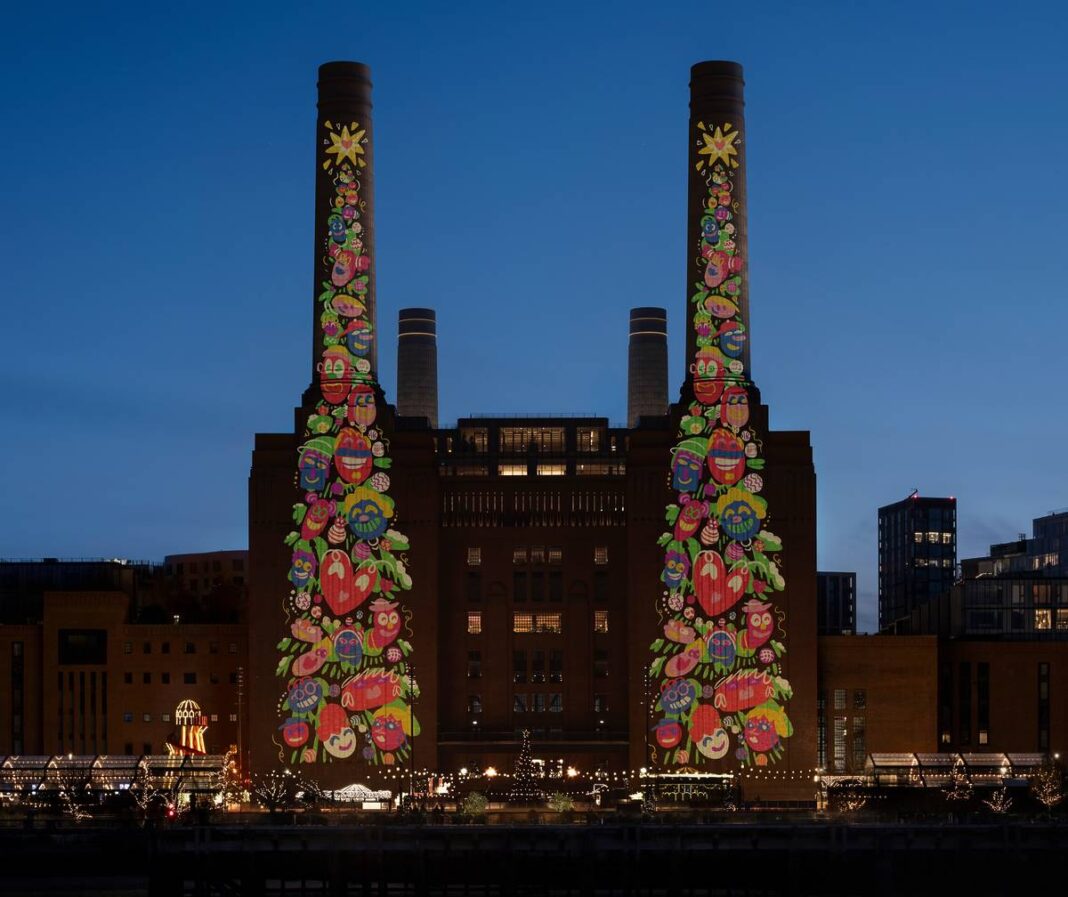
Apple transformed Battersea Power Station into a festive canvas by projecting Christmas tree drawings created on iPad by kids, artists, and everyday users across the UK. The campaign quietly showcased creativity over claims, letting real people’s work demonstrate the iPad’s creative power.
In the weeks leading up to Christmas, London’s Battersea Power Station became an unlikely canvas for something intimate, playful, and quietly powerful. Instead of a traditional holiday ad blitz filled with slogans, celebrities, or hard-selling product claims, Apple chose to let drawings do the talking. Christmas trees—imperfect, whimsical, bold, abstract—designed by kids, artists, and everyday creators on iPads across the UK were projected onto the iconic riverside landmark, transforming personal expression into public spectacle.
At first glance, the idea feels almost disarmingly simple. Apple invited people to design Christmas trees on the iPad. There were no strict rules, no stylistic guidelines, and no prerequisite of artistic skill. Children drew trees with uneven branches and oversized stars. Professional illustrators explored texture, colour, and form. Everyday users sketched playful, sentimental, or experimental interpretations. Each drawing reflected not just the holiday season, but the individual behind the screen. What followed was the alchemy of scale: these digital sketches were projected onto Battersea Power Station, turning one of London’s most recognisable industrial landmarks into a living gallery of collective creativity.
In doing so, Apple sidestepped the conventional language of advertising. The campaign made no overt claims about the iPad’s processing power, display quality, or creative superiority. There was no voiceover insisting the device was “the best tool for creativity.” Instead, the work trusted the audience to draw their own conclusions. If children could sketch freely, if artists could explore nuance, and if everyday users could create something worthy of being projected onto a historic building, then perhaps the product’s capability was already evident.
This approach reflects a broader philosophy that has long underpinned Apple’s marketing: show, don’t tell. But what distinguishes this campaign is its restraint. At a time when brands often feel compelled to shout louder during the festive season, Apple leaned into quiet participation. The campaign didn’t hinge on a single hero artwork or famous name. The stars were the contributors themselves, their drawings layered together in a shared visual moment.
The choice of Battersea Power Station was significant. Once a symbol of industrial might, later abandoned, and now reborn as a cultural and commercial hub, the building carries a layered history of reinvention. Projecting hand-drawn Christmas trees onto its façade created a dialogue between past and present, between the permanence of architecture and the fleeting nature of digital creativity. It grounded the campaign in place, making it unmistakably British, while still resonating with Apple’s global identity.
The execution was handled by TBWA\Media Arts Lab – Europe, Apple’s long-time creative partner, with production by Munz Made It. The collaboration focused less on spectacle for spectacle’s sake and more on authenticity. The drawings weren’t over-polished or homogenised to fit a single aesthetic. Their charm lay precisely in their differences—some playful, some sophisticated, some naïve. Together, they formed a mosaic that felt inclusive rather than curated.
That inclusivity is perhaps the campaign’s most striking quality. By opening the invitation to kids, artists, and everyday creators alike, Apple flattened the traditional hierarchy of “who gets to create.” In the context of advertising, this is a subtle but meaningful shift. The brand wasn’t just showcasing what professionals could do with its technology; it was celebrating what anyone could do. Creativity was positioned not as a rare talent, but as a shared human instinct, unlocked with the right tools and encouragement.
There is also something quietly strategic about choosing Christmas trees as the central motif. The image is universally recognisable, emotionally loaded, and open to interpretation. Everyone has an idea of what a Christmas tree should look like, which makes deviations from that idea instantly expressive. A crooked trunk, exaggerated ornaments, unexpected colours—each choice becomes a personal statement. In an era where digital platforms often reward sameness, the campaign elevated difference.
From a brand perspective, the move reinforces Apple’s long-standing association with creativity without leaning on nostalgia or repetition. Past campaigns like “Think Different” or “Shot on iPhone” established the company as a champion of creative expression. This Christmas activation builds on that legacy, but in a more participatory, less declarative way. It doesn’t tell you to think differently; it gives you a reason to do so.
The public nature of the projection also mattered. By taking drawings created in private—often on couches, at kitchen tables, or in classrooms—and displaying them on a monumental scale, Apple blurred the line between personal and communal creativity. Contributors could see their work become part of the city’s visual fabric, if only for a moment. For passersby, the projections offered a reminder that creativity doesn’t have to be intimidating or exclusive; it can be playful, imperfect, and shared.
Importantly, the campaign avoided the trap of seasonal sentimentality. While undeniably festive, it didn’t rely on overt emotional manipulation. There were no scripted family reunions or cinematic tear-jerkers. Instead, the emotion emerged organically from participation and recognition. Seeing a child’s drawing illuminated on Battersea Power Station carries a different kind of emotional weight—one rooted in pride, joy, and collective ownership.
In a crowded holiday advertising landscape, where brands compete fiercely for attention, Apple’s approach stands out for its confidence. It assumes that audiences are willing to engage with something quieter, something that requires a moment of looking rather than instant gratification. It trusts that creativity itself can be compelling enough.
The campaign also subtly reinforces the iPad’s role as a creative companion rather than a technical device. By foregrounding outcomes rather than specifications, Apple positions the product as an enabler of expression. This is particularly resonant in a cultural moment where technology is often criticised for distancing people from creativity. Here, the iPad becomes a bridge—between idea and image, between individual and community.
As the projections lit up Battersea Power Station, they did more than decorate a building. They created a shared experience, one that invited reflection on who gets to create, how creativity is valued, and what advertising can look like when it steps back and lets people lead. In turning Christmas tree drawings into an ad, Apple didn’t just celebrate the season; it reaffirmed a belief that creativity, in all its forms, is worth putting on a pedestal—even if that pedestal happens to be one of London’s most iconic landmarks.
Discover more from Creative Brands
Subscribe to get the latest posts sent to your email.