

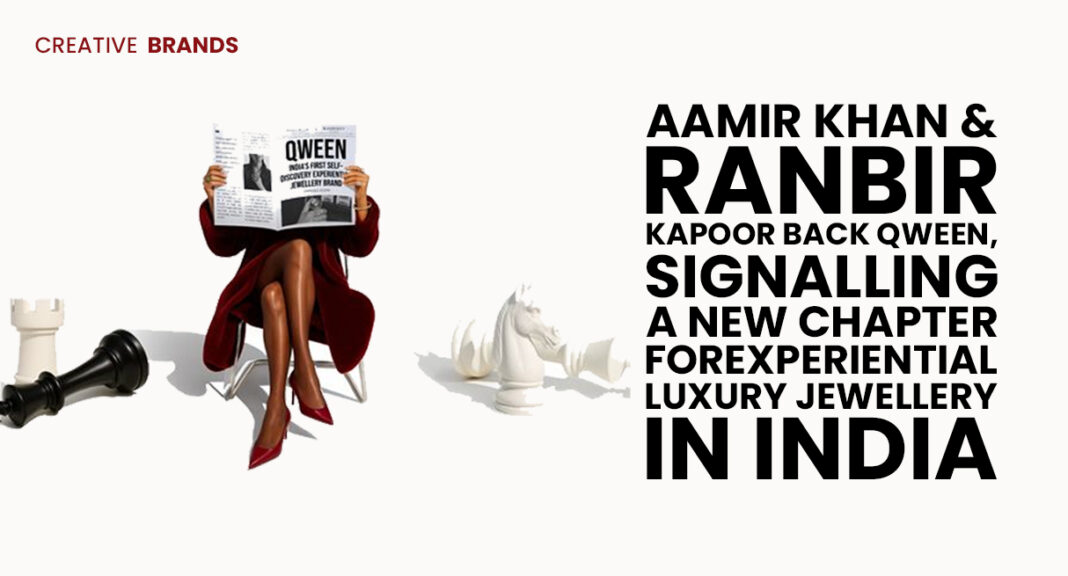
Bollywood stars Aamir Khan and Ranbir Kapoor are investing in Qween, a luxury jewellery brand launching in February 2026. Backed by a Rs 1,000-crore investment from Rosy Blue and Kashikey, Qween aims to redefine fine jewellery through natural diamonds, self-discovery and immersive luxury experiences.
Bollywood’s enduring star power is set to intersect with India’s fast-evolving luxury jewellery market as actors Aamir Khan and Ranbir Kapoor prepare to invest in Qween, a new-age fine jewellery brand positioning itself at the intersection of natural diamonds, personal meaning and immersive luxury. Scheduled to launch in February 2026, Qween enters the market at a moment when Indian consumers are rethinking not just what they buy, but why they buy it, especially in categories traditionally associated with status, celebration and inheritance.
The investments by Khan and Kapoor, both known for their selective professional choices and long-term thinking, signal a shift in how celebrity capital is being deployed in India. Rather than endorsements or short-term brand ambassadorships, their participation in Qween is framed as an investment in a concept-led luxury business. While the amount remains undisclosed, the move places two of Hindi cinema’s most influential figures behind a brand that is attempting to redefine jewellery as a tool for self-expression and self-discovery rather than mere ornamentation.
Their backing follows a Rs 1,000-crore strategic investment in Qween by global diamond powerhouse Rosy Blue and Japanese luxury jewellery house Kashikey Co. Ltd., lending the venture considerable financial heft and international credibility even before its official debut. The combination of celebrity investors and established global players reflects a broader trend in India’s luxury ecosystem, where deep-pocketed institutional capital increasingly converges with cultural influence to build brands designed for both domestic growth and global relevance.
Qween describes itself as India’s first 100 percent natural, experiential luxury jewellery brand built around the idea of self-discovery. This positioning arrives at a time when luxury consumption in India is undergoing a subtle but significant transformation. Younger affluent consumers, particularly in urban centres, are less inclined to view jewellery solely as a symbol of marital status or family wealth. Instead, they are seeking pieces that align with personal milestones, emotional journeys and individual identity. In this context, Qween’s emphasis on experience and introspection is as central to its proposition as the gemstones themselves.
Industry observers note that the timing of the launch is strategic. India’s luxury jewellery market has been expanding steadily, supported by rising disposable incomes, a growing base of high-net-worth individuals and an increasing acceptance of contemporary design sensibilities. At the same time, there is growing awareness around sourcing, authenticity and sustainability, especially in the diamond segment. By committing to 100 per cent natural diamonds and foregrounding narrative-driven design, Qween appears to be addressing both traditional expectations of value and newer demands for transparency and meaning.
The involvement of Rosy Blue is particularly significant. As one of the world’s largest diamond companies, with operations spanning mining, manufacturing and retail, its participation suggests confidence in Qween’s long-term vision. Rosy Blue’s presence also ensures access to a reliable global supply chain and deep expertise in natural diamonds, an advantage in a market where questions around lab-grown versus natural stones are increasingly part of consumer conversations. Meanwhile, Kashikey Co. Ltd. brings with it the heritage of Japanese craftsmanship, precision and understated luxury, elements that could influence Qween’s design philosophy and retail experience.
For Aamir Khan and Ranbir Kapoor, the investment reflects different but complementary brand alignments. Khan, widely regarded as a perfectionist with a track record of backing content-driven cinema, has often been associated with projects that emphasise depth and social relevance. His involvement lends Qween an aura of thoughtfulness and credibility that extends beyond glamour. Kapoor, representing a younger generation of stardom, embodies contemporary masculinity, introspection and a break from rigid conventions. Together, they mirror the brand’s ambition to speak across generations while challenging established narratives around jewellery and luxury.
The decision of two male actors to invest in a jewellery brand aimed at self-discovery also carries symbolic weight. Jewellery in India has long been framed predominantly as a women-centric category, tied to weddings and familial traditions. By associating the brand with ideas of personal journeys and inner exploration, Qween appears to be consciously broadening its appeal, potentially including men not just as buyers but as wearers and participants in the luxury experience. This aligns with a gradual cultural shift in which men are becoming more open to jewellery as a form of personal style and emotional expression.
Retail and brand strategists suggest that Qween’s experiential focus could manifest in immersive store designs, curated storytelling and personalised buying journeys rather than conventional showroom formats. Globally, luxury brands are investing heavily in experiences that slow down consumption, encouraging customers to engage emotionally with products. In India, where jewellery purchases have often been transactional and occasion-driven, this approach could mark a departure, particularly if executed with sensitivity to cultural nuances.
The February 2026 launch timeline gives Qween over a year to build anticipation and refine its offering in a competitive landscape dominated by established players and emerging boutique brands. The presence of heavyweight investors may also enable the brand to invest early in design talent, technology and customer experience, areas that are increasingly decisive in the premium segment. Analysts point out that while celebrity backing can generate attention, sustained success will depend on the brand’s ability to translate its philosophy into tangible value for consumers.
The broader context is also important. India is becoming an increasingly attractive destination for global luxury investments, not only because of market size but because of its cultural depth and evolving tastes. Collaborations between Indian cultural icons, global supply chain leaders and international luxury houses suggest a new model of brand-building that blends local relevance with global standards. Qween’s ownership structure reflects this convergence, positioning it as a brand that is Indian at its core but international in ambition.
As the luxury jewellery space becomes more crowded, differentiation will be key. Qween’s challenge will be to ensure that its narrative of self-discovery does not remain abstract but is embedded in design, sourcing, retail and communication. For consumers, particularly those in their 30s and 40s navigating personal and professional transitions, jewellery that symbolises inner milestones rather than social expectations could resonate deeply.
The entry of Aamir Khan and Ranbir Kapoor into this venture underscores how celebrity influence in India is evolving from surface-level visibility to strategic participation. Their investment in Qween is less about star endorsement and more about aligning with a vision that seeks to reinterpret luxury for a changing India. If successful, Qween could not only carve out a distinctive place in the jewellery market but also set a precedent for how experiential, values-driven luxury brands are built in the country.
As February 2026 approaches, the industry will watch closely to see whether Qween can live up to the promise suggested by its backers. With substantial capital, global expertise and cultural cachet on its side, the brand enters the market with momentum. Whether it can transform that momentum into lasting emotional and commercial value will ultimately determine its place in India’s luxury landscape.
Discover more from Creative Brands
Subscribe to get the latest posts sent to your email.