


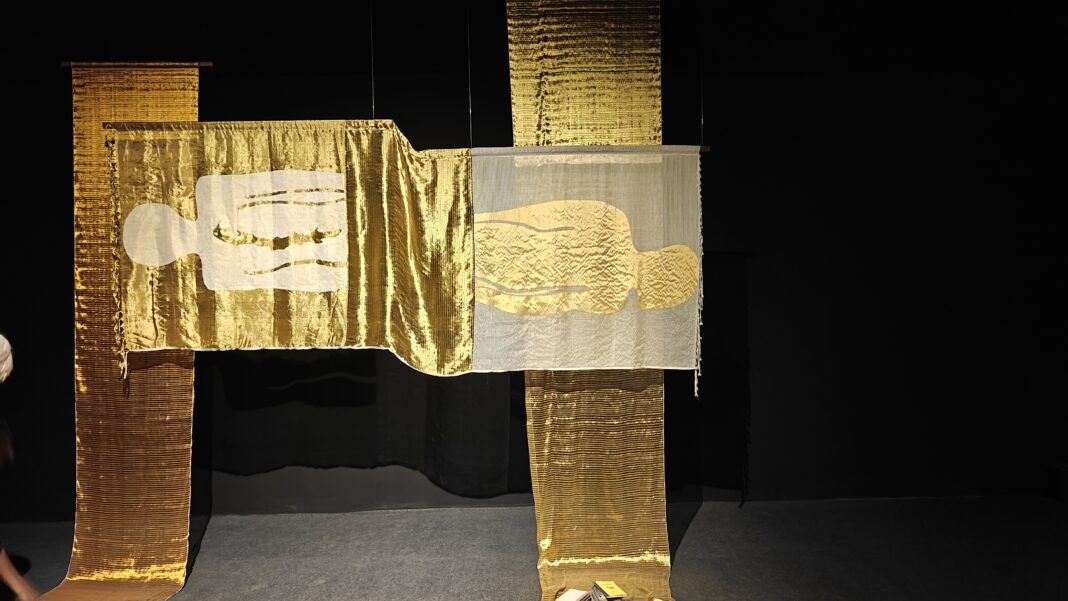
Artist Lakshmi Madhavan’s Looming Bodies at the Kochi People’s Biennale turns the spotlight on the kasavu weavers of Balaramapuram. Through 750 photographs and weaving remnants, the installation honours gestures of labour, heritage, and rhythm, while confronting the fragility of artisanal dignity and the decline of a community bound to its looms.
In the southern village of Balaramapuram, just outside Thiruvananthapuram, the rhythm of weaving has long been the heartbeat of its people. The kasavu cloth, with its shimmering golden borders, is celebrated across Kerala as a symbol of tradition, worn during weddings, festivals, and rituals. Yet, behind its radiant beauty lies a quieter, more fragile story—one of bodies bent over looms, gestures repeated endlessly, and a community slowly fading into obscurity. It is this story that artist Lakshmi Madhavan brings to the fore in her installation Looming Bodies, now on view at the Kochi People’s Biennale.
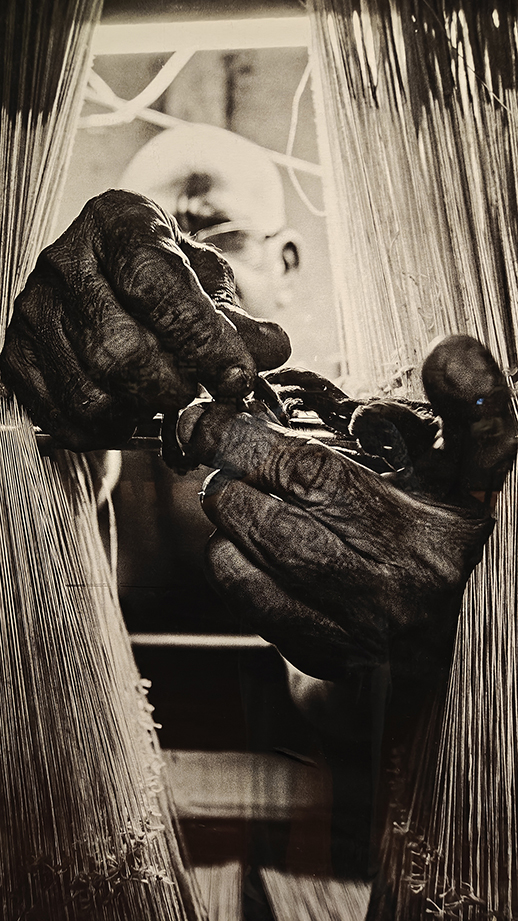
The exhibition is not about the cloth itself, but about the human labour that animates it. Through 750 commissioned photographs, taken over three years, Lakshmi documents the intimate gestures of the kasavu weaving community. Hands that twist thread spools, shoulders that lean into the loom, heads that bow in concentration—each movement is a gesture of meaning, a language of survival and heritage. The installation is accompanied by the detritus of weaving: cotton strands, loom parts, discarded spools, and wage books. Together, they form a landscape of labour, memory, and decline.
For Lakshmi, the project is deeply personal. Many of the weavers are her friends, people she has lived alongside and learned from. Her lens does not merely capture their work; it breathes with their rhythm. The photographs show bodies that respond as one with the loom, transmitting heritage through repetition. The loom is not just a machine—it is an extension of the body, a partner in the act of creation. Yet, as the wage books reveal, this intimacy is reduced to cold numbers: identity codes, hours logged, skills quantified. The human body, in its dignity and resilience, is flattened into data.
The poignancy of Looming Bodies lies in its confrontation with decline. Many of the weavers are now over sixty-five, their bodies bearing the marks of decades of labour. The photographs are not just records of gestures; they are testimonies to endurance and fragility. The kasavu cloth may gleam with timeless beauty, but the community that sustains it is shrinking. Younger generations, lured by other livelihoods, are reluctant to take up the loom. The rhythm of weaving, once a collective pulse, now falters.
Lakshmi’s installation asks us to reconsider what we value. In a world that celebrates the finished product—the gleaming kasavu sari, the polished textile—she turns our gaze to the process, to the gestures that make beauty possible. The exhibition juxtaposes the radiant cloth with the fragile ecosystems of artisanal labour. It asks: what is the dignity of a process when its makers are reduced to numbers? What happens to heritage when its custodians are left behind?
The photographs themselves are striking in their intimacy. A hand caught mid-motion, a spool rolling across the floor, a loom creaking under pressure—each image is a fragment of a larger rhythm. Together, they form a symphony of gestures, a choreography of labour. The detritus of weaving, displayed alongside, becomes relics of a sacred practice. Cotton strands, discarded threads, and loom parts are not waste; they are markers of memory, evidence of bodies that have laboured and endured.
In presenting these fragments, Lakshmi, elevates the weavers from anonymity to artistry. They are not mere workers; they are custodians of heritage, transmitters of rhythm and memory. Their gestures are not mechanical but deeply human, infused with meaning. Yet, the installation does not romanticise. It confronts the harsh realities of decline, the indignities of wage books, the fragility of ageing bodies. It is both celebration and lament, honour and critique.
The Kochi People’s Biennale provides a fitting stage for this work. Known for its engagement with communities and its emphasis on socially resonant art, the Biennale situates Looming Bodies within a larger conversation about labour, heritage, and dignity. In a globalised world where artisanal practices are often commodified or forgotten, Lakshmi’s installation insists on attention. It asks viewers to look beyond the cloth, to see the bodies that make it, to witness their gestures, and to acknowledge their decline.
The exhibition also resonates with broader questions about memory and transmission. Weaving is not just a craft; it is a form of storytelling, a way of passing down heritage through repetition. Each gesture is a memory inscribed in the body, each rhythm a link to the past. As the community declines, what happens to this memory? Can it be preserved in photographs, in installations, in art? Or does it fade with the bodies that carry it?
Lakshmi’s work suggests that art can be a form of preservation, a way of honouring gestures that might otherwise be forgotten. By documenting the weavers over three years, she creates an archive of labour, a testament to resilience. Yet, she also acknowledges the limits of art. Photographs can capture gestures, but they cannot sustain livelihoods. Installations can honour memory, but they cannot reverse decline. The dignity of artisanal labour requires more than recognition; it requires support, sustenance, and renewal.
In the end, Looming Bodies is both a tribute and a warning. It celebrates the beauty of kasavu weaving, the intimacy of gestures, the resilience of bodies. But it also confronts us with decline, with the fragility of ecosystems, with the indignities of reduction. It asks us to see, to witness, to remember. And in doing so, it challenges us to reconsider our relationship with heritage, labour, and dignity.
As visitors walk through the installation, they are invited to turn their attention away from the cloth and towards the bodies that make it. They are asked to see gestures not as mechanical motions but as acts of meaning. They are asked to witness decline not as inevitability but as a call to action. In the quiet rhythm of weaving, in the fragile beauty of gestures, lies a story of heritage, memory, and resilience—a story that Madhavan insists must be told.
At the Kochi People’s Biennale, Looming Bodies stands as a powerful reminder: behind every cloth lies a body, behind every gesture lies a memory, and behind every tradition lies a community. To honour the cloth, we must honour the bodies. To celebrate heritage, we must sustain its custodians. And to witness decline, we must ask what dignity truly means.
Discover more from Creative Brands
Subscribe to get the latest posts sent to your email.