


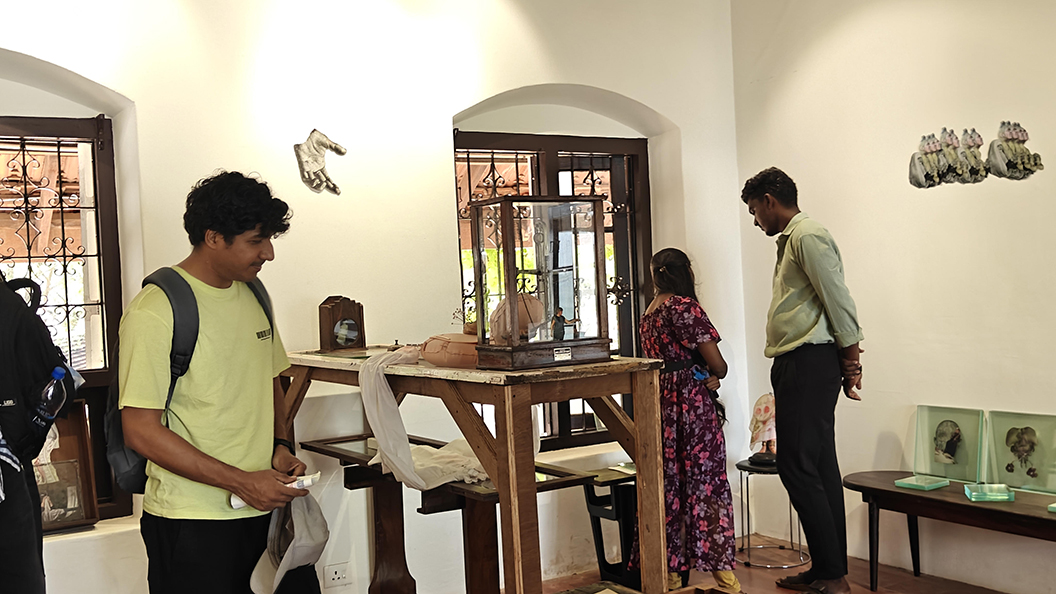
Berlin-based artist Anja Ibsch presents Still at the Kochi-Muziris Biennale, a mutable installation that merges fragments of her performative past with ecological residues and everyday matter. By inviting participation and dialogue, Ibsch challenges fixed notions of art, foregrounding endurance, memory, and collective encounters in fragile, shifting environments.
In the bustling, humid air of Kochi, where histories of trade, migration, and cultural exchange are etched into the city’s walls and waterways, Berlin-based artist Anja Ibsch has chosen to situate her latest work, Still. For Ibsch, whose practice has long interrogated the human body as a site of endurance and transformation, the Biennale offers not merely a stage but a living laboratory. Here, she unfolds a mutable installation that is as much about the act of hosting as it is about assembling fragments of memory, ecology, and human interaction.
Born in Rheine, Germany, in 1968, Ibsch has spent decades exploring thresholds of bodily endurance through performance, collage, and installation. Her work often draws on mythological narratives, religio-cultural beliefs, and scientific knowledge systems, weaving them into non-linear narrations that destabilise the viewer’s expectations. In Still, she extends this methodology into a shared space, one that resists closure and instead privileges openness, dialogue, and cohabitation.
At first glance, Still resembles a studio in flux: walls, tables, and windows populated with cutouts from
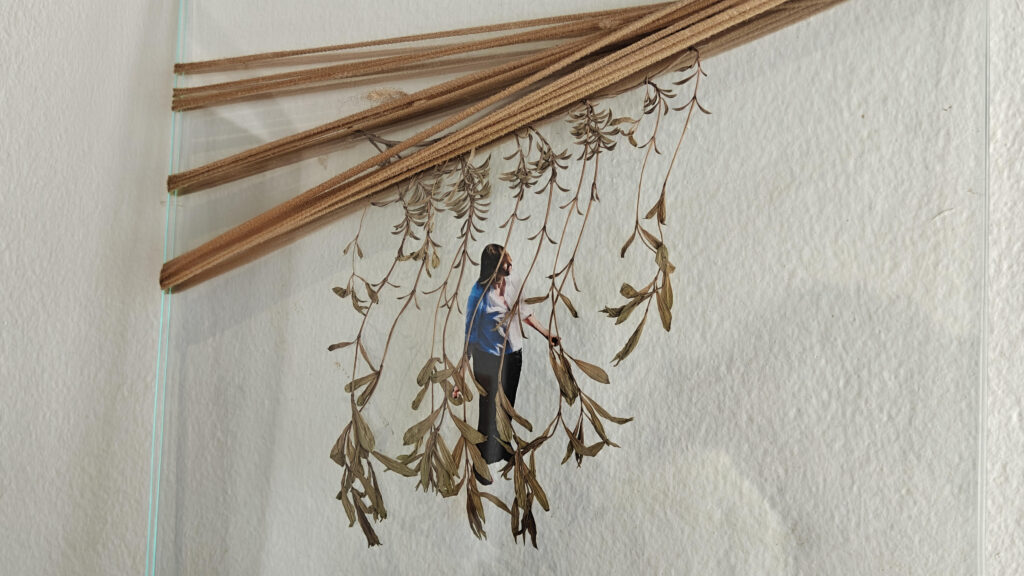
Ibsch’s performative past, pressed flowers, childhood photographs, biology textbooks, and quotidian matter gathered from Kochi itself. Yet the assemblage is never fixed. Unlike collage traditions that rely on glue as a binding agent, Ibsch deliberately keeps her combinations malleable, allowing them to shift in response to health-related transformations, environmental conditions, and interpersonal encounters. This refusal of permanence is central to her vision. It is not an isolated present she seeks to express, but a continuum—an ongoing stream where past and present coalesce.
Visitors entering the space are not passive spectators. They are invited to observe, converse, or even co-work alongside Ibsch, who remains present in the studio-like room. The process itself becomes transparent: bodily affectivities, socio-political negotiations, and vulnerable encounters are laid bare, destabilising the conventional distance between artist and audience. In doing so, Ibsch challenges the assumption of the artist as an authoritative figure and the viewer as a silent recipient. Instead, she privileges listening, paying attention, and continuous learning and unlearning.
This ethos of unscripted cooperation is what makes Still resonate so deeply within the Biennale’s broader context. Kochi, with its layered histories and diverse communities, becomes not just a backdrop but an active participant in the work. The fragments of mass-produced content, ecological residues, and personal memories that populate the installation are reconfigured in evolving assemblies, mapping values and happenings that bind communities together. In this way, Ibsch recognises contexts in which memories and entanglements resurface, straddling both personal and collective experiences.
The gesture of hosting, which underpins Still, is not merely about providing space. It is about holding space—for verbal and non-verbal conversations, for uncertainties and coincidences, for ruptures and uncanny encounters. By situating her work as a shared environment, Ibsch instils patience for incidents and expressions that cannot be scripted. The installation becomes a site where fragilities, continuities, and surrealities of unceasing environmental and humanitarian crises are reflected upon.
In its conceptual framework, Still also interrogates the outwardly motionless forms that populate our lives. By attending to the forces that characterise their production and dissemination, Ibsch unpacks their shifting cultural roles and emotive lives. The installation resists singular readings, instead opening itself to plural, vocal interpretations. Each fragment—whether a pressed flower or a childhood photograph—carries with it multiple resonances, which are amplified through their juxtaposition with other elements.
What emerges is a living collage, one that mirrors the complexities of existence in a world marked by crises and continuities. The installation’s evolving nature underscores the impossibility of resolution. Images are destabilised, ideas remain unresolved, and yet it is in this very instability that meaning is generated. For Ibsch, the act of assembling is not about achieving coherence but about acknowledging the multiplicity of experiences and perspectives that constitute reality.
The Kochi-Muziris Biennale, known for its emphasis on experimentation and dialogue, provides an apt setting for such a work. In a city where colonial histories intersect with contemporary global flows, Still resonates as both a personal archive and a collective mirror. It reflects the fragility of bodies and environments, while simultaneously affirming the resilience of communities that continue to adapt and endure.
Ibsch’s refusal to centre herself as the sole author of meaning is particularly striking. By decentering the figure of the artist, she opens up space for viewers to become co-creators. The installation is not a finished product but a process, one that evolves through encounters and conversations. In this way, Still challenges the very notion of art as a static object, proposing instead that it is a dynamic, relational practice.
The work’s attention to ecological residues also situates it within urgent conversations about environmental crises. By incorporating matter gleaned from Kochi, Ibsch foregrounds the entanglement of human and non-human worlds. The installation becomes a site where ecological fragilities are not abstract concepts but tangible presences, woven into the fabric of memory and experience.
Ultimately, Still is less about spectacle than about attentiveness. It asks viewers to slow down, to listen, to engage with the fragments that constitute the present. In a world increasingly dominated by speed and resolution, Ibsch’s insistence on patience and openness is radical. Her installation becomes a reminder that meaning is not found in closure but in the ongoing negotiation of relationships—between bodies, memories, environments, and communities.
As the Biennale unfolds, Still will continue to shift, reflecting the contingencies of its environment and the encounters it hosts. It is this openness to change that defines Ibsch’s practice and makes her work resonate across contexts. By situating the body as a site of endurance and the installation as a space of hosting, she offers a vision of art that is both deeply personal and profoundly collective.
In Kochi, where the sea carries whispers of centuries-old exchanges and the streets pulse with contemporary rhythms, Still finds its place as a living archive. It is an assemblage that resists finality, a collage that embraces fragility, and a shared space that privileges dialogue over resolution. For Anja Ibsch, art is not about answers but about encounters—and in Still, those encounters unfold in ways that are as unpredictable as they are transformative.
Discover more from Creative Brands
Subscribe to get the latest posts sent to your email.