


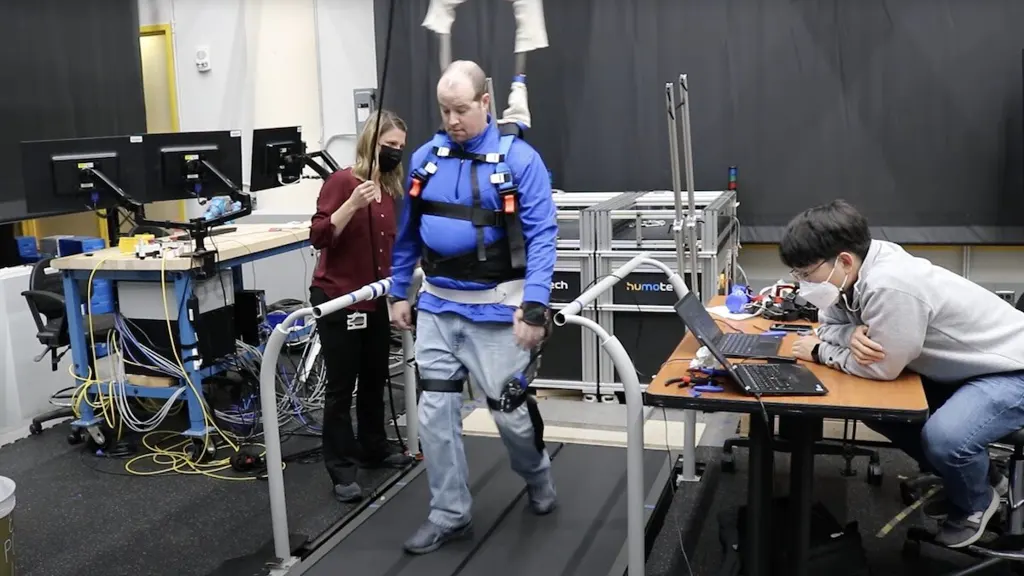
Kevin Piette’s triumphant walk with an AI-powered exoskeleton after 11 years of paralysis is more than a personal victory—it’s a glimpse into a future where software and hardware converge to restore dignity. As HealthTech builds digital backbones for accessibility, the next barrier lies in scaling innovation to reach everyone.
Imagine a world without wheelchairs. For centuries, mobility aids have been symbols of resilience, but also of limitation. They represent the human will to move forward, yet they also remind us of the barriers that remain. Into this landscape stepped Kevin Piette, a man who had been paralyzed for more than a decade. When he carried the Olympic torch, he didn’t just carry flame and tradition—he carried the future of mobility.
Piette walked again, not through miracle or chance, but through the fusion of human grit and elite engineering. His stride was powered by a self-balancing, AI-driven exoskeleton, a machine that transformed paralysis into possibility. It was a moment that blurred the line between science fiction and lived reality, a moment that asked us to reconsider what independence truly means.
The exoskeleton itself is a marvel of hardware: sensors, motors, and frames working in harmony to replicate the mechanics of walking. But hardware alone is not enough. As engineers often remind us, hardware is the body, but software is the nervous system. Without intelligent algorithms, without adaptive code that learns and responds, the machine is just metal and wires. With software, it becomes an extension of the human will.
This is the quiet revolution of HealthTech. It is not only about building devices that dazzle on stage or in laboratories. It is about creating digital backbones that allow these innovations to reach the people who need them most. From platforms like the National Disability Insurance Scheme (NDIS) to scalable digital healthcare systems, the challenge is not just invention—it is distribution. Technology must move beyond prototypes and pilot programs to become embedded in everyday lives.
The stakes are profound. For someone like Piette, walking again is not just about mobility. It is about dignity, independence, and the restoration of identity. For millions living with disabilities, the promise of HealthTech is not abstract—it is deeply personal. It is the difference between dependence and autonomy, between isolation and participation.
Yet the barriers remain. Cost is one. Accessibility is another. Even as exoskeletons and AI-driven devices evolve, they risk becoming luxuries rather than necessities if the digital infrastructure to support them is not built. That is why the conversation must shift from invention to integration. How do we ensure that breakthroughs in robotics, AI, and healthcare are not confined to elite hospitals or research centers, but are available in community clinics, rural towns, and homes across the world?
The answer lies in building systems that scale. Just as the internet transformed communication by creating a universal backbone, HealthTech must create a digital nervous system that connects patients, providers, and innovators. This means interoperable platforms, secure data sharing, and user-friendly interfaces that empower rather than intimidate. It means designing with empathy, ensuring that technology adapts to human needs rather than forcing humans to adapt to machines.
Kevin Piette’s walk is a symbol, but it is also a challenge. It asks us to imagine a world where wheelchairs are not the default solution, where mobility is redefined by technology that restores rather than compensates. It asks us to confront the next barrier: not the engineering of devices, but the engineering of systems.
We are building that backbone now. Every digital healthcare platform, every adaptive algorithm, every patient-centered interface is a strand in the nervous system of tomorrow’s medicine. The vision is clear: a world where technology does not just extend life, but enriches it; where independence is not a privilege, but a right.
The Olympic torch has always symbolized endurance, unity, and hope. When Piette carried it, he illuminated a path toward a future where disability is not defined by limitation, but by possibility. His walk was not just his own—it was a step forward for all of us.
The question that remains is simple, yet daunting: What’s the next barrier? Will it be affordability, accessibility, or awareness? Will it be the challenge of scaling innovation across borders and cultures? Or will it be the ethical responsibility of ensuring that technology serves humanity rather than profit?
Whatever the answer, Piette’s stride reminds us that barriers are not walls—they are thresholds. And with grit, engineering, and a digital backbone strong enough to carry us, those thresholds can be crossed.
Discover more from Creative Brands
Subscribe to get the latest posts sent to your email.