


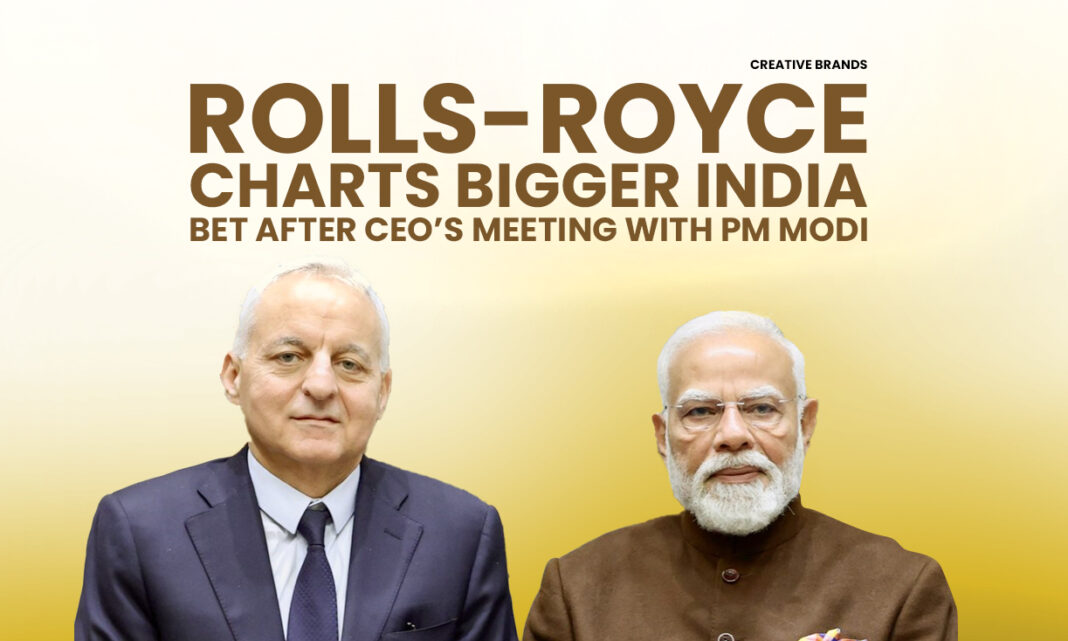
Rolls-Royce CEO Tufan Erginbilgic met Prime Minister Narendra Modi to outline plans for expanding the company’s India footprint, including making its Global Capability Centre the largest worldwide, co-creating complex manufacturing, and building advanced engineering capabilities aligned with India’s Viksit Bharat vision.
Rolls-Royce is preparing to significantly expand its presence in India, with Chief Executive Officer Tufan Erginbilgic meeting Prime Minister Narendra Modi to discuss how the British engineering major can play a deeper role in the country’s journey toward becoming a developed nation under the “Viksit Bharat” vision.
The meeting, described by officials as forward-looking and focused on long-term collaboration, centered on scaling up Rolls-Royce’s activities in India across high-value engineering, complex manufacturing and advanced research capabilities. At the heart of the discussions was the company’s plan to expand its Global Capability Centre (GCC) in India to become its largest worldwide.
Prime Minister Modi welcomed the company’s ambitions, underscoring India’s push to position itself as a global hub for innovation and advanced manufacturing. “We welcome Rolls-Royce’s enthusiasm towards scaling up its activities in India and partnering with our innovative and dynamic youth,” Modi said following the meeting.
The endorsement signals the government’s support for greater collaboration between multinational engineering firms and India’s growing technology and manufacturing ecosystem. For Rolls-Royce, the engagement comes at a time when the company is sharpening its strategic focus on high-performance power systems, civil aerospace, defence and new energy technologies.
Erginbilgic’s outreach reflects a broader trend of global companies rebalancing their operations toward India, not merely as a cost-efficient back office but as a strategic centre for engineering excellence and co-development. By proposing to make its Indian GCC the largest in its global network, Rolls-Royce is signalling confidence in the country’s talent pool and long-term industrial policy framework.
Global Capability Centres in India have evolved rapidly over the past decade. Once focused largely on IT services and support functions, many now house advanced design, digital engineering, analytics, artificial intelligence and product development teams. Rolls-Royce’s planned expansion aims to move further up that value chain, embedding critical engineering capabilities that support its global programmes.
According to people familiar with the discussions, the company is exploring how to co-create complex manufacturing capabilities in India, working with domestic partners and suppliers. This aligns with the government’s “Make in India” initiative and its push to strengthen domestic supply chains in aerospace and high-technology sectors.
For India, attracting deeper investment in complex manufacturing represents a strategic objective. As the country seeks to reduce import dependence and build indigenous capabilities in sectors such as defence and aviation, partnerships with global technology leaders are seen as essential accelerators.
Rolls-Royce has had a long-standing presence in India, particularly in aerospace and defence. However, the renewed emphasis appears to go beyond traditional buyer-supplier relationships. Instead, the focus is on co-creation—jointly building high-value products and systems, supported by advanced engineering skills developed locally.
Erginbilgic’s message to Indian stakeholders has been consistent: the future competitiveness of global engineering firms will depend on access to world-class talent and agile innovation ecosystems. India, with its vast pool of engineers and expanding startup landscape, fits squarely into that strategy.
The company’s plan to build high-value engineering capabilities in India dovetails with government priorities to harness the demographic dividend. With millions of young people entering the workforce each year, policymakers have stressed the importance of creating opportunities in high-skill sectors rather than low-value assembly operations.
By scaling up research, design and advanced manufacturing functions, Rolls-Royce could help create precisely such opportunities. The proposed expansion of the GCC is expected to generate roles in areas such as digital engineering, systems integration, advanced materials and potentially sustainable power solutions.
The timing is also notable. India is actively courting global aerospace and defence manufacturers as part of its ambition to become a major manufacturing and export base. The government has introduced production-linked incentives, simplified foreign direct investment norms in several sectors, and increased capital expenditure on infrastructure to make the country more attractive for large-scale industrial investments.
For multinational firms, India offers both a large domestic market and an increasingly competitive export platform. As global supply chains diversify, companies are seeking resilient production bases. India’s improving infrastructure, policy reforms and stable macroeconomic environment have strengthened its case.
The Rolls-Royce expansion plan, if executed as outlined in the meeting, could serve as a template for how global engineering giants engage with India’s development agenda. Rather than treating the country as a peripheral market, the approach envisions India as a core contributor to global product development and innovation.
Prime Minister Modi’s public support suggests the government views such collaborations as integral to achieving the Viksit Bharat goal—a vision that aims to transform India into a developed nation by 2047, marking 100 years of independence. Central to that ambition is the creation of high-income jobs, strong industrial capabilities and global competitiveness in advanced technologies.
Industry observers note that for Rolls-Royce, deepening its India footprint also strengthens its long-term access to one of the fastest-growing aviation markets in the world. India’s civil aviation sector is expanding rapidly, with airlines placing large aircraft orders and airport infrastructure scaling up across major cities.
While details of specific investment figures or timelines were not publicly disclosed, the tone of the meeting suggests momentum toward concrete next steps. Expanding a GCC to become the largest globally typically involves significant headcount growth, infrastructure investment and a reallocation of high-value workstreams from other geographies.
For India’s engineering workforce, such moves reinforce the country’s transition from a services outsourcing hub to a centre for innovation-led growth. The emphasis on co-creating complex manufacturing capabilities indicates a desire to embed design-to-production cycles within India, potentially boosting local supplier ecosystems and skill development.
As global competition intensifies in aerospace, defence and sustainable energy technologies, the ability to harness diverse talent pools will be critical. Rolls-Royce’s strategic recalibration toward India reflects that reality.
The meeting between Erginbilgic and Modi thus goes beyond a routine corporate courtesy call. It marks a signal of intent—both from a global engineering leader seeking to future-proof its operations and from a government eager to anchor high-value industrial partnerships.
If the plans discussed translate into tangible investments and expanded operations, Rolls-Royce’s growing footprint could become emblematic of India’s next phase of industrial growth: one defined not merely by scale, but by sophistication.
Discover more from Creative Brands
Subscribe to get the latest posts sent to your email.