


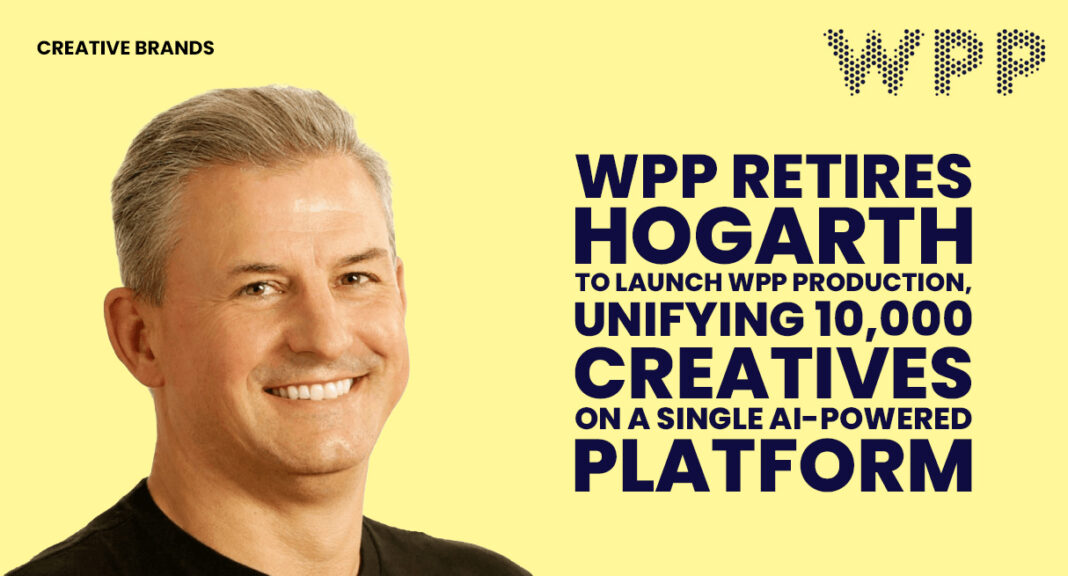
WPP is closing Hogarth and replacing it with WPP Production, a new global production engine uniting nearly 10,000 specialists on a single AI-powered platform. Led by former Hogarth CEO Richard Glasson, the move consolidates creative, media and production expertise to deliver faster, tech-enabled content at unprecedented scale for clients worldwide.
WPP is retiring one of its most recognisable production brands and replacing it with something far larger, more integrated and more technologically ambitious. Hogarth, the production company founded in 2008 that became a core engine for WPP’s agencies, is being closed. In its place rises WPP Production, a new global entity bringing together almost 10,000 people into what the holding company describes as a unified production ecosystem built for the demands of AI-era content.
Richard Glasson, who has led Hogarth as global chief executive since 2011, will now become chief executive of WPP Production. His remit expands dramatically: rather than overseeing a specialist production unit supporting WPP agencies, Glasson will lead a consolidated global platform where creative producers, craft specialists, technologists and content teams work as one integrated force across WPP’s entire client roster.
The move marks one of the most significant structural changes to WPP’s production capabilities in nearly two decades. Hogarth grew from a boutique production offer into a 7,000-plus strong global network that quietly powered campaigns for clients including Heinz, Nestlé, Volvo, Coca-Cola, Boots and Ford. It became known for its ability to execute high volumes of work efficiently and consistently across markets, often behind the scenes of WPP’s creative agencies.
Now, that model is being subsumed into something WPP believes is fit for a new era, where production is no longer a downstream executional step but a central, technology-enabled driver of how ideas are conceived, built and distributed.
Hogarth’s own website currently signals the transition: “We are in a period of profound transformation. WPP Production is a new type of production company built for the future. One that embraces the possibilities of new technologies and powers clients to make better work for every audience, at every moment at the speed and quality consumers’ demand.”
That statement captures the philosophy behind the overhaul. WPP is not simply renaming Hogarth; it is reframing production as an integrated discipline that sits at the intersection of creativity, media and technology. Under WPP Production, all teams will operate on a single platform powered by WPP Open, the company’s proprietary AI and data infrastructure, enabling shared workflows, assets and intelligence across the network.
The new entity is structured around four pillars. The first is the creation of a unified global team of craft experts, bringing together specialists in design, film, digital, post-production, and emerging formats under one coordinated structure. The second focuses on integrating agency producers more deeply into this system to drive greater innovation and eliminate the silos that have traditionally separated creative teams from production execution.
The third pillar signals WPP’s intent to lead in “next-generation content origination”, with an explicit commitment to generative AI, virtual production and hybrid production techniques. This is where WPP Production positions itself as more than a scaled-up studio network; it is pitched as a technology-led content engine capable of creating adaptive, personalised and high-volume work at unprecedented speed.
The fourth pillar, described as the “high velocity content studio”, aims to fuse production with media thinking. Here, content is designed with audience distribution in mind from the outset, enabling WPP to offer what it calls an “integrated production plus media solution” where storytelling, targeting and delivery are conceived as one system.
Glasson describes the shift as transformational, particularly for clients. “This is a transformative moment for us and, more importantly, for our clients. Bringing all of WPP’s craft expertise together in WPP Production reinforces our position at the heart of WPP’s integrated offering,” he said.
“It allows us to activate the full collective power of WPP – its talent, creativity, technology and data – to redefine content creation. We are focused on delivering smarter, more innovative and world-class storytelling that drives business for our clients.”
Cindy Rose, WPP’s chief executive, frames the move as a cornerstone of her broader strategy to simplify how clients access WPP’s services. “The launch of WPP Production is a cornerstone of our strategic vision to integrate our services, making it easier for clients to access WPP’s full spectrum of capabilities,” she said.
“In a rapidly evolving landscape where content is king, WPP Production will be the powerhouse that enables us to be the trusted growth partner for our clients. This is about delivering exceptional value and setting new benchmarks for the quality and scale of content production worldwide.”
The scale of the ambition is matched by the scale of the organisation. With nearly 10,000 people brought together, WPP Production becomes one of the largest production networks in the world, with studio locations planned across major markets. The transition will take effect on February 23, 2026.
Hogarth’s legacy, however, looms large over this shift. Over nearly two decades, it established itself as a trusted production partner for global brands, handling everything from Boots’ 2025 Christmas campaign “Gift happily ever after” to Coca-Cola’s sustainability-led “Recycle me” and Ford’s “Make it visible”. Its reputation was built on reliability, scale and the ability to deliver consistent quality across markets.
What changes under WPP Production is less about what gets made and more about how and why it gets made. By embedding AI-powered workflows and centralising creative producers onto a single platform, WPP is attempting to rewire the economics and speed of content creation, responding to client demands for more output, greater personalisation and tighter integration between idea, execution and distribution.
Questions remain about the human impact of such consolidation. Campaign has contacted WPP regarding potential job losses as a result of the changes, though no details have yet been confirmed. Any restructuring of this magnitude inevitably raises concerns about overlap, redundancies and role evolution as workflows become more automated and centralised.
For WPP, however, the message is clear: production is no longer a support function but a strategic core. By retiring Hogarth and replacing it with WPP Production, the group is signalling that the future of content lies in the fusion of craft, creativity, data and AI at global scale.
In doing so, WPP is betting that clients no longer want separate agencies, production houses and media partners, but a single, seamless engine capable of producing the right story for the right audience at the right moment — and doing it faster than ever before.
Discover more from Creative Brands
Subscribe to get the latest posts sent to your email.