


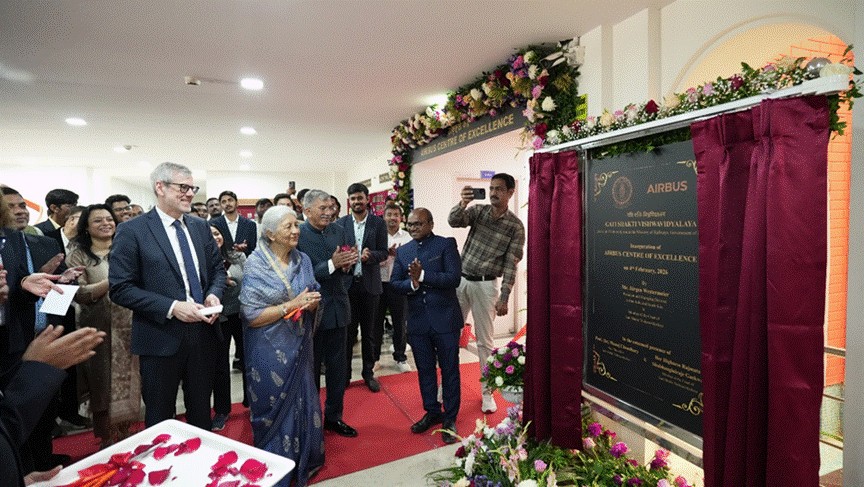
Airbus and Gati Shakti Vishwavidyalaya have inaugurated a Centre of Excellence in Vadodara to advance sustainable aerospace research, innovation, and skill development. Focused on Sustainable Aviation Fuel from municipal waste, the initiative strengthens India’s aerospace ecosystem through industry-academia collaboration, scholarships, research grants, and future-ready academic programmes.
In Vadodara, inside the campus of a university built on the idea that industry and academia must evolve together, a new chapter in India’s aerospace story quietly began. Airbus, the global aerospace major, and Gati Shakti Vishwavidyalaya (GSV), India’s only central university dedicated entirely to transportation and logistics, inaugurated a Centre of Excellence (CoE) for aerospace studies that signals something far larger than a ceremonial ribbon-cutting. It signals intent: to position India not just as a consumer of aerospace technologies, but as a contributor to their future.
The Centre of Excellence, inaugurated by Jürgen Westermeier, President and Managing Director of Airbus India and South Asia, in the presence of Her Highness Rajmata Shubhanginiraje Gaekwad and Prof. (Dr.) Manoj Choudhary, Vice Chancellor of GSV, represents a maturing partnership between the aerospace industry and a university uniquely designed to serve it. Announced in 2024, the CoE now stands as a physical and intellectual hub where research, innovation and talent development converge around one of aviation’s most urgent challenges: sustainability.
At the heart of this collaboration is a focus on Sustainable Aviation Fuel (SAF), particularly a pioneering approach that seeks to convert Municipal Solid Waste (MSW) into aviation fuel. For an industry under mounting pressure to decarbonise, and for a country grappling with waste management at scale, the convergence of these two challenges into a single research agenda is both practical and visionary. It is a proposition that transforms a civic liability into an industrial asset, while opening new research pathways for students and faculty.
Westermeier described the Centre as a milestone in Airbus’ mission to co-create a robust aerospace ecosystem in India. He underscored how the CoE embodies the company’s commitment to research and innovation, especially in ground-breaking technologies that align with India’s development priorities. By empowering students with the skills to shape the aviation landscape, he said, the partnership supports the Government of India’s Aatmanirbhar Bharat vision—self-reliance through capability building.
For GSV, the Centre is a natural extension of its founding philosophy. Established as a Central University by an Act of Parliament in 2022, GSV was conceived to address the entire transportation and logistics ecosystem through a demand-driven curriculum. From railways and highways to ports, aviation, maritime and supply chain networks, the university’s mandate is to produce skilled professionals and new technologies that serve national infrastructure and industry. The aerospace CoE fits seamlessly into this mandate, bringing aviation research into a larger framework of integrated transport thinking.
Vice Chancellor Prof. Manoj Choudhary highlighted how the partnership with Airbus has become a template for industry-academia collaboration in India. Under the guidance of the university’s Chancellor, Union Minister Ashwini Vaishnaw, GSV has been translating an industry-driven, innovation-led vision into tangible outcomes. The Centre of Excellence, he noted, is one of several steps already taken with Airbus, including the establishment of an Airbus Chair Professorship and a scholarship programme, all designed to nurture highly skilled human capital for the aerospace sector.
This is not a collaboration that began with the CoE. Since 2024, Airbus and GSV have been building the foundations of an integrated aerospace ecosystem through multiple interventions. A full scholarship programme supports 45 meritorious and underprivileged students, with one-third of the scholarships reserved for women, addressing both access and gender diversity in a sector traditionally skewed in representation. The Airbus Chair Professor for Aerospace Studies anchors academic excellence, enabling the development of undergraduate, postgraduate and executive programmes tailored to evolving industry needs.
The partnership has also expanded into structured research through a Joint Study Agreement (JSA) focused on sustainable aviation solutions. Under this agreement, grants are provided for research into converting municipal solid waste into Sustainable Aviation Fuel, combining GSV’s research capabilities with Airbus’ industrial expertise. The ambition is to create a locally sourced, circular economy for aviation fuel in India—one that reduces reliance on fossil fuels, manages waste more effectively, and fosters indigenous technological capabilities.
The symbolism of this approach is powerful. Aviation, often criticised for its carbon footprint, becomes part of a solution that addresses urban waste and energy sustainability. Students, instead of working on theoretical projects detached from real-world problems, are placed at the intersection of civic challenges and industrial innovation. The Centre of Excellence thus becomes a live laboratory where academic inquiry is directly tied to national priorities and global industry transitions.
The presence of Her Highness Rajmata Shubhanginiraje Gaekwad at the inauguration added a layer of local pride to the event, linking Vadodara’s legacy of patronage for education and culture with a forward-looking technological vision. For the city and the state of Gujarat, the CoE positions the region as a contributor to India’s aerospace research landscape, complementing existing industrial and educational strengths.
GSV’s unique structure makes it particularly suited for such partnerships. As India’s only university dedicated to transportation and logistics, it operates on the premise that modern infrastructure challenges cannot be solved in silos. Aviation is connected to railways through cargo logistics, to ports through multimodal transport, to urban mobility through passenger movement, and to digital networks through smart systems. This integrated perspective offers fertile ground for aerospace studies that go beyond aircraft design to encompass supply chains, fuel logistics, sustainability and systems thinking.
For Airbus, the collaboration represents a long-term investment in India’s intellectual and human capital. India is one of the fastest-growing aviation markets in the world, and as airlines expand fleets and connectivity deepens, the demand for skilled aerospace professionals will only rise. By investing at the university level, Airbus is helping shape the talent pipeline while contributing to research that could influence future industry practices.
The Centre of Excellence is also aligned with broader national aspirations. References to Aatmanirbhar Bharat and the vision of Viksit Bharat by 2047 underscore how such initiatives are seen as enablers of self-reliance and development. Rather than importing solutions, the emphasis is on nurturing local research, developing indigenous capabilities, and building ecosystems where industry and academia work in tandem.
What makes this initiative noteworthy is its holistic nature. It is not limited to infrastructure or symbolic partnerships. It spans scholarships for access, professorships for academic depth, research grants for innovation, and now a dedicated physical centre for collaboration. Each component reinforces the other, creating an environment where students can learn, experiment and contribute to real-world aerospace challenges.
As aviation globally confronts the twin pressures of growth and sustainability, the work undertaken at the CoE could have implications beyond India. If successful, research into converting municipal waste into aviation fuel could offer a model for other countries facing similar environmental and energy challenges. The CoE thus positions GSV and Airbus at the forefront of conversations that matter to the future of flight.
In Vadodara, the Centre of Excellence stands as more than a building or a programme. It represents a convergence of vision—of a university designed to serve industry, of a global aerospace leader committed to local ecosystems, and of a country determined to build its capabilities from the ground up. In classrooms and laboratories, in scholarship recipients and research fellows, the future of Indian aerospace is being quietly shaped, one experiment, one idea, and one student at a time.
Discover more from Creative Brands
Subscribe to get the latest posts sent to your email.