


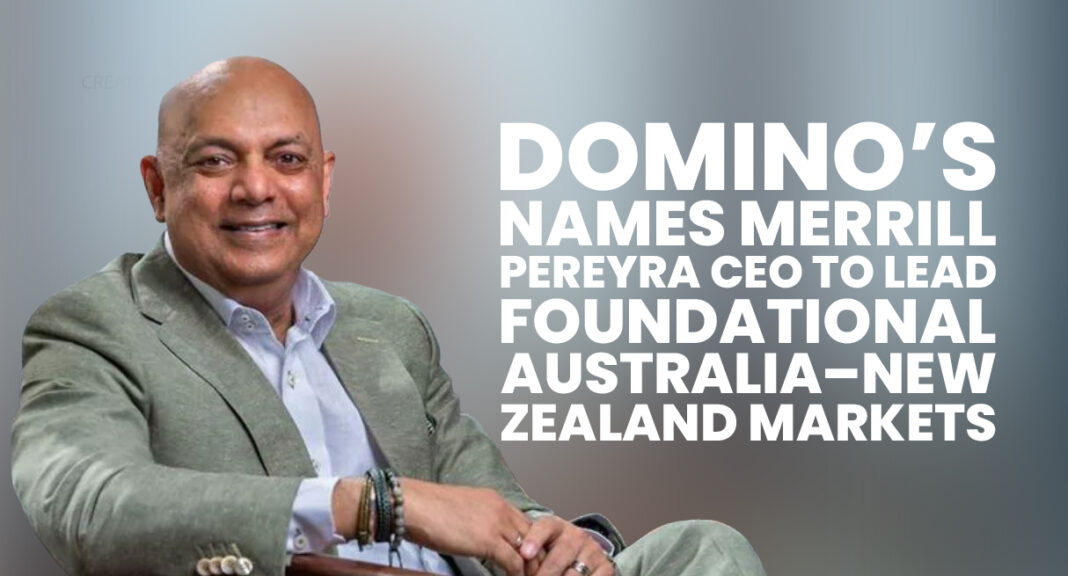
Domino’s Pizza Enterprises Limited has appointed Merrill Pereyra as Chief Executive Officer for Australia and New Zealand, placing him at the helm of the company’s largest regional operations. He will oversee more than 880 stores and carry full responsibility for sales, profitability, operations, franchise relations, and long-term brand strength.
Domino’s Pizza Enterprises Limited has elevated Merrill Pereyra to the role of Chief Executive Officer for its Australia and New Zealand operations, a decision that places one of the company’s most seasoned leaders at the center of its most valuable and strategically foundational markets. The appointment, announced this week, reflects Domino’s intention to reinforce its regional strength through experienced leadership, stronger franchise relationships, and a more customer-led operating ethos that will shape the brand’s next phase of growth.
Pereyra’s portfolio is extensive. As the new CEO across the two countries, he will hold direct accountability for performance across more than 880 stores — a scale that underscores the significance of the region not only as Domino’s original home market, but also as the anchor from which the brand has expanded its influence globally. Australia and New Zealand remain Domino’s largest market cluster, both in terms of physical footprint and brand contribution, making his remit one of the most consequential positions within the organisation.
The role is far from symbolic. In addition to overseeing store network performance, the CEO assumes responsibility for sales velocity, operational efficiency, unit profitability, and competitive positioning across the broader quick-service dining landscape. The market has evolved rapidly in recent years, with customers increasingly expecting digital convenience, faster delivery times, and menu variety suited to shifting dietary priorities. Pereyra is stepping into a leadership moment shaped by these pressures, and by a sector-wide race to build sustainable and technology-forward business models without sacrificing speed, value, or service consistency.
Industry observers have noted that Domino’s has long treated the Australia–New Zealand region as a testbed for innovation—whether through early adoption of online ordering platforms, investments in delivery optimisation tools, or trials in automated kitchen processes. The company was among the first in the sector to fully embrace end-to-end digital ordering, a move that transformed customer behaviour and proved lucrative for operators. Pereyra’s leadership is expected to expand on this groundwork, particularly as Domino’s seeks new levers for competitive differentiation in a landscape crowded with aggregators, new challenger brands, and rapidly expanding dark kitchen operators.
Central to his mandate will be franchise partnerships, a domain that has become increasingly important in sustaining profitable store models. Franchisees remain the backbone of Domino’s network, and their ability to thrive reflects directly on the health of the broader business. Strengthening these relationships requires a careful balance: driving operational excellence while ensuring unit economics remain compelling in markets with rising cost-of-living pressures, wage increases, and fluctuations across supply chains. Pereyra’s appointment signals an emphasis on collaborative performance frameworks rather than top-down directives—an approach industry analysts say has become necessary as franchise networks across the quick-service food space grow more vocal about profitability challenges.
The company has positioned Pereyra as a leader suited to build not only a stronger commercial operation, but one that is customer-oriented and tuned to long-term sustainability. Domino’s has frequently articulated ambitions around environmental accountability, packaging transitions, energy efficiency across store operations, and more ethical sourcing practices within supply chains. These initiatives align with consumer expectations—particularly among younger demographics—who prioritise brand responsibility alongside price and convenience. For Domino’s, embedding such values at scale is increasingly linked to maintaining brand loyalty in a competitive sector where switching costs for customers are nearly non-existent.
Customers in Australia and New Zealand have historically demonstrated a strong affinity for Domino’s, especially through promotional pricing and aggressive product innovation cycles that often outpace global competitors. However, that loyalty is not guaranteed. The rise of food delivery apps has introduced a generation of consumers who may choose convenience marketplaces over single-brand ordering. Pereyra’s customer-led mandate acknowledges this shift and hints at an intention to reinforce direct digital channels, loyalty system enhancements, and personalised ordering experiences that can keep Domino’s within consumers’ top-of-mind meal considerations.
From an investor standpoint, the appointment is seen as stabilising. Domino’s has undergone market recalibrations in recent years, responding to changes in consumption patterns post-pandemic, recalculated delivery expectations, and operational constraints tied to labour shortages. Analysts argue that leadership continuity paired with strategic renewal can help close the gap between operational realities and future growth aspirations. Pereyra’s oversight of both performance metrics and structural improvements gives him authority to align tactical decisions with long-horizon brand positioning—something investors often welcome in volatile consumer sectors.
Beyond financial metrics, the narrative around Pereyra’s appointment emphasises stewardship. Domino’s leadership has indicated its interest in a long-term view, one that avoids short-term revenue boosts at the expense of customer trust or brand integrity. This perspective has become more prevalent across the broader food retail ecosystem as companies contend with public scrutiny over pricing, wage practices, nutritional positioning, and environmental impact. Pereyra’s challenge will be translating sustainability rhetoric into operational frameworks that support profitable growth—an endeavour easier described than executed in a margin-sensitive sector.
Still, the markets of Australia and New Zealand present distinctive advantages. Consumers are accustomed to digital-first food ordering behaviour, franchise networks are mature compared to other regions, and regulatory environments—while more stringent in some areas—provide predictability as long as companies maintain compliance and community engagement. For Domino’s, leveraging these structural strengths while modernising operational models may provide the blueprint for future expansions and reforms abroad.
Discover more from Creative Brands
Subscribe to get the latest posts sent to your email.