


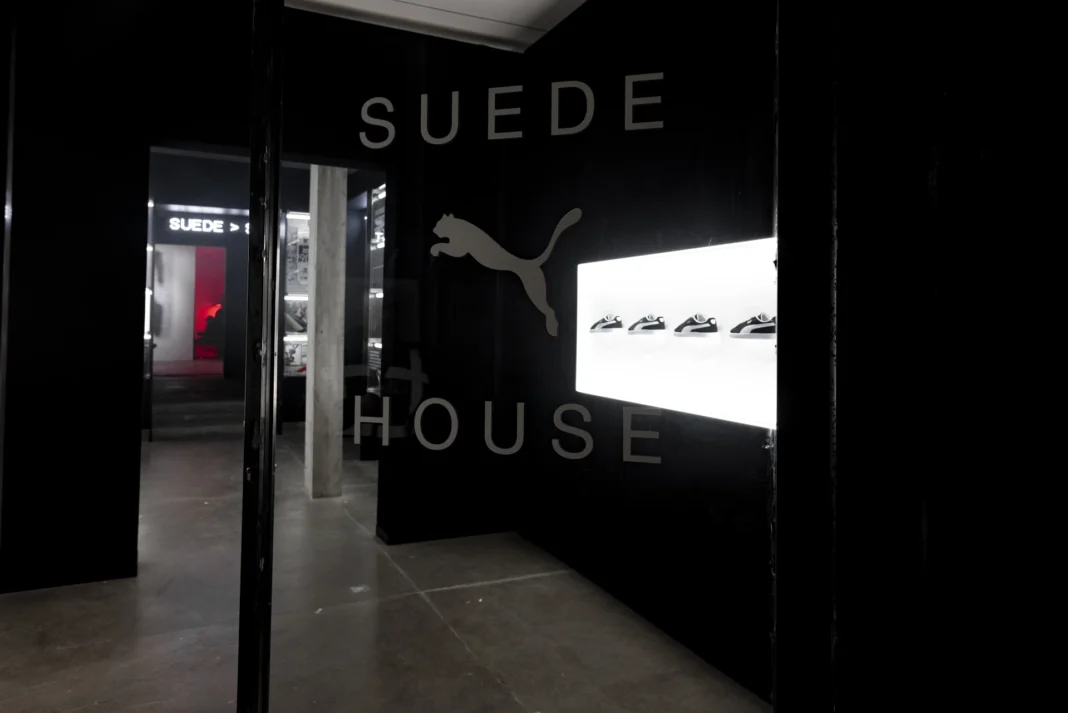
From Olympic podiums to basketball courts, concert stages, and city streets, the PUMA Suede has transcended sport to become a cultural symbol. Born in 1968 from the PUMA Crack and immortalized by Tommie Smith and Walt “Clyde” Frazier, the Suede now steps into a bold new era at Paris Fashion Week.
The story of the PUMA Suede is not just about a shoe. It is about a cultural artifact that has lived through decades of change, rebellion, artistry, and reinvention. To understand why the Suede continues to resonate today, one must return to 1968, a year of upheaval and transformation across the world. That year, PUMA introduced the Crack, a shoe named after the sports term for exceptional talent. It was designed for training and leisure, built to perform, but destined to become much more than a piece of athletic equipment.
The Crack’s place in history was cemented when Tommie Smith, the American sprinter, won the 200m race at the Mexico City Olympics, becoming the first human to break the 20-second barrier. On the podium, Smith raised his fist in a Black Power salute, a gesture that reverberated across the globe as a protest against racism and social inequality. Beside him, placed deliberately, was the PUMA Crack. In that moment, the shoe became more than footwear—it became a silent witness to history, a symbol of courage and defiance.
Soon after, another legend entered the Suede’s story. Walt “Clyde” Frazier, the flamboyant New York Knicks star, joined PUMA and sought to create a basketball shoe that reflected his personality both on and off the court. Using the Crack as inspiration, Frazier worked with PUMA to design a low-cut silhouette with a suede upper and his signature “Clyde” branding. The PUMA Clyde was born, and with it, the Suede began its journey from sportswear to style icon.
The Clyde was revolutionary not only because of its performance but because of its aesthetic. At a time when basketball shoes were largely utilitarian, the Clyde brought flair. Its suede material gave it texture, depth, and a sense of luxury. Its low-cut design allowed for versatility, making it equally at home on the hardwood and in everyday life. Frazier himself embodied this duality—an athlete with unmatched skill and a man of style who turned heads with his bold suits and confident swagger. The Clyde, and later the Suede, became extensions of that persona.
As the shoe grew globally, it took on a new name based on its defining material: the PUMA Suede. By the 1970s and 1980s, the Suede had transcended basketball. It found its way into hip-hop culture, worn by breakdancers who prized its grip and flexibility. On the streets of New York, the Suede became part of the uniform of a generation that was inventing new forms of expression. Its presence in music videos, on album covers, and in graffiti-filled neighborhoods cemented its place as more than a shoe—it was a statement.
The Suede’s versatility allowed it to cross boundaries effortlessly. On stages, musicians wore it as a badge of authenticity. On the streets, it became a symbol of rebellion and individuality. On courts, it remained a trusted companion for athletes. Few shoes have managed to live so many lives, adapting to the needs of each era while retaining their core identity.
What makes the Suede enduring is its ability to carry stories. Every scuff, every crease, every worn sole tells of the places it has been and the people who have worn it. From Tommie Smith’s podium protest to Walt Frazier’s dazzling performances, from breakdancers spinning on cardboard to musicians commanding arenas, the Suede has been present at moments that shaped culture.
Now, more than five decades later, the Suede is preparing for its next chapter. At Paris Fashion Week, PUMA is setting the stage for the Suede’s reinvention. The event is not just about showcasing new designs—it is about reaffirming the Suede’s place in the cultural conversation. Fashion Week is where heritage meets innovation, and for the Suede, it is an opportunity to remind the world of its legacy while pointing toward the future.
The anticipation is palpable. What will the next era of the Suede look like? Will it lean into its athletic roots, or will it embrace high fashion more fully? Will it continue to be a canvas for self-expression, or will it evolve into something entirely new? Whatever the answer, one thing is certain: the Suede will not fade quietly into history. It has proven time and again that it can adapt, survive, and thrive.
The Suede’s journey is also a reminder of the power of design. A shoe may seem like a simple object, but when imbued with meaning, it can become a vessel for identity, protest, and artistry. The Suede’s suede upper, once a design choice, became a symbol of luxury and individuality. Its low-cut silhouette, once a practical adjustment, became a marker of style. Its association with figures like Smith and Frazier gave it credibility and charisma. Over time, these elements combined to create something larger than the sum of its parts.
In many ways, the Suede reflects the evolution of culture itself. It began in sport, moved into protest, found a home in music, and now resides in fashion. Each stage of its life mirrors broader societal shifts. The 1960s were about breaking barriers and demanding equality. The 1970s and 1980s were about creativity, rebellion, and the birth of new cultural movements. Today, the Suede enters an era where fashion is global, diverse, and constantly reinventing itself.
For PUMA, the Suede is both a legacy and a challenge. How does one honor the past while creating something new? How does one retain authenticity while appealing to new generations? These are questions that every brand must grapple with, but for PUMA, the Suede provides a unique opportunity. It is not just a product—it is a story, and stories have the power to endure.
As Paris Fashion Week unfolds, eyes will be on the Suede. But beyond the runway, its impact will continue to be felt wherever people seek to express themselves. On courts, on stages, and on streets, the Suede will live on, carrying with it the weight of history and the promise of the future.
The icon lives on, not because it is preserved in museums or archives, but because it is worn, used, and loved. The Suede is alive in every step taken by those who choose it. And as it enters its next era, it reminds us that true icons are not static—they evolve, adapt, and continue to inspire.
Discover more from Creative Brands
Subscribe to get the latest posts sent to your email.