


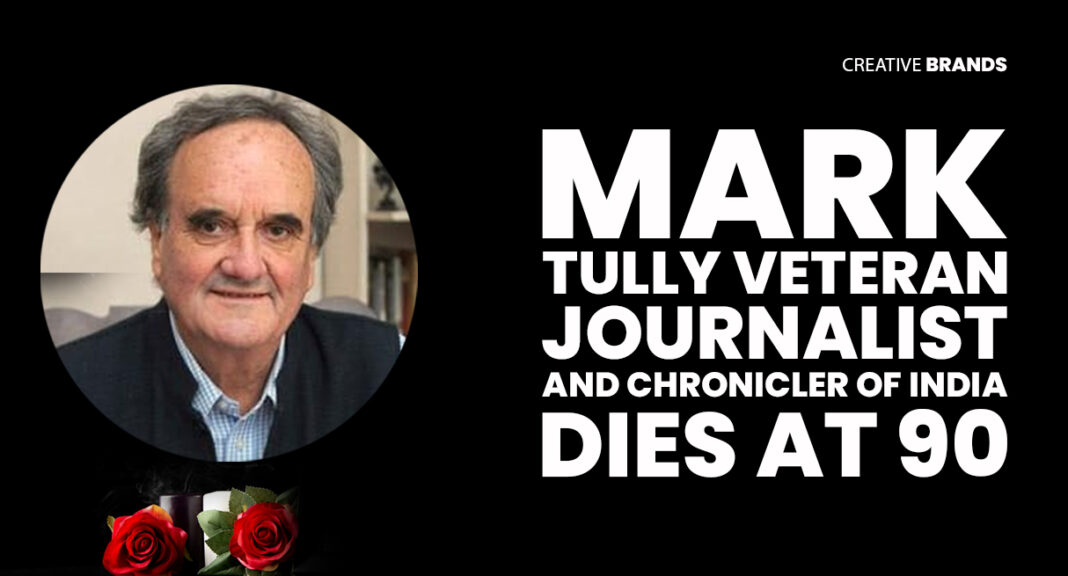
MARK TULLY,
Mark Tully, veteran journalist and author, passed away at 90 in Delhi’s Max Hospital Saket. Widely regarded as a chronicler of India, Tully was best known for his long association with the BBC until 1994 and his writings on India’s social, political, and cultural life, earning global recognition.
Mark Tully, the veteran journalist and author whose voice and words became synonymous with the story of modern India, passed away at Max Hospital Saket in Delhi on Sunday. He was 90. His death marks the end of an era in journalism, one defined by deep curiosity, empathy, and a rare ability to capture the complexities of a nation in transition. According to reports, Tully had been unwell for some time and was hospitalised about a week ago. His close friend and fellow journalist Satish Jacob confirmed the news, saying, “Mark passed away at Max Hospital Saket this afternoon.”
For decades, Tully was a towering presence in the world of journalism, particularly through his long association with the BBC, where he worked until 1994. His voice, calm yet authoritative, carried the stories of India to the world, bridging cultures and continents. He was not merely a foreign correspondent reporting from India; he became a chronicler of its soul, weaving narratives that reflected the country’s contradictions, challenges, and triumphs. His work was marked by a deep respect for the people he wrote about, and his ability to listen and observe made his journalism stand apart.
Born in Calcutta in 1935, Tully’s early life was shaped by India, though he later moved to Britain for his education. His return to India as a journalist was, in many ways, a homecoming. He joined the BBC in 1964 and soon became its India correspondent, a role that would define his career. Over the next three decades, he reported on some of the most significant events in India’s history: the Emergency of 1975, the assassination of Prime Minister Indira Gandhi in 1984, the rise of communal tensions, and the economic liberalisation of the 1990s. His reporting was not confined to politics; he delved into the social and cultural fabric of the country, exploring its villages, traditions, and everyday lives.
Tully’s departure from the BBC in 1994 did not mark the end of his engagement with India. On the contrary, it allowed him to devote more time to writing, producing books that became essential reading for anyone seeking to understand the country. Works such as No Full Stops in India and India’s Unending Journey reflected his nuanced understanding of a nation that defied easy categorisation. His writings were not just reportage; they were meditations on identity, change, and continuity. Through his books, Tully invited readers to see India not as a puzzle to be solved but as a living, breathing entity with its own rhythms and contradictions.
Recognition for his work came from both India and abroad. He was awarded the Padma Bhushan in 2005, one of India’s highest civilian honours, acknowledging his contribution to journalism and literature. Yet Tully remained modest about his achievements, often emphasising that his role was simply to tell stories as faithfully as he could. His humility and integrity earned him respect across generations of journalists and readers.
Tully’s legacy lies not only in the stories he told but in the way he told them. At a time when journalism often veered towards sensationalism, he embodied a quieter, more thoughtful approach. He believed in the power of context, in the importance of history and culture in shaping events. His reporting was marked by patience and depth, qualities that are increasingly rare in the fast-paced media landscape of today. For many, his voice on the radio was a trusted companion, guiding them through the tumultuous events of India’s recent past.
Beyond journalism, Tully was deeply engaged with India’s cultural and spiritual life. He was fascinated by the country’s religious traditions and often wrote about the role of faith in shaping its society. His explorations were not superficial; he sought to understand the philosophical underpinnings of Hinduism, Islam, Christianity, and other traditions, and how they interacted in the everyday lives of people. This interest gave his work a richness that went beyond politics and economics, situating India within a broader human context.
Friends and colleagues remember Tully as a man of warmth and generosity. Satish Jacob, who worked closely with him, described him as not just a colleague but a confidant and friend. Many younger journalists recall his willingness to mentor and guide, offering advice without condescension. His presence in Delhi’s journalistic circles was reassuring, a reminder of the values of integrity and curiosity that underpin good reporting.
Tully’s passing leaves behind a void that will be hard to fill. In an age of fragmented narratives and fleeting attention spans, his commitment to depth and nuance stands as a reminder of what journalism can and should be. His work continues to inspire those who seek to understand India in all its complexity. For readers and listeners across the world, he offered a window into a country that was at once ancient and modern, chaotic and ordered, fragile and resilient.
As India mourns the loss of one of its most perceptive chroniclers, it also celebrates the legacy he leaves behind. His books remain on shelves, his broadcasts echo in memory, and his insights continue to shape conversations about the country. Mark Tully’s life was a testament to the power of storytelling, to the belief that words can bridge divides and foster understanding.
He is survived by his family, friends, and countless admirers who found in his work a mirror of India’s journey. His death is not just the passing of a journalist; it is the departure of a voice that helped define how India was seen and understood, both within and beyond its borders.
Mark Tully’s story is, in many ways, the story of India itself—complex, layered, and unending. His passing at 90 is a moment of reflection, a reminder of the importance of chroniclers who dedicate their lives to telling the stories of nations and people. As the world remembers him, it does so with gratitude for a life well lived, a career that enriched understanding, and a legacy that will endure.
In the quiet corridors of Max Hospital Saket, where he breathed his last, the world lost not just a journalist but a storyteller, a chronicler, and a friend of India. His voice may be silent now, but his words will continue to resonate, reminding us of the power of listening, observing, and telling stories with honesty and compassion. Mark Tully’s journey has ended, but his story remains, woven into the fabric of India he loved and chronicled so faithfully.
Discover more from Creative Brands
Subscribe to get the latest posts sent to your email.