


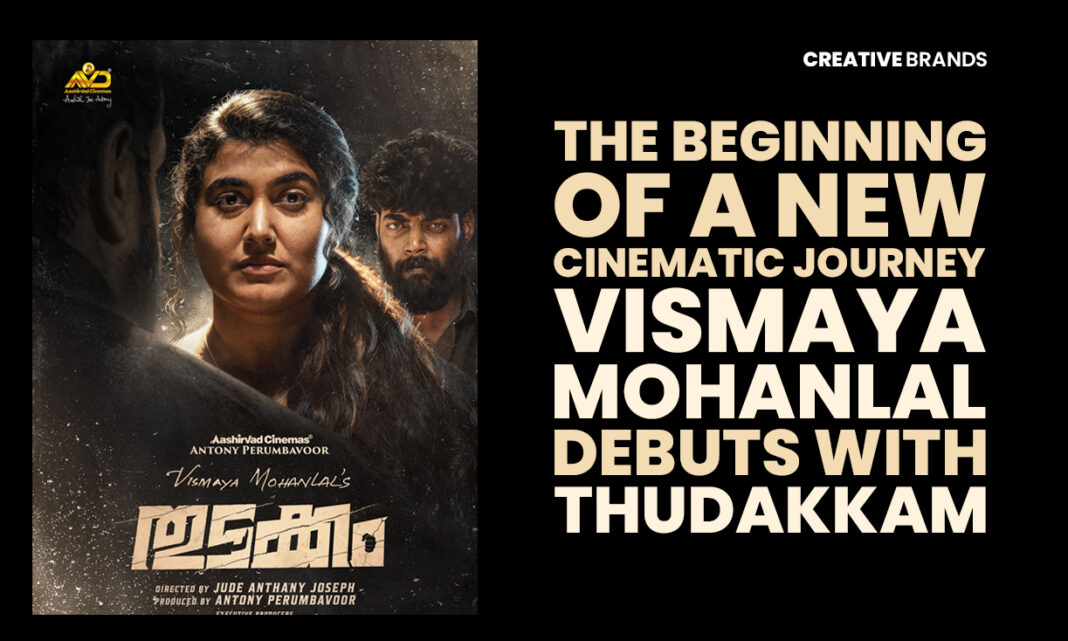
Vismaya Mohanlal, daughter of Malayalam superstar Mohanlal, makes her acting debut in Thudakkam, directed by Jude Anthany Joseph and produced by Antony Perumbavoor under Aashirvad Cinemas. The film introduces her through a gritty, performance-driven narrative, signalling a serious cinematic beginning rather than a typical star-launch spectacle.
There are certain moments in cinema that signal not just the arrival of a new film, but the arrival of a new voice, a new performer, and in many ways, a new legacy. Malayalam cinema now stands on the brink of one such moment with Thudakkam, the much-anticipated debut of Vismaya Mohanlal, daughter of Malayalam superstar Mohanlal. Produced by Antony Perumbavoor under the banner of Aashirvad Cinemas and directed by acclaimed filmmaker Jude Anthany Joseph, the film marks the beginning—quite literally, as the title translates to “Beginning”—of what could be a significant career in contemporary Malayalam cinema.
The first poster of Thudakkam immediately establishes its tone and stylistic intentions. Vismaya appears front and center, framed in a moody portrait that captures both vulnerability and determination. Her gaze meets the viewer directly, quietly asserting her presence without theatricality. Behind her, the supporting faces seem to hint at a web of relationships and tension, setting up what appears to be a character-driven drama with grit at its core. The poster does not rely on extravagance or familiar tropes; instead, it announces the debutant with a cinematic seriousness uncommon for first-time actors emerging from industry families.
Aashirvad Cinemas, the home production banner long associated with some of Malayalam cinema’s biggest titles, is backing the film, adding immediate credibility to the project. Antony Perumbavoor takes the producer’s seat, with Dr. Emil Vincent and Dr. Anisha Antony serving as executive producers. While commercial pedigree often defines many star-kid debuts in Indian cinema, Thudakkam appears to take an alternative route, leaning into narrative intensity rather than star-driven spectacle. That choice feels deliberate and quietly strategic.
At the creative helm is Jude Anthany Joseph, a director known for his distinct tonal command—balancing realism, emotional density and accessibility. The writing team, including Binish Nellikkal, Akhil Krishna and the director himself, signals a collaborative effort in shaping the narrative. The poster’s typography and color palette, darkened and textured, places the film in the realm of grounded social drama or psychological storytelling rather than the flamboyant or comedic genres that sometimes host debut performances.
What makes Vismaya’s debut particularly intriguing is the duality of expectation that surrounds her. On one side lies the unavoidable shadow of her lineage—a father whose name evokes a library of iconic performances and decades of stardom. On the other is the evident attempt of Thudakkam to introduce her not as an extension of that legacy, but as an individual performer with her own cinematic path to chart. Malayalam cinema has historically been kind to new talents, but rarely has the arrival of a debutant carried such a layered intersection of anticipation, curiosity and comparison.
In Malayalam cinema’s recent evolution, newcomers have been embraced with growing openness. Performance-oriented scripts and character-first narratives have created space for actors to emerge without the need for typical star-launch packaging. In that sense, Thudakkam seems to emerge in the right cultural moment. Audiences have become more attentive to nuance, more appreciative of grounded storytelling and more welcoming of fresh performers who bring sincerity rather than spectacle.
Beyond the poster’s central reveal, the film’s credits further illuminate the seriousness of the production. The sound design is led by Vishnu Govind, a name associated with immersive auditory worlds in Malayalam cinema. Production design sits with Santosh Raman, contributing to the visual language that appears to lean into realism. Costume design by Jithesh Poyya, art direction by Mohanraj K Payyanur and makeup by Biju Thomas further underline the controlled aesthetic envisioned for the film.
The technical crew, spanning cinematography to editing, ensure that this debut is not merely symbolic but professionally robust. Films with grounded dramatic tones often rely more heavily on such departments—texture, lighting, soundscapes and design elements become narrative tools rather than background decoration. Thudakkam seems poised to use those tools effectively.
While the poster does not reveal plot details, the imagery hints at social or personal conflict. The gaze of the supporting characters, particularly the young man in the background, carries a brooding quality—suggesting relational dynamics that may orbit around the protagonist. Vismaya’s character may inhabit a space of negotiation, confrontation or emotional upheaval. Whether the film leans into contemporary social drama, psychological exploration or an interpersonal narrative remains to be seen, but its first impression suggests depth.
The absence of overt glamour in Vismaya’s introduction is notable. The casting choice and the poster design both reject the default debut template often seen in mainstream Indian cinema. Instead of placing Vismaya in a stylised or ornamental frame, the film introduces her through expression, presence and emotive potential. This creative choice may serve two parallel functions: it separates her debut from her lineage and signals an industry-backed faith in her performance capabilities.
For Malayalam cinema, talent has often been a defining factor over lineage. Performers who have endured and grown in the industry have typically done so through versatility and craft rather than mere inheritance. If Thudakkam indeed positions Vismaya as an actor of substance rather than spectacle, the film could function as a thoughtful launchpad for her future roles.
The film’s title, Thudakkam, gains metaphorical resonance in this context. It is not just the beginning of a story on screen, but the beginning of a career, a cinematic identity and a public journey for its debutant. The creative team’s composure in presenting this moment—without fanfare or sensationalism—suggests an awareness that beginnings matter most when they are authentic rather than loud.
As anticipation builds, much of the audience curiosity will center around how Vismaya performs within the film’s narrative. Will she carry emotional weight? Will she show range? Will she surprise? Will she bring an interpretive language that is her own and not merely an echo of expectation? These questions do not merely apply to her, but to any actor stepping onto the cinematic stage for the first time. Yet in Vismaya’s case, they arrive amplified.
Malayalam cinema’s current trajectory—with its embrace of realism, craft-driven filmmaking and storytelling innovation—may be the ideal landscape for her debut. If Thudakkam succeeds in its narrative aims, Vismaya may find herself entering an industry moment that values performance more than pedigree.
With production now under way and the poster serving as the film’s first formal introduction, the countdown to Thudakkam has quietly begun. No release date has been announced yet, and no further promotional materials have been revealed. But if the poster’s restraint is any indication, the film seems intent on letting the work speak for itself rather than relying solely on legacy or hype.
For now, Thudakkam stands as both a cinematic beginning and a symbolic one. It marks the entry of a new performer, the expansion of a storied banner and the continuation of Malayalam cinema’s modern evolution. When the film finally reaches audiences, the industry will not just be watching the screen—it will be watching a debut, a first step and perhaps the shaping of a future star in real time.
Discover more from Creative Brands
Subscribe to get the latest posts sent to your email.