


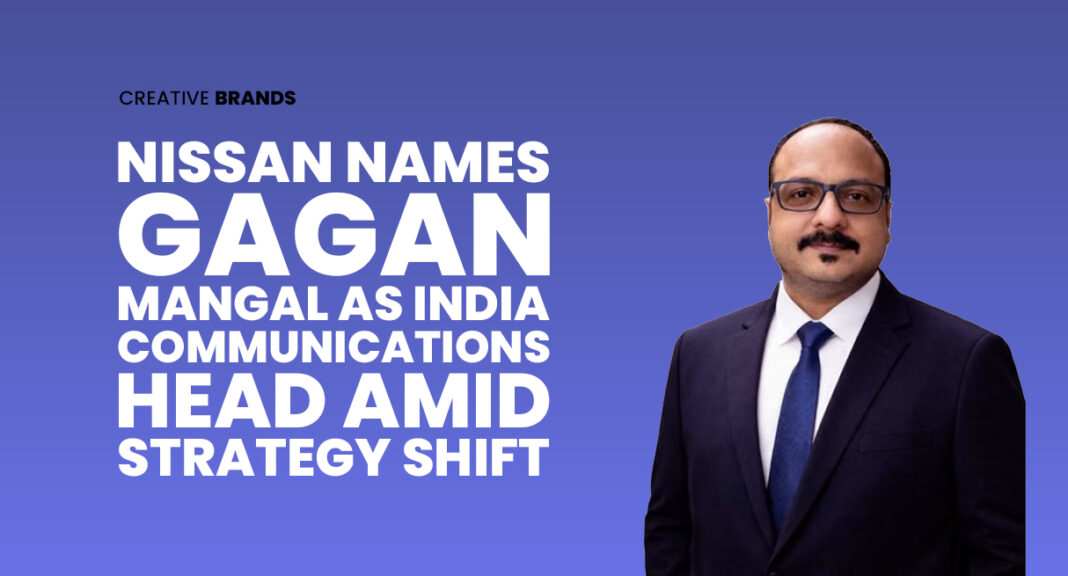
Nissan Motor Corporation has appointed Gagan Mangal as its Head of Communications for India. He joins from Volkswagen India, where he led Press and Marketing Communications. The move signals Nissan’s focus on stronger messaging, deeper stakeholder engagement, and brand rebuilding in a competitive automotive landscape shaped by new technologies and shifting consumer expectations.
Nissan Motor Corporation has appointed Gagan Mangal as its new Head of Communications for India, a development that underscores the company’s renewed emphasis on strategic brand-building and stakeholder engagement in one of its key emerging markets. Mangal joins the Japanese auto major from Volkswagen India, where he was leading Press and Marketing Communications, and was credited for developing strong media relationships and consistent storytelling around the brand’s product and technology portfolio in the Indian market.
His move to Nissan comes at a time when the automotive sector is navigating significant shifts — from electrification and digital retail to changing consumer preferences and tighter regulatory frameworks. For companies operating in India, an effective communication strategy is no longer viewed as merely complementary to business operations, but central to building relevance, trust and long-term customer loyalty. Nissan’s decision to bring in a leader with experience across brand messaging, media strategy and corporate positioning highlights the expanding role that communications now plays in shaping corporate conviction and public perception.
Industry watchers note that Nissan has been recalibrating its India strategy in phases, with a renewed focus on product introductions, technology positioning and customer connect programmes. The company has also been working to strengthen its dealer network and after-sales experience to build more confidence among prospective buyers. Against this backdrop, the communications charter is expected to broaden from simple product publicity to managing multiple layers of engagement — including corporate, policy, media, customer and community-oriented streams.
Mangal’s previous role at Volkswagen India saw him at the intersection of marketing and communications, a dual responsibility that has become increasingly relevant in the modern automotive landscape. Traditional silos between product communication, marketing outreach and media relations have been dissolving as brands seek more coherent and integrated storytelling across their consumer touchpoints. His familiarity with this integrated approach is likely to help Nissan craft a more unified narrative as it positions itself within a crowded and competitive marketplace that includes legacy global players as well as ambitious domestic manufacturers.
Automotive analysts suggest that India continues to be an important part of Nissan’s global footprint, even though it remains a relatively complex market to scale. The company has been actively evaluating how global brand equities can be adapted to local sensibilities, particularly as electric mobility begins to gain policy backing. Communications leaders also have a role in framing how companies speak about innovation, safety, sustainability and affordability — themes that now sit at the heart of automotive decision-making among Indian consumers, regulators and media alike.
Mangal’s appointment therefore arrives at a moment when narratives matter as much as machinery. The automotive industry, once driven purely by engineering and performance metrics, is now as much about purpose, transparency and community-building. Communications heads are expected to convey business decisions with clarity, translate global intent into local context, and respond swiftly to external developments that influence consumer confidence. In this environment, Nissan’s investment in strengthening its communications leadership reflects a broader strategic ambition.
For Nissan India, the coming period is expected to involve product-led engagement supported by evidence-driven storytelling. Stakeholders across the supply chain — from manufacturing partners to dealers — increasingly expect clearer communication about future plans, policy alignments and technology roadmaps. Media too has evolved into a more analytical and multi-platform ecosystem, demanding richer perspectives, faster responses and more compelling narratives. Experienced communicators like Mangal are therefore seen as crucial to steering this expanded communication environment while safeguarding brand credibility.
While Nissan has not publicly elaborated on the specific mandates attached to Mangal’s new role, industry observers anticipate that his portfolio will include strengthening Nissan’s presence in mainstream and emerging media, reinforcing its voice in the electric mobility conversation, and shaping communication around future launches and market strategies. His cross-functional experience could also support internal communications and leadership messaging, areas that have become essential as multinational companies navigate hybrid work cultures and distributed operational models.
As the automotive sector continues to evolve, communication leaders occupy an increasingly strategic position within the corporate hierarchy. Nissan’s choice signals its recognition of this shift and its intention to sharpen how it is seen, understood and experienced in India. Gagan Mangal’s appointment, therefore, is not just a personnel update; it reflects the expanding influence of communications on the way mobility brands compete, differentiate and build trust in one of the world’s most dynamic auto markets.
Discover more from Creative Brands
Subscribe to get the latest posts sent to your email.