


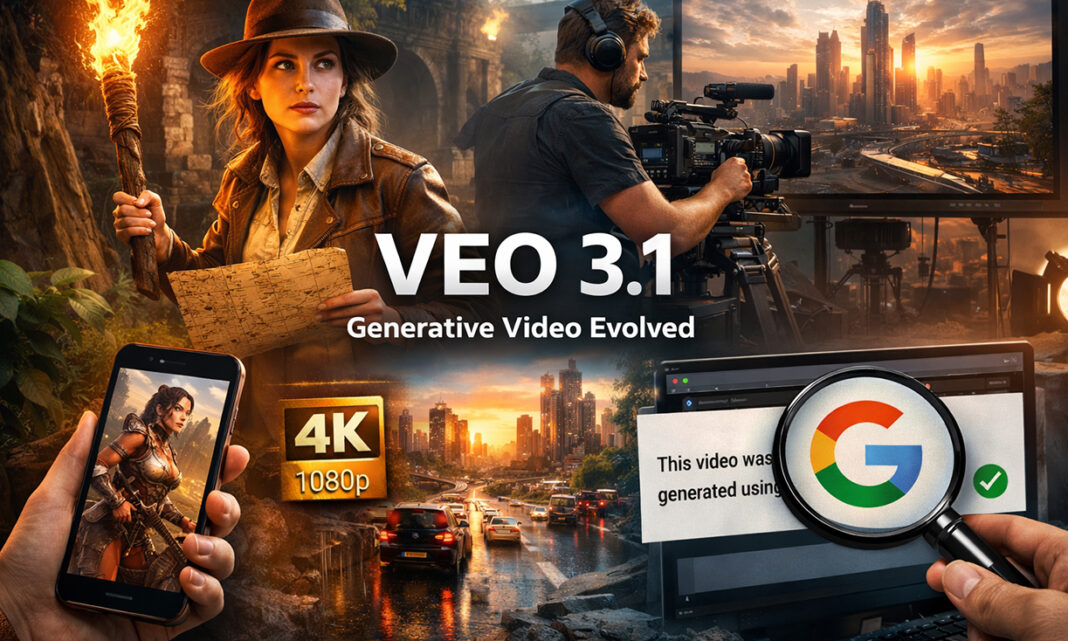
Google’s Veo 3.1 update introduces more expressive generative video tools with improved character consistency, native vertical formats, and pro-grade 1080p and 4K options. The revamp makes AI video more suitable for both casual creators and professional filmmakers, while new provenance verification tools add accountability to an increasingly synthetic video landscape.
Veo 3.1, Google’s generative video model, is preparing to unlock a new chapter of expressiveness with a series of upgrades designed to widen the bridge between imagination and moving image. The latest update goes beyond incremental tweaks, opening up fresh creative possibilities for everyone, from hobbyist storytellers using smartphones to seasoned filmmakers working at a cinematic scale. While generative video is still a young field, Veo 3.1’s push toward richer control, higher resolution, and mobile-first formats suggests that the model is maturing fast — and that the future of video creation may be both more accessible and more technically ambitious than ever before.
One of the most visible upgrades in Veo 3.1 is a reengineered “Ingredients to Video” workflow, which allows users to generate new video clips using their own images as visual building blocks. The feature has been revamped to support better character consistency, tighter background control, and more intentional object placement — three areas that have historically challenged generative video systems. These improvements allow users to simulate the sort of continuity that filmmakers take for granted: a character retains the same facial features across shots, objects remain in the same environment, and surface textures maintain coherence from frame to frame. Such advances are not merely cosmetic; they signal an important step toward narrative reliability in AI-generated media, where the goal is no longer just to produce a novel clip but to tell a story with stable internal logic.
This upgrade may sound technical, but its implications stretch into culture and platform dynamics. Casual creators can now produce TikTok- or YouTube-style videos without needing to film or animate every asset themselves, while professionals can draft previsualizations, mood films, or experimental test shots with less friction. The creative gap between a storyboard and a working draft begins to shrink. For brands and creative studios, the ability to “lock in” artistic decisions like backgrounds, props, or character design could make AI video a practical tool rather than a novelty. For independent filmmakers, the technology could serve as a sandbox for experimenting with style or camera language without access to actors, sets, or post-production houses. The mainstream implications may unfold more gradually, but the direction is clear: the generative video system is increasingly becoming a creative collaborator.
Another upgrade aimed squarely at the realities of 2026 media consumption is the addition of native vertical video support for the Ingredients workflow. The shift acknowledges how profoundly platforms like TikTok, YouTube Shorts, and Instagram Reels have reshaped the video economy. Mobile screens are now the primary window through which millions of users—especially Gen Z and Gen Alpha—experience visual storytelling. Generative tools that cannot support tall formats out of the box risk feeling outdated, because repurposing widescreen footage for vertical platforms not only requires reframing but often damages quality. Veo 3.1 bypasses this constraint by generating clips directly in mobile-first aspect ratios, enabling full-frame clarity without cropping or compression artifacts. For platforms hungry for endless content and for creators who work at the speed of trends, this seemingly simple design change could significantly accelerate adoption.
Technical quality also sees a leap forward with newly introduced professional-grade resolution options, including state-of-the-art 1080p output and optional 4K upscaling. High resolution is not simply a matter of cosmetic polish; it affects compositing, color grading, and the ability to integrate AI-generated footage into larger cinematic or advertising pipelines. For agency work, commercial films, and long-form storytelling, higher resolution can be the difference between exploratory use and deployment in real productions. In the film and VFX space, resolution determines how well AI imagery sits alongside traditionally shot material. If generative footage can withstand scrutiny at 4K, then the door opens to hybrid workflows where AI assists rather than replaces traditional filmmaking. Even if Veo’s outputs are not yet poised to rival the controlled chaos of live-action cinematography, the ability to generate detailed, texture-rich motion at higher fidelity makes experimentation more consequential.
The upgrades arrive during an inflexion point for generative video, where models such as Veo, OpenAI’s Sora, and emerging research prototypes from China, Europe, and Silicon Valley are racing to push realism, controllability, and narrative cohesion forward. What distinguishes Veo 3.1 is not only image quality but also its sensitivity to creator behaviour and platform culture. Instead of treating generative video as a pure research challenge, the update treats it as a craft—one where editing, shot selection, and visual continuity matter. Storytelling has always involved constraint: angles must match, characters must persist, environments must feel like parts of the same world. If AI systems cannot respect such constraints, they remain toy technologies. If they can, they begin to feel like tools.
Beyond creation, Veo’s ecosystem also shows early signals of accountability and provenance. In case users missed it in earlier announcements, Google quietly enabled a verification flow within the Gemini app that allows users to upload a video and ask if it was generated using Google AI. While still opt-in and limited to Google’s own outputs, the feature gestures toward a future where provenance becomes embedded in the user experience. This matters because generative video carries both creative promise and societal risk. The ease of producing photorealistic motion raises questions about misinformation, impersonation, and the general erosion of audiovisual trust. Verification mechanisms—while currently modest—may eventually help standardise how authentic or synthetic footage is labelled, tracked, and understood.
Taken together, Veo 3.1 paints a picture of generative video that is shifting from “novel” to “usable,” from experimental spectacle to functional platform. The upgrades lower friction for casual creators, raise quality ceilings for professionals, and expand compatibility with the global media formats that dominate in 2026. For Google, the project also strengthens its broader Gemini ecosystem, integrating creation, verification, and platform tools into a coherent content pipeline. For creators, the question becomes less about whether AI can make a video and more about how video-making itself might change.
There are still open challenges. Cinematic storytelling requires not only consistent visuals but compelling performances, pacing, camera grammar, and emotional nuance. Filmmakers know that the difference between a convincing scene and an uncanny one often lies in subtle micro-movements, timing, and framing. Generative video remains limited in how well it can translate script-level intention into shot-level execution. Tools like Veo may accelerate early ideation or allow for playful experimentation, but full productions still depend heavily on human direction, human actors, and human editing. That said, the technology is moving quickly enough that scepticism must be updated frequently.
If the last decade of digital media was shaped by smartphones, influencers, and vertical video platforms, the next may be shaped by generative engines that compress production timelines, democratize access, and redefine what “shooting” a scene even means. Veo 3.1 does not close that loop, but it pushes the industry closer to a new storytelling grammar—one where creators describe rather than capture, assemble rather than film, a
Discover more from Creative Brands
Subscribe to get the latest posts sent to your email.