


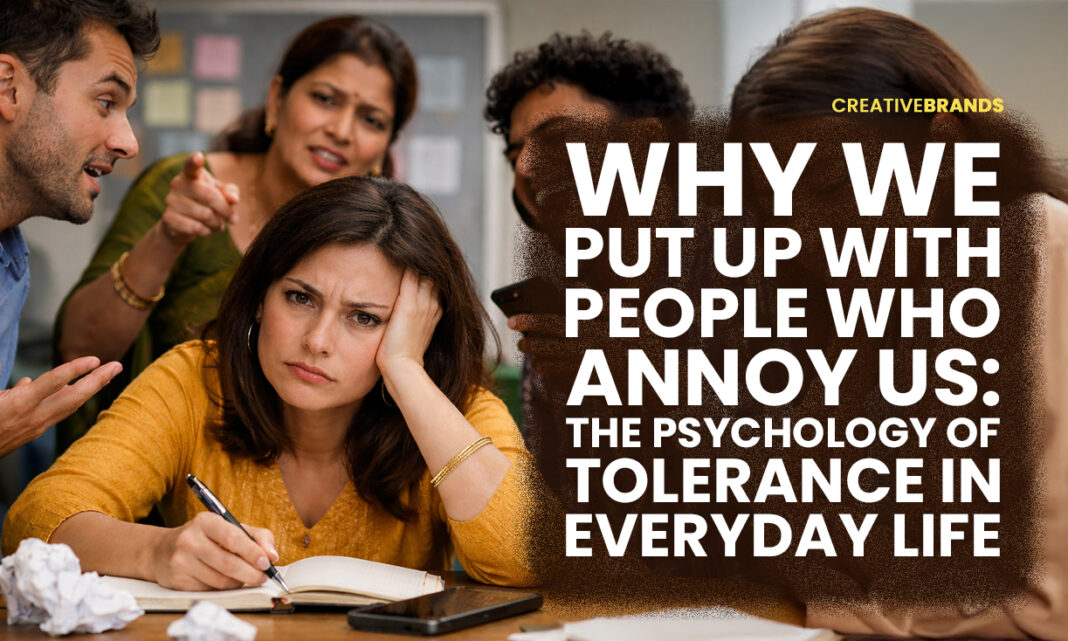
From difficult colleagues to challenging family members, tolerating irritating people is a daily reality. Rooted in evolution, social norms, empathy, and fear of conflict, this behaviour helps societies function. Understanding the psychology behind tolerance reveals how boundaries, self-awareness, and emotional intelligence can turn quiet endurance into a healthier way of coexisting.
Every day, in offices, families, neighbourhoods, and public spaces, people find themselves sharing time and space with others who test their patience. The colleague who never stops talking, the relative who criticises everything, the neighbour who ignores boundaries, the stranger whose behaviour feels inconsiderate or loud. These encounters provoke a deceptively simple question: why do we tolerate people at all, especially when they irritate us? The answer lies deep within human psychology, shaped by evolution, social norms, emotional needs, and the practical realities of living in a shared world.
Humans are fundamentally social creatures. Long before modern societies existed, survival depended on belonging to a group. Cooperation meant protection, access to resources, and shared knowledge, while exclusion often meant death. This evolutionary inheritance still governs modern behaviour. The brain is wired to prioritise social bonds, even when those bonds are uncomfortable. Tolerating difficult people is often an unconscious calculation that maintaining the relationship—or at least avoiding conflict—is safer than challenging it. The discomfort of irritation is weighed against the perceived risk of social rupture, and tolerance usually wins.
Social norms further reinforce this instinct. From childhood, people are taught rules of politeness, respect, and restraint. “Be patient,” “Don’t make a scene,” and “Keep the peace” are not just moral lessons but social survival strategies. These norms act as invisible contracts that allow large, diverse societies to function. Tolerance becomes a form of social glue, preventing minor irritations from escalating into open conflict. Even when someone’s behaviour feels unreasonable, the expectation to remain civil exerts a powerful influence, guiding reactions long before conscious reasoning kicks in.
There is also the role of power and dependence. Many irritating relationships are not optional. A difficult boss controls career prospects, a family member is bound by blood, a client or customer represents income, and a neighbour shares physical space. In such situations, tolerance becomes a strategy for self-preservation. Psychologists describe this as adaptive behaviour: people adjust their responses to minimise harm and maximise stability. Enduring irritation is often perceived as the lesser evil compared to the potential consequences of confrontation, such as job loss, family rifts, or prolonged hostility.
Empathy, too, plays a subtle but significant role. Humans possess a natural capacity to imagine the inner lives of others, even when those others are annoying. This capacity can soften reactions. An irritating person may be reframed as stressed, insecure, lonely, or unaware of their impact. Such interpretations do not excuse behaviour, but they make it more tolerable. Empathy allows people to see irritation as a symptom rather than an attack, reducing emotional intensity and making coexistence easier.
Another reason people tolerate irritating behaviour is the hope for change. Relationships are dynamic, and many people believe that patience will eventually be rewarded. This belief is especially strong in close relationships, where shared history and emotional investment create an expectation that things can improve. The human mind is inclined toward optimism in social bonds, often overestimating the likelihood that others will adapt, mature, or become more considerate. Tolerance, in this sense, is an investment in a better future, even when evidence suggests otherwise.
Fear of conflict is also a powerful motivator. Confrontation triggers stress responses associated with danger: increased heart rate, muscle tension, and anxiety. For many, especially those raised in environments where conflict was punished or emotionally unsafe, avoidance becomes a default coping mechanism. Tolerating irritation feels emotionally cheaper than engaging in a potentially volatile exchange. Over time, this avoidance can become habitual, shaping a personality that values harmony over self-expression, even at personal cost.
Yet tolerance has limits, and human behaviour reflects a constant balancing act between endurance and self-protection. When irritation accumulates without release, it often emerges as passive-aggressive behaviour, resentment, or emotional withdrawal. These responses reveal an important psychological truth: tolerance is not infinite. The brain keeps score, even when the conscious mind tries to ignore discomfort. Understanding this helps explain why people sometimes appear calm for long periods, only to react strongly to seemingly minor triggers. The irritation was never small; it was simply stored.
Living with irritating people, then, is less about suppressing emotion and more about managing it intelligently. One effective strategy is cognitive reframing, a process by which individuals consciously reinterpret situations to reduce emotional impact. Instead of viewing irritating behaviour as intentional or personal, it can be seen as habitual, unconscious, or rooted in the other person’s limitations. This shift does not change the behaviour, but it changes the emotional response, giving the individual greater control.
Setting boundaries is another crucial element, though it is often misunderstood. Boundaries are not acts of aggression but of clarity. They define what behaviour is acceptable and what is not, without attacking the person. Psychologically, boundaries protect mental well-being by reducing ambiguity and resentment. People who struggle to tolerate irritation often lack clear boundaries, leading them to endure more than they should and then feel overwhelmed. Learning to express limits calmly and consistently can transform tolerance from silent suffering into conscious choice.
Self-awareness also plays a key role. Irritation is not solely about the other person; it is also shaped by one’s own stress levels, expectations, and unresolved emotions. When people are tired, anxious, or overburdened, their tolerance threshold drops sharply. Understanding this connection allows individuals to respond with curiosity rather than blame. Instead of asking, “Why are they so irritating?” the more useful question becomes, “Why is this affecting me so strongly right now?”
At a deeper level, irritating people often mirror aspects of ourselves that we dislike or suppress. Psychology refers to this as projection. Traits such as arrogance, neediness, or disorganisation may provoke strong reactions precisely because they touch unresolved internal conflicts. In this way, irritation can become a teacher, revealing areas of personal growth. While this perspective does not make the behaviour pleasant, it adds meaning to the experience and reduces the sense of helplessness.
Ultimately, tolerance is not about liking everyone or accepting all behaviour. It is about navigating the reality of human diversity with a balance of patience, self-respect, and emotional intelligence. The modern world, with its crowded cities, interconnected workplaces, and digital proximity, offers little escape from others’ habits and personalities. Learning to live with irritation is therefore not a moral weakness but a practical skill.
The human capacity to tolerate others has allowed societies to form, families to endure, and institutions to function despite constant friction. It is an imperfect skill, shaped by fear, empathy, habit, and hope. When practiced unconsciously, it can lead to quiet resentment; when practiced thoughtfully, it can become a form of strength. In understanding why we tolerate irritating people, we gain insight not only into human behaviour, but into ourselves—and into the delicate psychology that makes shared life possible.
Discover more from Creative Brands
Subscribe to get the latest posts sent to your email.