


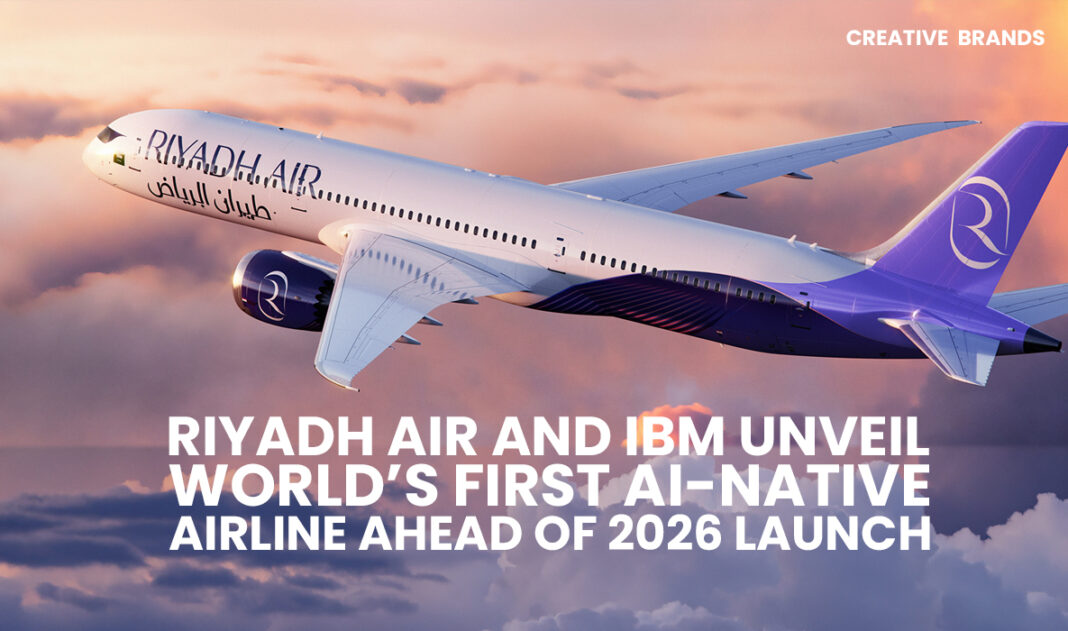
Riyadh Air and IBM have announced the launch of what they call the world’s first AI-native airline at IBM Think Riyadh 2025. Built without legacy systems, the airline embeds AI across operations and experiences, setting a new benchmark for aviation as it prepares for commercial service in 2026.
When Riyadh Air and IBM took the stage at IBM Think Riyadh 2025 to announce the launch of what they called “the world’s first AI-native airline,” the claim immediately signalled ambition on a scale rarely heard in commercial aviation. This was not presented as another digital transformation project or a retrofit of smart technologies onto an established carrier. Instead, the partnership framed Riyadh Air as an airline conceived, designed and built for an era in which artificial intelligence is not a tool on the margins, but the operating core.
Saudi Arabia’s newest national carrier is still months away from its commercial debut, with full service expected to begin in early 2026. Yet the declaration that it is already operating initial flights and functioning as an AI-native enterprise suggests a decisive turning point in a three-year collaboration that has quietly unfolded behind the scenes. For both Riyadh Air and IBM, the moment marks the transition from conceptual design to live execution, turning years of architectural planning into a working airline.
The central premise underpinning the partnership is a rejection of what many in aviation have come to accept as inevitable: decades of layered, ageing technology systems stitched together over time. According to the companies, Riyadh Air has been designed “from the ground up without legacy patch work,” allowing AI-driven operations to form the foundation of everything from internal processes to the passenger experience. The ambition is not simply to run flights more efficiently, but to set what the companies describe as a new benchmark for innovation across the industry.
For Riyadh Air, the decision to build anew rather than inherit legacy systems was a strategic one. Adam Boukadida, the airline’s Chief Financial Officer, captured this thinking bluntly. “We had a clear choice—be the last airline built on legacy technology or the first built on the platforms that will define the next decade of aviation,” he said. His words reflect a broader awareness within aviation that the industry’s entrenched IT architectures often slow innovation, complicate integration and inflate costs. By contrast, Riyadh Air’s approach aims to remove half a century of technological baggage in one move.
IBM Consulting has played a central role in translating that ambition into reality. Acting as the orchestrator of Riyadh Air’s AI strategy, IBM coordinated 59 separate workstreams and brought together more than 60 partners in what the company described as a complex, multi-layered ecosystem. Among those partners were global technology players, including Adobe, Apple, FLYR and Microsoft, each contributing capabilities that fit into the broader architecture of an AI-native airline.
At the heart of the system sits IBM’s WatsonX Orchestrate platform, which the airline is using to embed AI across its operations. Rather than deploying AI as standalone tools or experimental pilots, Riyadh Air is using the platform to integrate generative and agentic AI directly into core workflows. This approach allows automation, decision-making and intelligence to operate seamlessly across departments, from finance and operations to customer engagement.
IBM’s Senior Vice President for Consulting, Mohamad Ali, described the project as a blueprint for a new kind of enterprise. “By embedding AI into the very foundation of its operations, Riyadh Air is setting a new blueprint for what it means to build a modern, adaptive enterprise from the ground up,” he said. For IBM, the airline represents more than a single client engagement; it is a proof point for how organisations born in the AI era can operate differently from those forced to modernise later.
The stakes of this experiment extend beyond technology alone. Riyadh Air is positioning itself within the broader context of Saudi Arabia’s Vision 2030, which seeks to diversify the kingdom’s economy and strengthen its role as a global travel and business hub. Aviation plays a central role in that vision, and the creation of a technologically advanced carrier aligns with national ambitions to project innovation and future readiness on the global stage.
According to the release, a key focus of the AI-native model is the convergence of employee and guest experiences. Traditional airlines often treat internal systems and customer-facing platforms as distinct domains, linked loosely at best. Riyadh Air is attempting to dissolve that divide by creating what it calls a synchronized environment, where employees and AI systems work together in real time to deliver what it describes as “effortless travel.”
In practical terms, this means rethinking how airline staff interact with technology at every touchpoint. By infusing generative AI and agentic AI into workflows, employees are meant to be supported by intelligent systems that anticipate needs, surface insights and automate routine tasks. The aim is to free human staff to focus on higher-value interactions, particularly in moments that shape passenger perception, such as service recovery, personalised assistance and problem-solving.
For travelers, the promise is a more responsive and personalised journey. While specifics remain limited, the implication is that AI-native operations can enable smoother booking experiences, real-time updates, proactive disruption management and more tailored communication. By designing these capabilities into the airline from inception, rather than layering them onto older systems, Riyadh Air hopes to avoid the inconsistencies that often frustrate passengers.
The complexity of coordinating 59 workstreams and over 60 partners underscores the scale of the undertaking. Aviation is among the most regulated and operationally demanding industries, and building an airline from scratch involves navigating safety, compliance, logistics and global interoperability. Adding an AI-first strategy to that mix raises the bar further, requiring careful governance and integration to ensure reliability and trust.
Yet it is precisely this complexity that makes the project notable. Many airlines are experimenting with AI in isolated domains—dynamic pricing, predictive maintenance or chat-based customer support—but few have the opportunity to rethink their entire operating model without historical constraints. Riyadh Air’s clean-slate approach offers a rare test case for whether AI-native design can deliver measurable advantages in resilience, efficiency and experience.
As initial flights are already underway, the coming months will be closely watched by both industry observers and competitors. The move from concept to commercial service in early 2026 will test whether the theoretical advantages of AI-native architecture translate into consistent, scalable performance in real-world conditions. Issues such as system reliability, data governance and human-AI collaboration will come into sharp focus once operations expand.
For Boukadida, the effort is explicitly forward-looking. “Riyadh Air isn’t just built for today; it’s built for the future and creating a pathway for many airlines to follow in the years to come,” he said. That pathway, if successful, could challenge long-standing assumptions about how airlines are designed and operated, particularly at a time when the industry faces pressure to become more agile, sustainable and customer-centric.
IBM, meanwhile, positions the collaboration as evidence of its ability to operate at the intersection of strategy, technology and ecosystem coordination. Helping a new national carrier emerge as an AI-native enterprise reinforces the company’s ambitions in consulting and enterprise AI, especially in markets investing heavily in digital infrastructure.
Whether Riyadh Air ultimately redefines aviation or simply becomes a high-profile experiment will depend on execution as much as vision. What is clear, however, is that the airline’s launch marks a distinct moment in the industry’s evolution—a signal that the next generation of carriers may not be constrained by the past, but shaped instead by platforms and intelligence designed for the decades ahead.
Discover more from Creative Brands
Subscribe to get the latest posts sent to your email.