


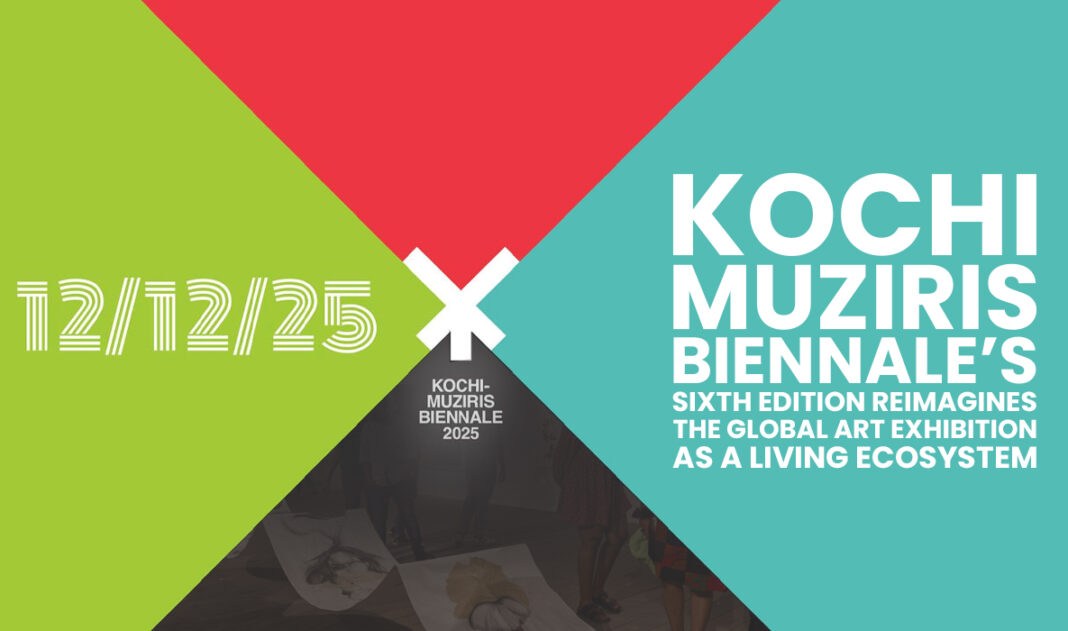
Running from December 12, 2025, to March 31, 2026, the sixth Kochi-Muziris Biennale moves beyond spectacle to embrace process, collaboration and friendship economies. Rooted in Kochi’s history, it reimagines the biennale as an evolving, responsive ecosystem engaging local contexts and global artistic perspectives.
The sixth edition of the Kochi-Muziris Biennale arrives with a quiet but decisive shift in how one of India’s most influential contemporary art events understands itself. Rather than presenting the Biennale as a singular, centralised exhibition-event built for spectacle and completion, the curatorial vision this time proposes something more porous and patient: an invitation to embrace process as methodology, and to recognise the friendship economies that have long sustained artist-led practices as the very scaffolding of the exhibition.
This conceptual turn reframes the Biennale not as a destination to be consumed, but as a living ecosystem—one that evolves through shared space, time and resources, and grows through dialogue rather than decree. In doing so, the Kochi-Muziris Biennale continues to distinguish itself from the global circuit of biennales that often prioritise scale, speed and visual impact. Instead, it leans into slowness, collaboration and locality, asserting that meaning in art can emerge through sustained relationships rather than finished gestures.
The context of Kochi is central to this approach. A historic port city that once functioned as a meeting point for traders, travellers and ideas from across the world, Kochi offers a natural framework for thinking about exchange—not as transaction alone, but as conversation. The Biennale’s decision to begin with its site and region, and then engage outward with emerging global perspectives, reflects an understanding of globalism that is grounded rather than abstract. Rootedness here is not a limitation; it is a strategy.
By anchoring the exhibition in local histories, geographies and social realities, the Biennale resists the homogenising pressures of the conventional biennale model, which often demands easily legible themes and finished spectacles that can travel seamlessly across borders. The sixth edition proposes instead an exhibition that is evolving, responsive and alive—one that changes as artists, audiences and spaces interact with it over time. This makes the Biennale less a static event and more a process unfolding across months, conversations and collaborations.
The emphasis on “process as methodology” marks a subtle but radical departure in curatorial thinking. Rather than foregrounding completed works as the sole carriers of meaning, the Biennale highlights the conditions under which art is made: friendships, informal networks, shared labour and mutual care. These “friendship economies,” often invisible within institutional art structures, are acknowledged as foundational rather than peripheral. In doing so, the exhibition calls attention to alternative models of cultural production that operate outside market-driven imperatives.
This shift is especially resonant in an era when the global art world is grappling with questions of sustainability—both ecological and cultural. Large-scale exhibitions are increasingly scrutinised for their carbon footprints, labour practices and resource consumption. The Kochi-Muziris Biennale’s move toward decentralisation and shared resources offers a response rooted not in austerity, but in relational abundance. By allowing elements of the Biennale to coexist and grow in dialogue with one another, the exhibition proposes a way of working that is adaptive rather than extractive.
The sixth edition also reflects a maturation in the Biennale’s institutional thinking. Since its inception, the Kochi-Muziris Biennale has occupied a unique place in India’s cultural landscape, bridging local artistic energies with international attention. Over successive editions, it has faced logistical challenges, public scrutiny and debates around governance and management. This year, assurances of a more robust management model suggest an effort to consolidate operational lessons alongside curatorial experimentation.Dr Venu V, Chairperson, Kochi Biennale Foundation, in commenting on the upcoming edition, noted that with a better management model in place, this year’s Biennale is expected to be an extraordinary experience for visitors. His statement gestures toward a renewed confidence—not only in the artistic vision, but in the infrastructure supporting it. For an exhibition that seeks to embrace openness and fluidity, such organisational stability becomes crucial, ensuring that experimentation is supported rather than undermined by practical constraints.
Visitors to the Biennale can expect an experience that unfolds rather than declares itself. The exhibition’s ecosystemic approach means that encounters may feel intimate, provisional and sometimes unfinished. This is intentional. By resisting closure, the Biennale invites audiences to become participants in meaning-making rather than passive spectators. Viewers are encouraged to spend time, return to sites, and engage with works and artists in ways that privilege curiosity over consumption.
The decision to decentralise also has implications for how the Biennale inhabits the city of Kochi. Instead of drawing all attention toward a single locus, the exhibition spreads across spaces, histories and neighbourhoods, encouraging movement through the city and engagement with its layered identities. In this sense, Kochi itself becomes a collaborator rather than merely a backdrop—a living archive shaped by trade, colonial encounters, migration and resistance.
Importantly, the sixth edition’s embrace of process does not imply a rejection of ambition or global relevance. On the contrary, by foregrounding emerging global perspectives through dialogue rather than dominance, the Biennale positions itself within contemporary debates on decolonisation, pluralism and cultural sovereignty. It suggests that global conversations need not be homogenised to be meaningful, and that specificity can generate resonance across borders.
Artist-led initiatives lie at the heart of this thinking. Historically, many of the most innovative art movements have emerged from informal collectives and friendships rather than institutional mandates. By recognising these dynamics, the Biennale aligns itself with a lineage of practices that value trust, experimentation and shared risk. This acknowledgement also challenges hierarchies within the art world, where visibility and validation are often tied to institutional access rather than sustained practice.
For artists, this framework offers space to work without the pressure of delivering instantly legible outcomes. For audiences, it offers an encounter with art that is less didactic and more conversational. And for the Biennale itself, it offers a way to remain responsive—to artists, to its city, and to the shifting conditions of the world it inhabits.
As the Kochi-Muziris Biennale enters its sixth chapter, it does so with an expanded understanding of what an exhibition can be. It proposes that a biennale need not be defined solely by what is shown, but by how relationships are built, resources are shared and conversations are sustained. In choosing to value process over product, and friendship over spectacle, the Biennale stakes a claim for a slower, more attentive cultural practice.
In a global art landscape often driven by urgency and visibility, the sixth Kochi-Muziris Biennale offers something rarer: time. Time to think, to connect, and to allow meaning to emerge organically. As it unfolds across Kochi’s historic spaces, the Biennale invites visitors not just to witness art, but to dwell within the conditions that make art—and community—possible.
Discover more from Creative Brands
Subscribe to get the latest posts sent to your email.