


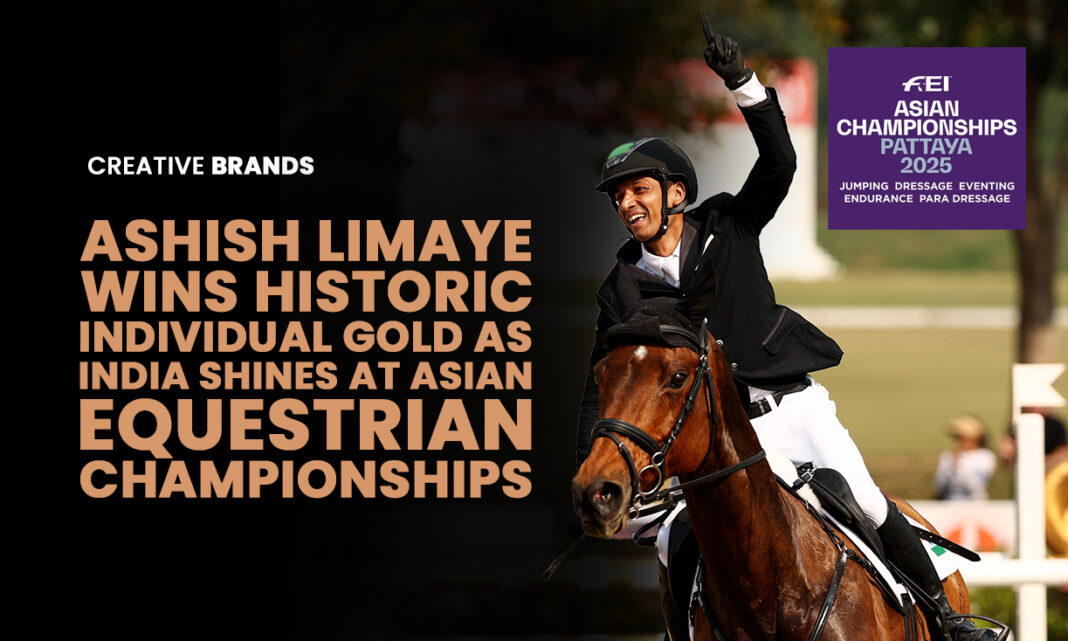
Ashish Limaye made history by winning India’s first-ever individual gold in eventing at the Asian Equestrian Championships, riding Willy Be Dun to a 29.4 score. Supported by Embassy International Riding School, he also led Team India to a silver medal, marking the nation’s biggest equestrian triumph since 1982.
Ashish Limaye’s golden moment at the Asian Equestrian Championships did not arrive quietly; it arrived like a long-awaited exhale—one filled with years of persistence, heartbreak, redemption, and finally, triumph. Riding his trusted partner Willy Be Dun with the steady confidence of an athlete who has lived every high and low of the sport, Limaye scripted history by clinching India’s first-ever individual gold medal in eventing at the prestigious continental championship. His final score of 29.4 was not just a number; it was the culmination of a journey shaped by discipline, faith, and the unwavering belief of those who stood by him. With this victory, he also becomes the first Indian rider to win an individual continental gold since the 1982 Asian Games, marking a monumental milestone for Indian equestrian sports.
The medal feels even sweeter when placed within the context of Limaye’s personal trajectory. Eventing, often described as the triathlon of equestrian sport, demands a unique blend of precision, endurance, partnership, and mental resilience. Riders must excel across dressage, cross-country, and show jumping—three phases that test both athlete and horse in completely different ways. Limaye has been mastering this discipline for years, and yet, his biggest breakthrough arrived now, after setbacks that would have discouraged many others.
He still remembers the bitter sting of the last Asian Games, where he was poised to win but faltered at a critical moment. His words after the win reflected the emotional weight of that memory. “It has been a long journey, but today it all seems worth it,” he said, holding back the emotion of a man whose redemption was written not just in victory but in perseverance. “Especially after the last Asian Games when I was leading and had a blank moment—it felt like I let everyone down. Today, this feels like a redemption.”
His victory was not solitary; it was a symphony of people, organisations, and, most importantly, the horse with whom he shares an unbroken bond. “It takes a village to get here,” Limaye acknowledged. “My family, my trainers Carola Bierlein and Jerome Robine, and everyone that was a part of it directly or indirectly got us this medal… and on top of the list is my horse, WILLY BE DUN!” That emphasis was more than sentiment—it was truth. In equestrian sport, the horse is a full partner, and the success of one is inseparable from the spirit of the other. Willy Be Dun, seasoned, steady, and full of heart, carried Limaye through every hurdle, embodying the athletic grace required to rise above a fiercely competitive field.
But behind every elite athlete stands an ecosystem without which such glory is impossible. And in Limaye’s case, that backbone has been Embassy International Riding School (EIRS) and its leadership. For years, EIRS and its chairman Jitu Virwani have been among the strongest supporters and sponsors of Limaye’s journey. They believed in his potential long before this gold medal turned that faith into a headline. Virwani and EIRS Director Silva Storai have consistently provided Limaye with world-class training facilities, infrastructure, and international-level exposure—resources that remain rare for Indian athletes in equestrian disciplines.
Storai, a celebrated equestrian herself and the first woman jockey licensed in India and Italy, has long recognised Limaye’s grit and promise. She has watched him train through heat, fatigue, and the emotional burden of past disappointments. His win, she noted, was a testament not just to talent but to his perseverance and willingness to rise after every fall. At EIRS, she has cultivated a culture where discipline meets compassion, and Limaye’s victory stands as a reflection of that dynamic.
The championship also brought another moment of pride: the Indian team—comprising Ashish Limaye, Shashank Kanumuri, and Shashank Kataria—earned a silver medal with a combined score of 121.8, finishing just behind Thailand. For a nation still building its presence in global equestrian sports, this team success signals a promising shift. It shows that India is no longer an outlier but an emerging contender, supported by institutions capable of nurturing world-class riders.
Limaye’s individual win, however, sits at the heart of this narrative, radiating significance beyond the medal ceremony. This is a sport where India has historically been overshadowed by nations with stronger equestrian cultures and deeper institutional support. For decades, the lack of infrastructure, access to quality horses, and limited funding kept Indian riders away from podium finishes. Breaking through that barrier is more than a personal feat—it is a rewriting of expectations.
The win also inspires a new generation of young riders who train at EIRS and other academies across the country, often dreaming quietly and working relentlessly. Limaye’s journey gives their dreams a shape, a direction, and, importantly, a real possibility. When he says this medal belongs to an entire community, he means it. And for those watching him navigate each phase of the event with precision and resolve, it becomes clear that India now possesses both the talent and the nurturing systems to challenge the world.
The details of this victory will likely be recounted for years—the calmness of his dressage round, the fearless flow of his cross-country ride, and the exactness of his show jumping. But what will stay alive longer is the spirit of the moment: the image of an Indian rider standing tall with a gold medal that had eluded the country for over four decades. His victory marks not just a sporting achievement but a cultural one, elevating equestrian sport into national conversation and inspiring institutions to invest further.
For Embassy International Riding School, the win validates years of commitment to building a global-standard equestrian ecosystem in India. Their investment in training, international coaching, and athlete development has now produced a continental champion. For Limaye, the medal is both an ending and a beginning—an affirmation of what he has endured and an opening into the future he hopes to create.
As he held the medal, reflecting on everything that led him there, he returned to gratitude more than once. Gratitude for his supporters, for his coaches, for his family, and above all, for Willy Be Dun. It was a gold won by partnership, by belief, by long roads traveled and longer ones yet to come.
And for Indian equestrian sports, it was a reminder that history can change in a moment—sometimes at the hands of a rider who refused to give up, riding a horse that believed in him just as much as he believed in himself.
Discover more from Creative Brands
Subscribe to get the latest posts sent to your email.