


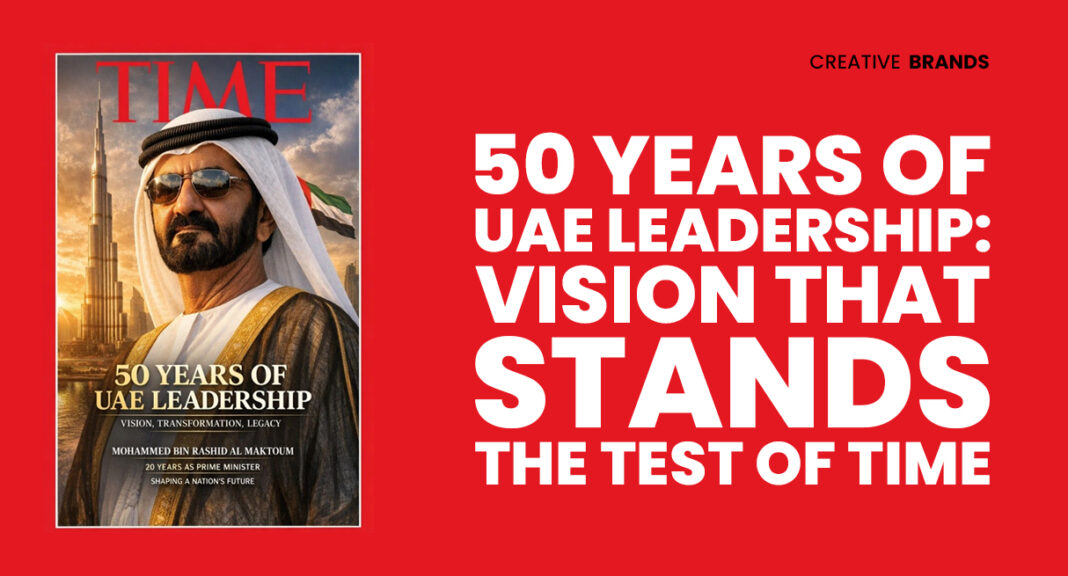
For over five decades, the UAE’s leadership has built a nation defined not by resources, but by long-term vision, strategic governance, and disciplined execution. Under a model that plans in generations, not cycles, the UAE evolved from federation to global hub, proving that leadership is ultimately about direction—not power.
Fifty years ago, the United Arab Emirates entered the global map with more sand than skyline, more aspiration than infrastructure, and more ambition than certainty. What it lacked in physical resources, it compensated for with leadership that saw beyond horizon lines. The transformation of the UAE from a young federation into a nation studied by policymakers and economists worldwide has become a case study in the power of long-term vision. As the country crosses five decades of governance, development, and institution-building, the story that emerges is not merely about oil wealth, nor the skyscrapers that now define the Dubai skyline, nor the global businesses that anchor its economic model. It is fundamentally a story about strategy, continuity, and leadership built for generations, not election cycles. It is a narrative that would fit comfortably on the cover of a global publication like TIME—not for spectacle, but for substance.
Among the architects of the UAE’s governance model stands His Highness Sheikh Mohammed bin Rashid Al Maktoum, who marks two decades as the nation’s Prime Minister. His premiership has been shaped not around preserving power, but around expanding capability. In a world where governments often struggle to deliver on promises made in four-year cycles, the UAE’s political DNA has insisted on planning for the next 40. From the earliest days of federal consolidation to modern strategies such as Vision 2021 and the ambitious Centennial 2071 roadmap, the country’s leadership has treated governance less as administration and more as nation-building. Every initiative is asked to serve a higher question: where will the UAE be in decades, not in quarters.
This generational thinking explains why the country often appears to move at a different rhythm compared to other states. Decision-making is fast, but priorities are patient. Reform is continuous, yet identity is preserved. Innovation is welcomed, but coherence is protected. It is this balance that has allowed the UAE to transition from a resource-based economy to an ever-diversifying global hub. The logic is simple but rare: speed can coexist with stability if clarity guides both.
The shift from traditional public administration to what observers describe as inspirational governance was neither accidental nor rhetorical. Ministries were not treated merely as bureaucratic outposts tasked with compliance and paperwork, but as performance units charged with delivering outcomes. Public service became synonymous with public value. The Prime Minister’s Office itself transformed into an engine of execution, data tracking, policy design, and government acceleration. Initiatives were not only launched, but measured; not only announced, but delivered; not only imagined, but institutionalized.
Dubai’s evolution into a logistical, technological, and tourism hub often captures the imagination of international audiences. But these visible outcomes reflect a broader governing ethos that touches every sector. Digital governance took root early, not as a branding exercise but as an efficiency mandate. Economic diversification was pursued so the country would not be held hostage by commodity cycles. Talent attraction became a deliberate policy, recognising that 21st-century competitiveness depends more on human capital than natural resources. Global partnerships were nurtured not merely to seek investment, but to secure influence and to ensure the UAE could shape—not just participate in—the international order.
In international political discourse, trust in public institutions has declined in much of the world. Democracies and non-democracies alike have faced scepticism about whether governments can deliver on the needs of their citizens. Against this backdrop, the UAE’s governance model has increasingly drawn attention not for ideological reasons but for operational ones. It offers a case study in what happens when leadership is both centralised and future-focused, when continuity is treated as a national asset, and when credibility is built on results rather than rhetoric. The past fifty years tell a clear story: ambition without execution is aspiration; execution without ambition is maintenance. The UAE pursued both.
This distinction matters. A global analyst observing the nation’s trajectory might summarise its governance method with three words: vision, discipline, and delivery. Vision sets direction, discipline protects it from distraction, and delivery turns policy into progress. That triad is not exclusive to any one country, but rarely do governments sustain it over half a century. The UAE did so while navigating regional conflicts, global recessions, pandemics, and the seismic economic shifts of globalisation. Throughout, the objective was not only to modernise but to future-proof.
The significance of this leadership model extends beyond the Middle East. As geopolitical polarisation intensifies and as many societies wrestle with short-termism in politics, the UAE’s experience raises uncomfortable but compelling questions for policymakers worldwide. What does it mean for a government to think in decades rather than cycles? How does national identity evolve in a global hub with enormous demographic diversity? Can a young nation leapfrog legacy systems to become a global benchmark for governance? And perhaps most importantly, what does the future demand from governments that did not grow up in the 20th century but must define the 21st?
As the UAE enters its next chapter, the framing has changed. The question is no longer whether it can grow—growth has been proven. The skyscrapers have been built, the ports have been expanded, the airlines have connected continents, the satellites have been launched, and the museums now tell stories once unimaginable in the Gulf. The new inquiry is more sophisticated: how responsibly will the UAE lead, how inclusively will it govern, how resiliently will it innovate, and how sustainably will it expand influence in a shifting global order?
Leadership, at its core, has always been about direction rather than power. Power can be inherited or seized; direction must be chosen, protected, and refined. Fifty years on, the direction chosen by the UAE has reshaped its society, its economy, and its global identity. What began as a federation of emirates in a challenging geographic landscape evolved into a nation that competes not by size, but by strategy. In doing so, it offers a reminder that nationhood is not built solely by geography, or by resources, or by treaties, but by vision—and the courage to pursue it beyond the span of a single lifetime. That is what truly stands the test of time.
Discover more from Creative Brands
Subscribe to get the latest posts sent to your email.