


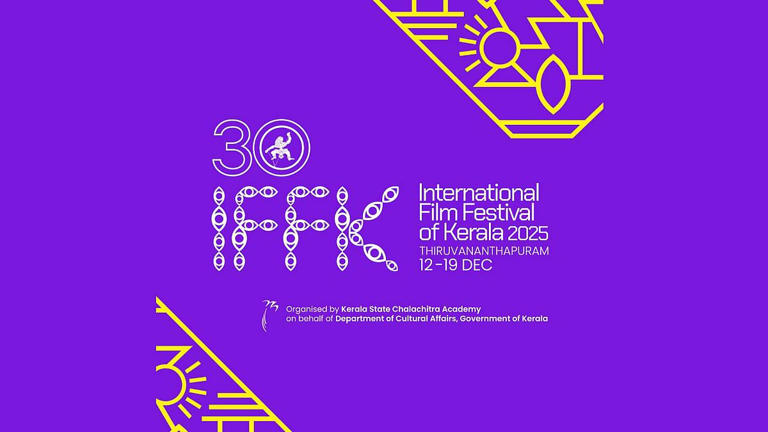
The 30th edition of the International Film Festival of Kerala (IFFK) will run from December 12–19, 2025, in Thiruvananthapuram. Featuring over 200 films from 70 countries, retrospectives on Ritwik Ghatak and Garin Nugroho, and tributes to global cinema, the festival continues its legacy of showcasing diverse voices, immersive storytelling, and cultural dialogue.
The picturesque city of Thiruvananthapuram, Kerala, is gearing up once again to host what has become one of Asia’s most beloved celebrations of cinema: the International Film Festival of Kerala (IFFK). As the festival marks its 30th edition from December 12–19, 2025, it arrives with more ambition, diversity and global reach than ever before. Organised by the Kerala State Chalachitra Academy on behalf of the state’s Department of Cultural Affairs, IFFK has over three decades evolved into a festival that balances artistic excellence, cultural exchange, and popular participation.
This year’s edition promises over 200 films from nearly 70 countries, screened across 16 theatres—including a brand-new screen added specifically to handle growing audience demand. From arthouse gems to socially resonant documentaries, from regional Indian voices to global auteurs, IFFK continues to honour its long-standing tradition of inclusivity and cinematic exploration.
The festival’s structure reflects a wide-ranging panorama of world cinema. Audiences will encounter films under categories such as International Competition (focusing on features from Asia, Africa, and Latin America), World Cinema, Indian Cinema Now, Malayalam Cinema Today, Country Focus, retrospectives and tributes, curated packages, as well as contemporary Indian and international works. The programme also integrates Open Forum discussions, masterclasses, workshops, and a revered Aravindan Memorial Lecture—making IFFK not just a festival, but a living film school and cultural symposium.
Opening the festival this year is the Arabic-language historical drama Palestine 36. The film delves into the 1936 uprising in Palestine against British colonial rule and captures the turbulence, aspirations, and tragedies of that era. Its selection underscores IFFK’s commitment to politically resonant cinema that transcends national boundaries.
Among the special attractions of IFFK 2025 is the centenary tribute to Ritwik Ghatak, the legendary Bengali filmmaker whose work has left an indelible mark on Indian cinema. To honour his legacy, the festival will screen four of his most celebrated films—including entries from his acclaimed Partition trilogy—restored and presented for contemporary audiences to rediscover. Concurrently, a retrospection celebrating the prolific career of esteemed African auteur Abderrahmane Sissako adds another layer to the global sensibility of the festival.
The “Contemporary Filmmaker in Focus” spotlight falls this year on Garin Nugroho, Indonesia’s internationally celebrated director known for politically charged, socially conscious cinema that continues to provoke and inspire. The festival will showcase five of his works, giving viewers the rare opportunity to immerse themselves in his cinematic universe. Meanwhile, the “Country Focus” shines on Vietnam, offering a curated glimpse into the evolving narratives of Southeast Asian cinema—a bold move towards deeper cultural exchange and broader cinematic horizons.
IFFK’s growth from its modest beginnings in the mid-1990s to its current stature has been nothing short of remarkable. The very first edition, held in Kozhikode in December 1994 to coincide with a century of cinema, screened 100 films—a symbolic gesture to past and future of film. Since then, the festival has become a key cultural institution, regarded by critics and cinephiles as “Asia’s best managed and probably the world’s most people-centred film festival.” Its unique positioning arises from a commitment to democratic access: delegate passes are affordable, screenings are open to general audience, and Malayalam film lovers find a platform alongside global cinema enthusiasts—an opportunity rare in most international festivals.
But beyond the grandeur of opening nights and global lineups, what sets IFFK apart is its role as a cultural nexus—a place where filmmakers, critics, students, enthusiasts, and ordinary viewers converge to experience cinema not just as entertainment, but as a medium of discussion, memory, identity, and transformation. The festival’s open forums and workshops allow for meaningful dialogues about film craft, global issues, regional politics, identity, and society. It is where storytelling becomes social reflection, and cinema transforms into a collective journey of consciousness and empathy.
The 30th IFFK also arrives at a time of renewed global challenges—political upheavals, identity crises, social conflicts, climate anxieties—making its role even more relevant. The selection of films such as “Palestine 36,” retrospectives of Ghatak and Sissako, and works from emerging filmmakers across continents reflects a deliberate curatorial choice. It suggests that IFFK isn’t content merely to entertain; it seeks to provoke, to question, to challenge comfort zones and encourage empathy. In an era fragmented by digital streaming and passive consumption, IFFK champions the communal, immersive experience of cinema, where the screen becomes a mirror of society, memory, and hope.
As the festival unfolds in the first week of December under Thiruvananthapuram’s moist winter skies, the city itself becomes a theatre. Theaters like the historic Tagore, regional auditoriums, and newer cinema halls will light up with screenings; cafes, hostels, and lodges will bustle with film conversations; lanes and libraries will echo with the energy of cinephiles discovering films that challenge them, move them, or simply make them think. For many, this is more than a fest—it is pilgrimage.
For those attending, IFFK offers more than films. It offers connection—to cultures, to strangers, to global narratives. It offers exposure to storytelling that defies language, borders, and convention. It offers the rare chance to sit in a hall, surrounded by diverse viewers, and be reminded that stories can bind humanity in shared sorrow, hope, wonder, and longing.
In its 30th year, IFFK stands as a testament to the enduring power of cinema in a fast-changing world. It remains a festival rooted in tradition yet boldly looking forward—welcoming global voices, regional stories, new realities, and timeless questions. For a generation navigating flux and identity, IFFK reaffirms that film is not just art, but memory, resistance, community, and dream. As lights dim and the screen illuminates, IFFK invites the world—one story at a time.
Discover more from Creative Brands
Subscribe to get the latest posts sent to your email.