


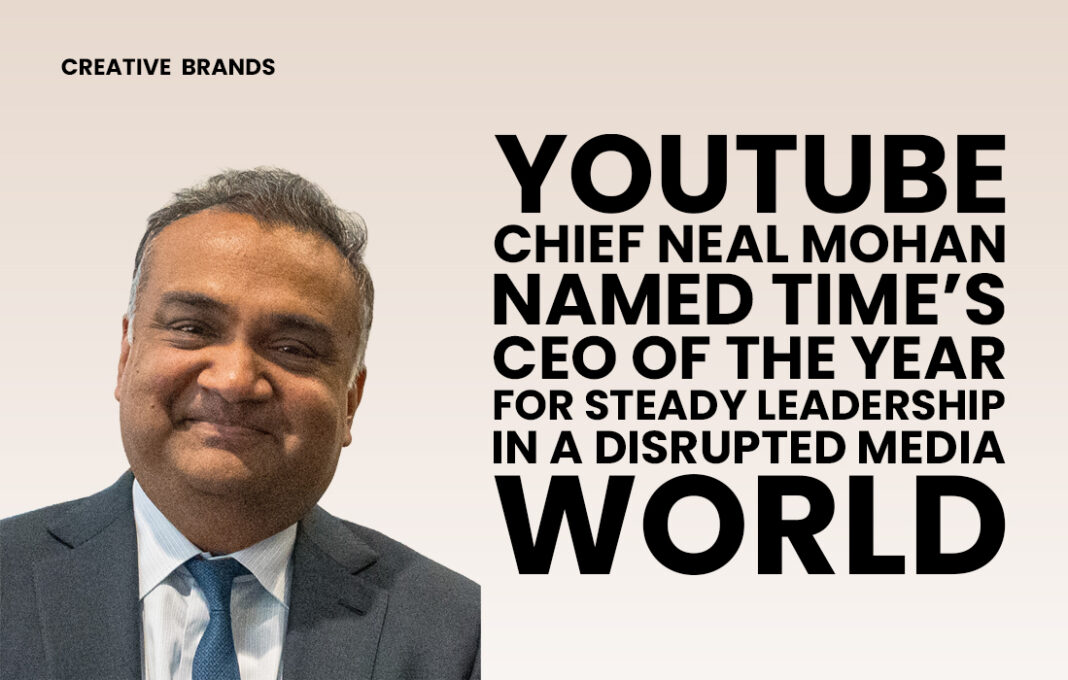
TIME has named YouTube CEO Neal Mohan its CEO of the Year, recognising his calm, measured leadership of the world’s largest video platform. As YouTube marks 20 years, Mohan’s stewardship has helped guide a rapidly evolving global media ecosystem shaped by creators, culture and technology.
Neal Mohan, the chief executive officer of YouTube, has been named TIME’s CEO of the Year, an honour that reflects not just the scale of the platform he runs but the particular style of leadership he embodies at a moment of profound upheaval in global media. In an era when many technology leaders project flamboyance, provocation, or world-remaking ambition, Mohan stands out for how unassuming he is. When you meet him, there is no sense of theatrical authority or restless ego. He is quiet-spoken, deliberate, and notably difficult to rattle. He talks about watching sports, attending his daughters’ dance recitals, and admits that his favourite candy is the decidedly unglamorous Butterfinger. While others in his peer group flirt with space travel or political crusades, Mohan’s focus is far narrower—and, arguably, far heavier. He just runs YouTube.
That statement alone carries extraordinary weight. YouTube, which celebrated its 20th anniversary this year, is not simply a platform but an entire media universe. More than two billion people—roughly a quarter of the world’s population—visit it every day. Every minute, users upload more than 500 hours of new video, a constant torrent of content that includes everything from music videos and podcasts to political commentary, conspiracy theories, children’s programming, livestreamed wars, and everyday moments of human life. The sheer scale of it has few parallels in history, and overseeing it places Mohan at the centre of how billions of people consume information, entertainment, and culture.
For Mohan, that responsibility is inseparable from the transformation of the media industry itself. “The dynamics of the entire media industry are changing before our eyes,” he says. “It’s incredibly disruptive.” Traditional broadcasters, film studios, record labels and news organisations now operate in a world where YouTube is not just a distributor but often a competitor, a partner, and a primary gateway to audiences. The platform has redefined what it means to be a creator, collapsing the distance between production and distribution and turning bedrooms into studios and individuals into global brands.
Mohan’s leadership challenge is less about grand vision statements and more about stewardship. As the “mayor” of this global megalopolis, as some have described the role, he understands that one of his central duties is to project calm rather than charisma. In an environment defined by constant scrutiny, algorithmic complexity, and cultural volatility, stability becomes a form of power. “He walks around almost like he’s the manager at a restaurant,” says Kinigra Deon, one of YouTube’s rising creative stars, capturing the way Mohan blends authority with approachability. He is present, observant, and focused on making sure the system runs.
This temperament has become especially important as YouTube navigates some of the most contentious issues facing modern media. Questions around misinformation, political influence, creator compensation, copyright, child safety, and artificial intelligence intersect on the platform every day. Each policy change can have global consequences, shaping livelihoods and public discourse simultaneously. Unlike traditional media companies, YouTube must moderate not dozens or hundreds of outputs, but billions, relying on a combination of machine learning, human oversight, and evolving community standards.
Under Mohan’s tenure, YouTube has continued to refine its approach to creator monetisation, reinforcing the idea that the platform is not just a stage but an economy. Millions of creators now earn income through advertising revenue, memberships, merchandise, and brand partnerships. In many countries, YouTube has become a viable alternative to traditional employment, especially for younger generations who see storytelling, commentary, or performance as careers rather than hobbies. Managing this ecosystem requires balancing opportunity with accountability, ensuring that growth does not come at the expense of trust.
Trust, in many ways, is the central currency of Mohan’s leadership. Viewers trust YouTube to entertain, inform, and sometimes educate. Advertisers trust it to place their brands responsibly. Creators trust it to reward effort fairly and transparently. Governments and regulators, often sceptically, trust—or at least expect—the platform to limit harm without stifling expression. Maintaining those relationships is less about dramatic intervention than consistent, incremental decision-making, the kind that rarely makes headlines but gradually shapes the platform’s character.
Mohan’s low-profile demeanour contrasts sharply with the outsized influence of the company he leads. YouTube’s role in music, for example, is unparalleled. It is simultaneously the world’s largest music discovery platform and one of the most important drivers of global pop culture. In news and politics, it functions as both archive and amplifier, hosting official broadcasts and user-generated reactions side by side. In entertainment, it competes with streaming giants while also feeding them, breaking talent that later migrates to film, television, and live tours.
TIME’s recognition of Mohan comes not from a single breakthrough moment but from his ability to guide YouTube through relentless change without losing its essential openness. Two decades after its founding, the platform is no longer the scrappy disruptor it once was, yet it still thrives on the energy of individuals experimenting with format, voice, and identity. Mohan’s task has been to professionalise without sterilising, to scale without flattening.
Artificial intelligence now looms as the next frontier. From recommendation algorithms to generative tools that can create video, music, and voices, AI is reshaping how content is produced and consumed. Under Mohan, YouTube has signalled that it intends to integrate these technologies carefully, positioning them as aids to creativity rather than replacements for human expression. Once again, the focus is on balance—embracing innovation while preserving the authenticity that keeps viewers engaged.
That measured approach mirrors Mohan’s personal style. He does not dominate rooms or cultivate mystique. Instead, he listens, absorbs, and decides. In a tech culture often obsessed with disruption for its own sake, his philosophy suggests that endurance can be just as powerful as reinvention. Running YouTube, as he implicitly understands, is not about constantly reinventing the wheel, but about keeping it turning smoothly at a scale few can comprehend.
Being named TIME’s CEO of the Year places Mohan among a lineage of leaders whose influence extends far beyond balance sheets. Yet his story resists easy mythmaking. There are no rockets, no public feuds, no dramatic proclamations about saving or reshaping humanity. There is simply the quiet, ongoing work of managing the world’s largest video platform as it continues to redefine how people see, hear, and understand each other.
In that sense, Mohan represents a different archetype of power in the digital age: not the visionary provocateur, but the steady custodian. And in a media ecosystem defined by constant noise, that may be precisely what makes his leadership—and YouTube’s continuing relevance—so remarkable.