


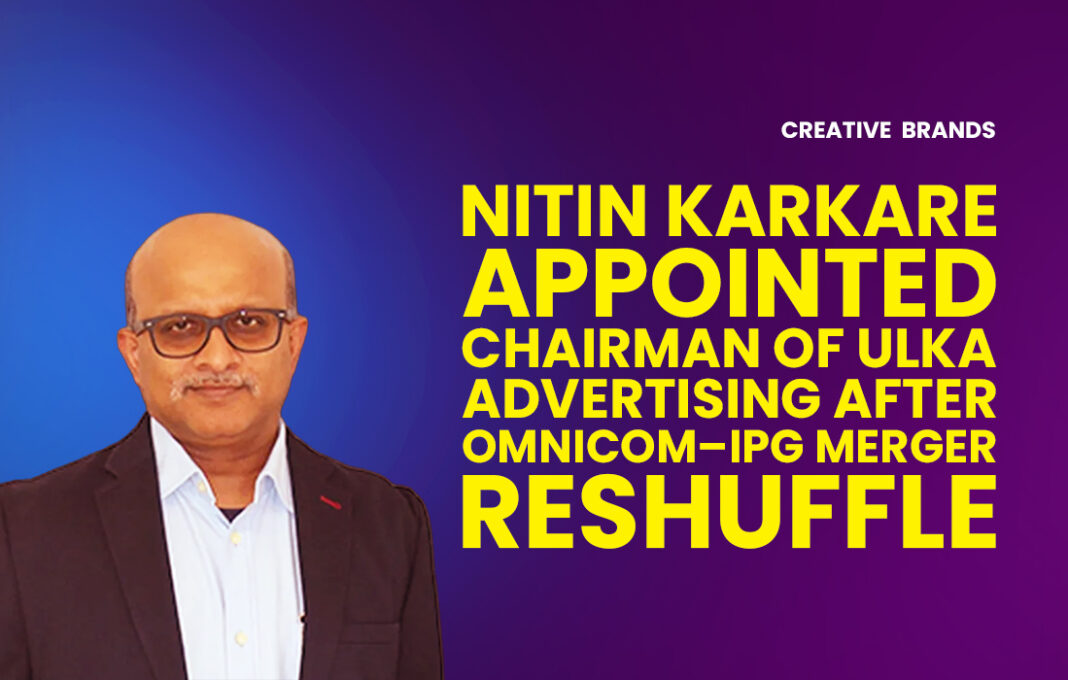
Following the Omnicom–Interpublic Group merger, industry veteran Nitin Karkare has been named Chairman of Ulka Advertising and Executive Director at Omnicom Advertising India. The restructuring places Ulka under the BBDO group after the FCB brand was retired as part of the integration.
In the wake of one of the most consequential consolidations in the global advertising industry, Omnicom’s merger with Interpublic Group, leadership shifts have begun to shape the next phase of India’s agency landscape. Among the most significant moves to emerge from this realignment is the appointment of seasoned advertising professional Nitin Karkare as Chairman of Ulka Advertising and Executive Director at Omnicom Advertising India. The decision signals both continuity and recalibration as the combined holding company restructures its portfolio and leadership priorities to align with a new global operating model.
The Omnicom–IPG merger, announced as a strategic step to create scale, streamline operations, and strengthen competitive advantage across markets, has triggered a series of structural changes worldwide. In India, these changes have been particularly visible, given the depth and diversity of the agency networks previously operating under the two banners. One of the most notable outcomes of the integration exercise has been the repositioning of Ulka Advertising, a legacy Indian agency with deep roots in the country’s advertising history. As part of the restructuring, Ulka has been brought under the BBDO group, following the decision to retire the FCB brand within the merged organisation’s Indian operations.
This transition marks the end of an era for FCB in India, a network that built formidable equity over decades through iconic campaigns and long-standing client relationships. However, within large global mergers, brand consolidation is often an unavoidable reality, driven by the need to reduce overlap and sharpen strategic focus. By aligning Ulka with BBDO, Omnicom has sought to combine the former’s strong Indian heritage and client intimacy with BBDO’s globally recognised creative and strategic frameworks. The move reflects a broader effort to rationalise agency offerings while preserving the strengths of established local operations.
At the centre of this transition stands Nitin Karkare, whose appointment is widely seen as a stabilising and strategic choice. A veteran of the Indian advertising industry, Karkare brings with him decades of experience across creative leadership, agency management, and client stewardship. Over the years, he has been closely associated with building agency cultures that balance creative ambition with business discipline, a skill set that becomes particularly valuable during periods of organisational change.
In his role as Chairman of Ulka Advertising, Karkare is expected to oversee the agency’s strategic direction during a time when it is redefining its identity within the BBDO ecosystem. The challenge will be to ensure that Ulka’s legacy of strong storytelling and market understanding is not diluted, even as it adopts new processes, global best practices, and cross-market collaboration models typical of large multinational networks. As Executive Director at Omnicom Advertising India, his remit expands further, placing him in a key position to influence broader group-level decisions, talent integration, and long-term growth strategies across the merged entity’s advertising businesses in the country.
Industry observers note that leadership continuity has become a critical factor in ensuring smooth transitions after large-scale mergers. In India’s advertising market, where relationships—both with clients and talent—are deeply personal and long-standing, sudden or poorly managed changes can disrupt business momentum. Karkare’s credibility within the industry, combined with his familiarity with Omnicom’s operating culture, is therefore seen as an asset in reassuring stakeholders that the restructuring is designed to strengthen rather than unsettle the organisation’s presence in the market.
The move also underscores Omnicom’s confidence in local leadership at a time when global holding companies are increasingly balancing centralised control with regional autonomy. While the merger has set broad strategic imperatives at a global level, its success will ultimately depend on how effectively those strategies are interpreted and executed in individual markets like India, which presents its own complexities in terms of scale, diversity, and rapid digital transformation.
For Ulka Advertising, the leadership change comes at an inflection point. Founded decades ago and long regarded as one of India’s most respected agencies, Ulka has weathered multiple industry shifts—from the rise of television advertising to the digital and social media revolution. Being placed under the BBDO banner offers new opportunities, including access to global resources, exposure to international creative benchmarks, and participation in a larger network that serves multinational clients across categories. At the same time, it demands cultural alignment and operational agility, areas where leadership will play a decisive role.
The retirement of the FCB brand, meanwhile, reflects a strategic decision rather than a commentary on performance. Across global mergers, agencies with overlapping capabilities are often consolidated to avoid duplication and internal competition. In this context, Omnicom’s choice to streamline its Indian operations by focusing on fewer, more sharply differentiated brands aligns with global trends in agency management, where clarity of positioning is increasingly essential in a crowded and competitive marketplace.
From a talent perspective, the restructuring presents both challenges and opportunities. Mergers often lead to uncertainty among employees, particularly around roles, reporting lines, and long-term career paths. Karkare’s expanded leadership role positions him as a key figure in managing these transitions, ensuring that talent is retained, morale is maintained, and creative momentum is not lost in the process of integration. His track record of mentoring and building leadership teams will be closely watched as Ulka and Omnicom Advertising India navigate this new chapter.
Clients, too, will be looking for reassurance that the changes will enhance rather than disrupt service delivery. The promise of the Omnicom–IPG merger lies in its potential to offer clients more integrated solutions, combining creative excellence with data, technology, and scale. In India, where marketers are increasingly demanding measurable outcomes and seamless omnichannel strategies, the success of this promise will depend on how well agencies like Ulka adapt under their new organisational structures.
As the dust settles on the merger and its immediate aftermath, the appointment of Nitin Karkare stands out as a signal of intent. It suggests that Omnicom views experienced, locally grounded leadership as central to extracting value from the integration, rather than relying solely on global directives. For Karkare, the role represents both a recognition of his contributions to the industry and a challenge to guide a storied agency through transformation without losing its soul.
In an industry defined by constant change, the Omnicom–IPG merger marks one of the most significant shifts in recent years. How agencies respond to this new landscape will shape not only their own fortunes but also the broader contours of India’s advertising ecosystem. With Ulka Advertising entering a new phase under the BBDO group and with Karkare at the helm, the coming months are likely to reveal how legacy, leadership, and global ambition can be brought together to create renewed relevance in an evolving market.