


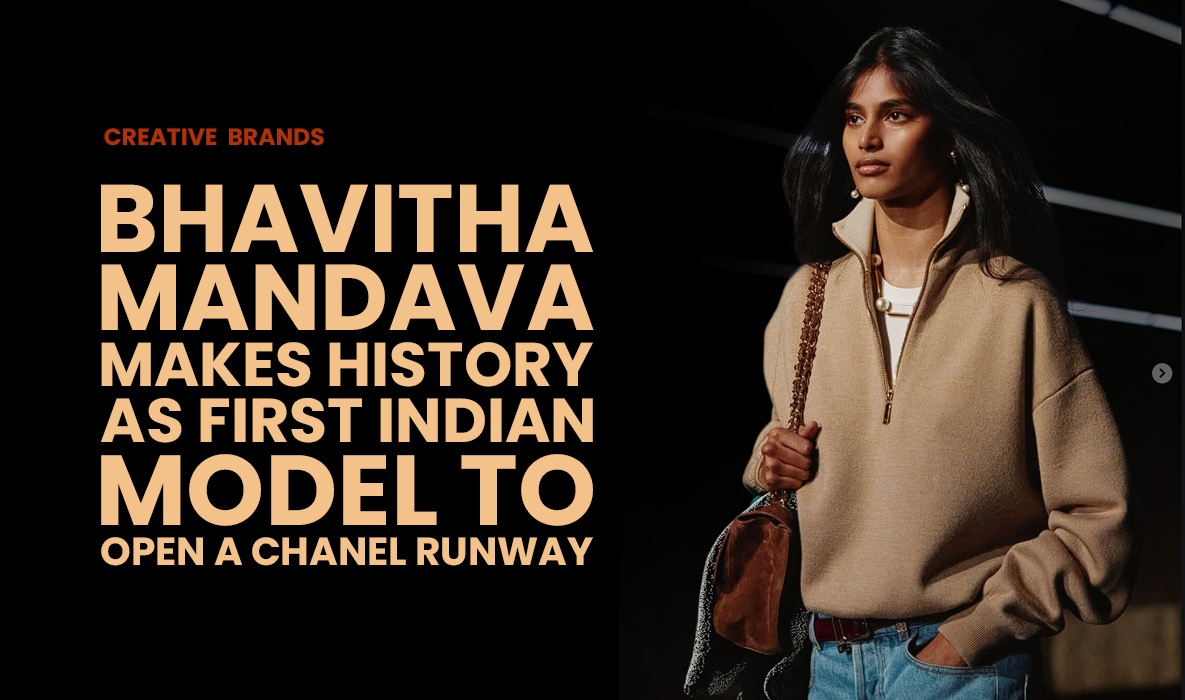
Bhavitha Mandava has become the first Indian model to open a Chanel show, leading the Métiers d’Art runway in New York. Her breakthrough reflects a wider shift in global luxury, where Indian talent is moving from symbolic inclusion to shaping narratives of beauty, craftsmanship and cultural relevance.
When Bhavitha Mandava stepped onto the runway to open Chanel’s Métiers d’Art show in New York, the moment resonated far beyond the rarefied world of high fashion. Set against the raw, cinematic backdrop of an abandoned subway station, the show marked the first time an Indian model had ever opened a Chanel runway. For Mandava, it was a personal breakthrough. For the industry, it was a symbolic shift with real narrative weight — a sign that Indian representation in global luxury is moving from visibility to authorship.
Mandava’s journey to that defining moment is as unconventional as it is emblematic of a new kind of fashion story. A former architect and a graduate of New York University, she was scouted less than a year ago on the New York subway, not in a curated casting or through a global agency network, but in one of the city’s most ordinary, unpredictable public spaces. That origin story mirrors the setting of her Chanel debut, grounding high fashion in lived, urban reality and reinforcing the idea that the luxury world’s gateways are beginning, however cautiously, to open wider.
Opening a Chanel show is not simply another booking. It is a statement role, one that sets the tone for the entire collection and signals how the house wants the audience to see what follows. Métiers d’Art, in particular, occupies a special place in Chanel’s calendar, celebrating the artisans, ateliers and craftsmanship that underpin the brand’s identity. To place Mandava at the front of that narrative was a deliberate choice, and one that aligned with a broader recalibration underway at the highest levels of the fashion industry.

Indian presence in global luxury has been steadily growing, but Mandava’s moment marks a shift in texture and intent. This is not about symbolic inclusion or tokenised diversity; it is about Indians shaping the visual language and emotional core of major fashion narratives. From Leena Nair’s appointment as global CEO of Chanel to Louis Vuitton’s India-inspired runway presentations, and from Sabyasachi Mukherjee’s expanding global collaborations to Bvlgari’s India-centric campaigns, the signals are becoming harder to ignore. Indian culture is no longer being referenced as an exotic flourish; it is increasingly being treated as a source of authority, sophistication and contemporary relevance.
Mandava’s rise is inseparable from this context, but it also stands on its own as a reflection of changing ideas of beauty and confidence. Her background in architecture brings a different kind of presence to the runway — one shaped by structure, proportion and spatial awareness rather than traditional modelling pipelines. That depth resonates in an industry that is beginning to value individuality and narrative as much as physical appearance. In a season of fashion that has often been criticised for chasing fleeting trends, her casting felt grounded, intentional and forward-looking.
For India and its vast diaspora, the impact of such moments is cumulative. Representation on global runways has long existed, but often at the margins — a face here, a walk there, rarely positioned at the centre of the story. By opening the show, Mandava was not merely participating; she was leading. That distinction matters. In fashion, as in culture more broadly, who goes first often determines how the rest are seen.
This shift also reflects how global luxury brands are redefining their strategies in a world where growth is increasingly tied to cultural relevance. Markets like India are no longer peripheral; they are essential to the future of luxury consumption, creativity and influence. As brands compete for authenticity and resonance, they are recognising that representation is not a moral add-on but a business imperative. Casting choices, leadership appointments and creative collaborations are becoming tools for signalling openness, modernity and global fluency.
Diaspora visibility plays a crucial role in this evolution. Indian-origin professionals, creatives and talents operating within global systems are acting as bridges, translating culture across contexts without diluting its essence. Mandava’s story — an Indian woman discovered in New York, educated in the US, and now leading one of the most storied fashion houses’ runways — captures that hybrid reality. It is a narrative that feels contemporary, borderless and deeply relevant to a generation navigating multiple identities.
At the same time, her success underscores how notions of beauty are being recalibrated. For decades, global fashion operated within narrow aesthetic frameworks that left little room for diverse features, body types or cultural expressions. At the same time, progress has been uneven; moments like Mandava’s signal a broadening of those definitions. Indian beauty, in all its complexity and variety, is increasingly visible not as an exception, but as part of the norm.
The choice of an abandoned subway station as the show’s setting adds another layer of meaning. The space evoked movement, transition and hidden histories — themes that resonate with stories of migration, discovery and transformation. For Mandava, who was herself discovered in the subway, the symbolism felt almost cinematic. It reinforced the idea that talent can emerge from unexpected places, and that luxury, at its most powerful, draws meaning from real life rather than existing above it.
This moment also invites reflection on how Indian fashion and craft are influencing global design narratives more broadly. Indian textiles, techniques and philosophies have long inspired designers, often without adequate acknowledgement. Today, there is a growing push toward more transparent collaboration and credit. Métiers d’Art’s focus on craftsmanship aligns naturally with Indian traditions of handwork and artisanal excellence, creating space for deeper, more respectful exchanges between global houses and Indian creative ecosystems.
For young Indian models, designers and creatives watching from afar, Mandava’s opening walk offers more than inspiration; it offers validation. It suggests that pathways into the highest echelons of global fashion, while still challenging, are becoming more accessible to those who bring authenticity, skill and perspective rather than conforming to inherited templates. It also reinforces the importance of patience and preparedness — Mandava’s architectural training and academic background shaping a confidence that reads on the runway.
From an industry perspective, the moment signals an inflexion point. Fashion has always been a mirror of power structures, tastes and aspirations. As those structures shift toward a more multipolar world, the faces and stories that dominate the runway inevitably follow. India’s growing economic, cultural and creative influence is finding expression not only in consumer markets but on the symbolic stages that shape global imagination.
Mandava’s walk at Chanel does not mark an end point; it marks a beginning. It suggests a future where Indian representation is not confined to diversity conversations but embedded in creative leadership and storytelling. From simply appearing on the runway to setting the tone, the transition is profound.
As the last echoes of footsteps faded in that New York subway station, what lingered was not just the memory of a striking opening look, but the sense that something had shifted. Indian talent is no longer waiting in the wings of global fashion. It is stepping confidently into the spotlight, shaping how the world sees beauty, presence and possibility.
Discover more from Creative Brands Mag
Subscribe to get the latest posts sent to your email.
















Leave a comment