


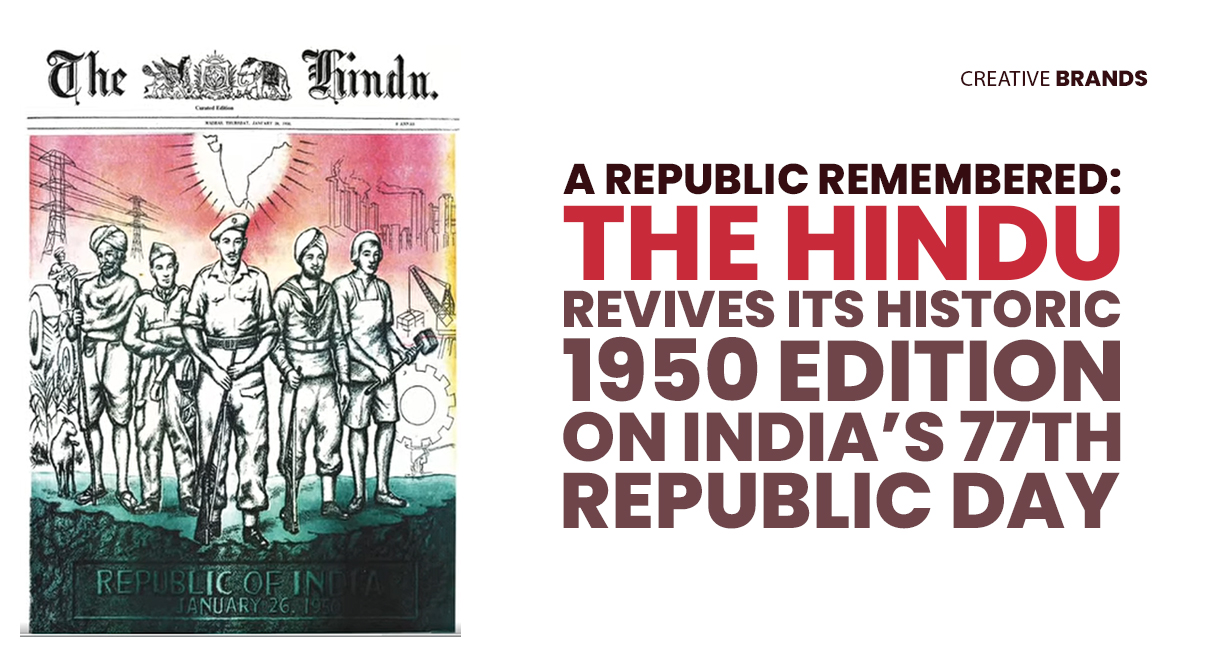
As India celebrates its 77th Republic Day, The Hindu has released a collector’s edition of its original January 26, 1950 issue. Chronicling the birth of the Republic, the 62-page newspaper captures Dr. Rajendra Prasad’s swearing-in, Nehru’s address, global messages, and reflections on India’s democratic foundations, now available in limited copies.
On January 26, 1950, India awoke to a new dawn. The Constitution had come into effect, the Republic was born, and a nation long bound by colonial rule stepped into its sovereign future. That morning, The Hindu carried a historic issue that chronicled the moment with the gravity and reverence it deserved. Now, seventy-seven years later, as the country marks its 77th Republic Day, The Hindu has brought back that very edition in a specially curated collector’s release, offering readers a chance to hold history in their hands once more.
The 62-page, two-section newspaper is more than a relic of print journalism. It is a living document of India’s democratic journey, a record of the day when Dr. Rajendra Prasad was sworn in as the nation’s first President and Jawaharlal Nehru addressed the people as Prime Minister of a Republic. The edition captures the solemnity of the inauguration, the ceremonial grandeur of the day, and the profound sense of transition from colonial subjugation to constitutional self-rule. For readers today, it is not merely a newspaper but a time capsule, a bridge to the aspirations and anxieties of a young nation finding its voice.
The front pages of that 1950 issue carried the defining images and words of the day. Dr. Rajendra Prasad’s swearing-in was reported with the dignity befitting the occasion, marking the beginning of a new constitutional order. Nehru’s address, infused with his characteristic eloquence, spoke of responsibility, unity, and the promise of democracy. His words, printed in black ink on crisp paper, resonated with the optimism of a people who had endured struggle and sacrifice to arrive at this moment. To read them now, in facsimile, is to hear again the cadence of a leader who believed deeply in the power of democratic governance.
Beyond the domestic milestones, the edition also reflected India’s arrival on the global stage. Messages of congratulation poured in from world leaders, including U.S. President Harry Truman and Lord Mountbatten, the last Viceroy of India. Their words acknowledged not only India’s achievement but also its significance in the post-war world order. For a nation emerging from colonial rule, such recognition was a validation of its place among sovereign states. The collector’s edition preserves these messages, reminding readers of the international resonance of India’s transformation.
What makes this re-release remarkable is the breadth of content beyond the headline news. The 1950 edition carried authoritative commentary on the Constitution of India, explaining its principles, its vision, and its promise. It offered reflections on Gandhian philosophy, underscoring how the moral compass of the Mahatma continued to guide the Republic even after his assassination two years earlier. It provided insights into India’s early worldview, articulating how the nation saw itself and its role in shaping a just and equitable global order. These essays and commentaries, written in the immediate aftermath of independence, remain strikingly relevant, speaking to debates that continue to animate Indian democracy today.
For readers across generations, the collector’s edition is more than a historical artefact. It is a tangible reminder of the foundations upon which the Republic was built. The ink may have faded slightly, the paper may carry the patina of age, but the words remain alive with meaning. They remind us that democracy is not a gift but a responsibility, not a destination but a journey. In revisiting the 1950 edition, one is reminded of the fragility and resilience of democratic institutions, of the ideals that animated the Constitution, and of the sacrifices that made self-rule possible.
The emotional significance of this release cannot be overstated. For those who lived through the early years of independence, it is a chance to relive the pride of that first Republic Day. For younger generations, it is an opportunity to connect with history not through textbooks but through the very pages that carried the news as it unfolded. In an age of digital feeds and instant updates, the tactile experience of holding a newspaper that once marked the birth of a nation is profoundly moving. It is history you can touch, a reminder that democracy is not abstract but lived, recorded, and remembered.
The Hindu’s decision to curate and release this edition speaks to the enduring role of journalism in shaping national memory. Newspapers are often described as the first draft of history, but in this case, the draft has become a definitive record. By preserving and reissuing the 1950 edition, The Hindu affirms its place not only as a chronicler of events but as a custodian of collective memory. It underscores the power of print to capture moments that transcend time, moments that continue to define who we are as a people.
The availability of this collector’s edition on Blinkit adds a contemporary twist to the story. In 1950, readers would have queued at newsstands to buy their morning paper. In 2026, they can order it online and have it delivered to their doorstep. The medium has changed, but the message endures. The limited quantity ensures that each copy is treasured, a keepsake to be preserved and passed down. It is a reminder that history, though past, remains present in the objects we choose to hold close.
As India celebrates its 77th Republic Day, the re-release of this edition invites reflection on the journey since 1950. The Republic has grown, stumbled, and risen again. It has faced challenges of poverty, inequality, and conflict, but it has also achieved remarkable progress in science, technology, and global leadership. The ideals enshrined in the Constitution continue to guide the nation, even as debates over their interpretation and implementation persist. To revisit the 1950 edition is to return to the source, to the moment when those ideals were first proclaimed, and to measure how far we have come.
The collector’s edition is not just for historians or collectors. It is for every citizen who wishes to understand the meaning of Republic Day beyond parades and ceremonies. It is for those who seek to connect with the spirit of 1950, to hear again the voices that shaped the Republic, and to carry forward their vision. In holding the edition, one holds a piece of the Republic itself, a fragment of the day when India declared to the world that it would govern itself, by itself, for itself.
Seventy-seven years on, the Republic remains a work in progress. Its foundations are strong, but its future depends on the vigilance and participation of its citizens. The Hindu’s collector’s edition is a reminder of that responsibility. It tells us that democracy is not only about leaders and institutions but about people and their choices. It invites us to reflect, to remember, and to recommit to the ideals that gave birth to the Republic.
The re-release of the January 26, 1950 edition is both a celebration and a call to action. It celebrates the birth of the Republic, the vision of its leaders, and the pride of its people. It calls us to remember that the Republic is ours to nurture, ours to protect, and ours to carry forward. As the pages turn, history speaks, reminding us that the story of the Republic is still being written, and that each of us has a role in its unfolding.
Discover more from Creative Brands Mag
Subscribe to get the latest posts sent to your email.
















Leave a comment